




Online Consultation
Please accurately enter the information below.
Quick Cost Consultation
Quick Consultation & Reservation
Cases finding
similar to my profile






Cases finding
similar to my profile
Customer Diagnostics
Post-Pregnancy Abdominal Sagging That Exercise Couldn’t Fix 4-Month Results After Full Abdominoplasty (Tummy Tuck) in Gangnam, Seoul, Korea
2026-03-15
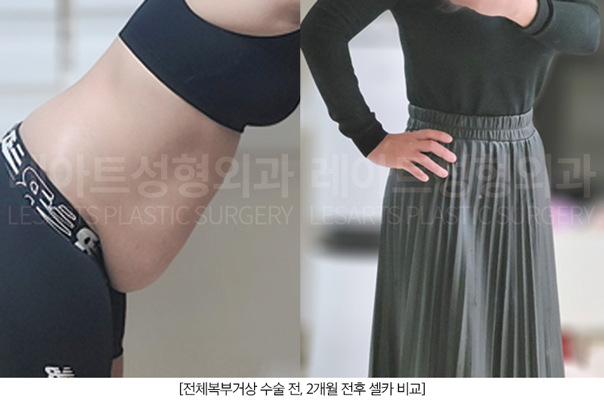
In this post, we will review a patient case involving full abdominoplasty
(tummy tuck) performed at a plastic surgery clinic in Gangnam, Seoul, Korea.
The patient had experienced three cesarean section deliveries,
after which significant changes developed in the abdominal area.
These changes included loose abdominal skin,
structural changes in the abdominal wall,
and protrusion of the lower abdomen.
Although the patient had gained weight in the past,
she later successfully reduced and stabilized her weight through consistent exercise.
However, despite maintaining a stable body weight,
the abdominal contour did not return to its previous shape,
which led her to seek consultation
at our plastic surgery hospital in Gangnam, Seoul.
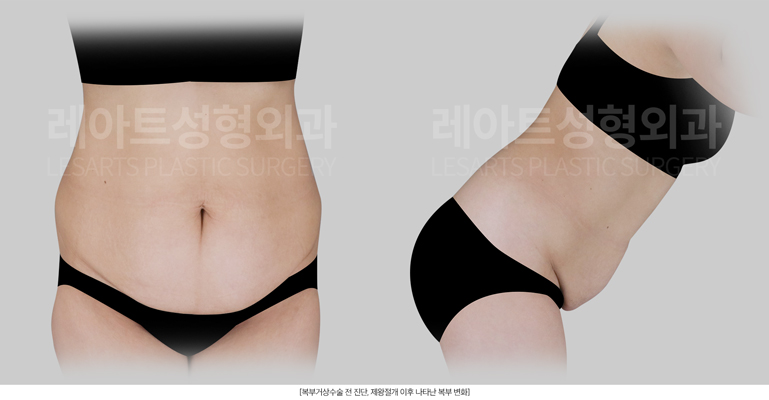
Pre-Surgery Evaluation
Abdominal Changes After Cesarean Section
After careful examination, the following characteristics
were observed before the abdominoplasty procedure:
-Significant skin laxity across the entire abdomen
-Excess skin and folding mainly below the belly button
-Forward protrusion of the lower abdomen
-The navel positioned relatively low
-Severe rectus diastasis (separation of abdominal muscles)
-The total abdominal fat amount was not excessive,
but liposuction was needed to refine the contour
-The love handle area showed volume mainly
due to loose skin rather than fat accumulation
Consideration of the Previous Cesarean Section Scar
An important part of surgical planning
was the position of the patient’s previous C-section scar.
Because the existing cesarean scar was located relatively low,
it was explained in advance that the tummy tuck incision might be placed
slightly above the previous scar. After detailed consultation and explanation,
the patient fully understood and agreed to proceed with surgery.
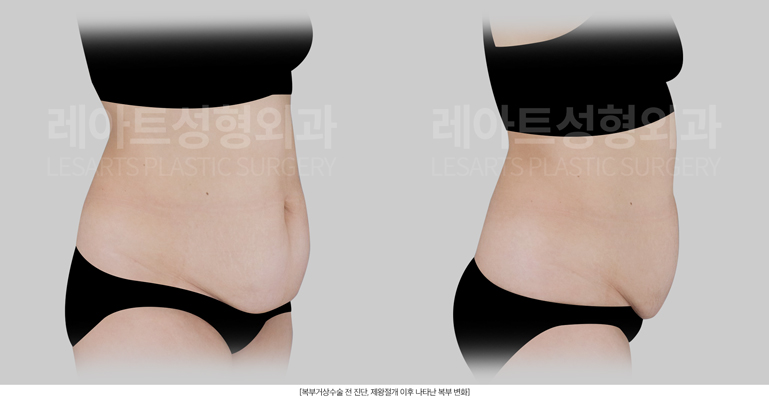
Surgical Plan
Full Abdominoplasty (M-Type Tummy Tuck)
Because the patient had skin laxity throughout the abdomen,
a full abdominoplasty (M-type tummy tuck) was planned.
This procedure removes excess skin and
lifts the abdominal tissue to restore a firmer contour.
Rectus Muscle Repair (Abdominal Wall Tightening)
During examination,
severe rectus muscle separation (rectus diastasis) was confirmed.
Therefore, rectus muscle repair (abdominal wall tightening)
was an essential part of the surgery.
By repairing the separated muscles,
the procedure aimed to:
-Restore core abdominal support
-Improve forward abdominal protrusion
-Improve the overall function and stability of the abdominal wall
Umbilicus (Belly Button) Correction
During a tummy tuck surgery,
the skin of the lower abdomen is lifted and removed.
As a result, the belly button must be repositioned and redesigned.
The patient preferred a vertically shaped navel,
so a new umbilicus was carefully designed and
positioned to match the patient’s natural body proportions.
Abdominal Liposuction
Although the patient did not have a large amount of abdominal fat,
liposuction was performed together with
abdominoplasty to enhance the final result.
The goal was to:
-Improve the overall abdominal contour
-Create a smoother transition across the abdomen
Outer Thigh Liposuction and Hip Dip Fat Grafting
To create a smoother silhouette from the waist to the hips,
additional procedures were planned:
-Outer thigh liposuction to reduce the “saddlebag” area
-Hip dip fat grafting to restore volume in the hip depression area
This combination helps create a more balanced
and natural body contour.

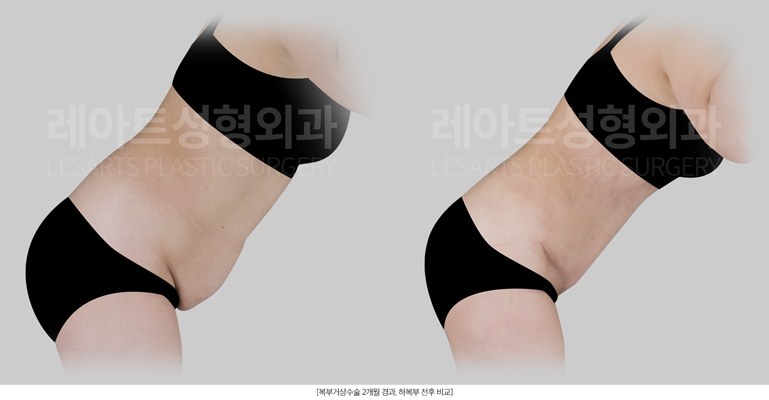
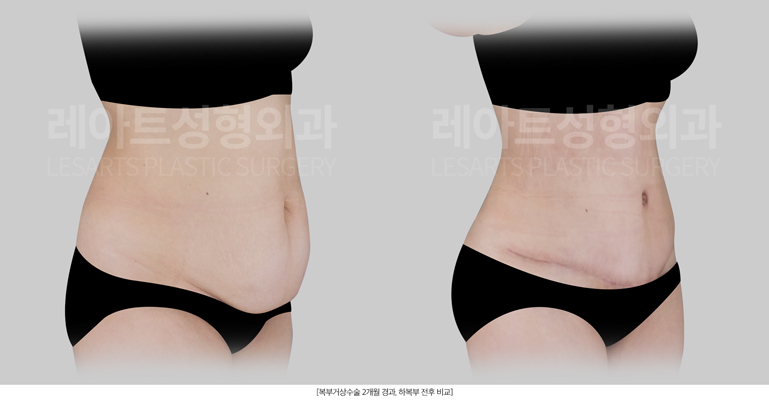

2-Month Postoperative Results
Lower Abdomen Before and After Comparison
When comparing the before and after photos of the abdominoplasty,
several improvements can be observed.
Before surgery:
-The abdominal skin sagged downward
from the upper abdomen to the lower abdomen
-The abdomen appeared heavy and drooping
-The waistline was not clearly visible
-The body proportions appeared less balanced
After surgery:
-The abdominal contour became firmer
-A defined waistline became visible
-The overall body proportions appeared more balanced

Improvement of Lower Abdominal Bulging
Before surgery, the patient had significant lower abdominal protrusion,
especially when standing or bending forward.
After tummy tuck surgery, this bulging was significantly improved.
The abdomen now appears more natural regardless of posture or viewing angle.
In addition, the wrinkles and folds in the lower abdominal skin were also removed,
resulting in a smoother skin surface.
Incision Location and Scar Placement
The abdominoplasty incision was placed as low as possible in the lower abdomen,
allowing the scar to be hidden under underwear or bikini lines.
Interestingly, the previous cesarean section scar
was removed during the surgery, leaving only the tummy tuck scar.
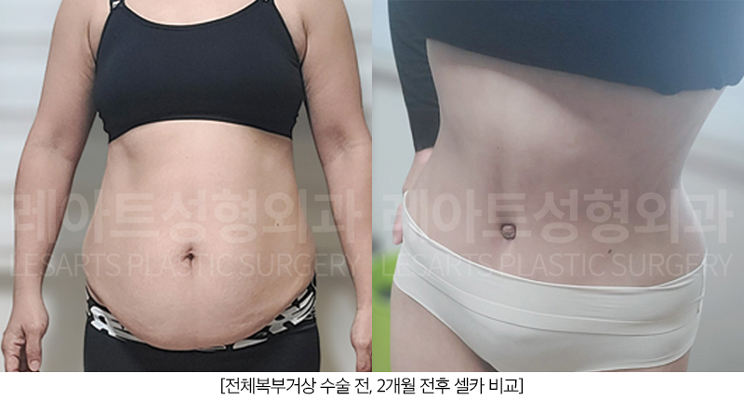
The patient is currently two months post-operation,
and the recovery process is progressing well.
At this stage:
-The surgical tissues are continuing to stabilize
- The abdominal contour is gradually becoming more natural
We will continue to monitor the patient through regular follow-up visits and
scar management treatments at our plastic surgery clinic in Gangnam, Seoul.
With consistent postoperative care and healthy lifestyle habits,
the patient can expect even more satisfying long-term results.
#Abdominoplasty
#M-type
#Abdominal liposuction(M) #Hip Fat Transfer(M)


Cases finding
similar to my profile
Customer Diagnostics


Select the surgery and
area you are interestedto see real
before andafter changes.


we
make you,
the art
Clinic hours
MON - FRI
10 am – 7pm
SAT
10 am – 4pm
Holiday
SUN, HOLIDAY
Location
Lesarts Moon Clinic Tower 4-5F, 40, Nonhyeon-ro 168-gil,
Gangnam-gu, Seoul, Republic of Korea

Medical institution name Lesarts Plastic Surgery
Address Lesarts Moon Clinic Tower 4-5F, 40, Nonhyeon-ro 168-gil, Gangnam-gu, Seoul, Republic of Korea
Representative Moon sung jun
