




Online Consultation
Please accurately enter the information below.
Quick Cost Consultation
Quick Consultation & Reservation
Cases finding
similar to my profile






Cases finding
similar to my profile
Customer Diagnostics
Lower Abdominal Sagging After Pregnancy – How Can a Tummy Tuck Improve It? 6-Month Results of S-Type Abdominoplasty at a Plastic Surgery Clinic in Gangnam, Seoul, Korea
2026-03-18
After pregnancy and childbirth,
many patients notice that when they bend forward,
the lower abdominal skin folds or appears saggy.
In many cases, this is not simply due to weight gain.
Instead, it is caused by a combination of stretched skin and
structural changes in the abdominal wall during pregnancy and delivery.
Even after body weight becomes stable,
if the lower abdomen remains unchanged,
it is important to evaluate whether this is a structural issue
rather than just a body shape concern.
In this case, the patient visited our plastic surgery clinic in Gangnam,
Seoul, Korea, mainly concerned about lower abdominal sagging
that became more noticeable when bending forward.
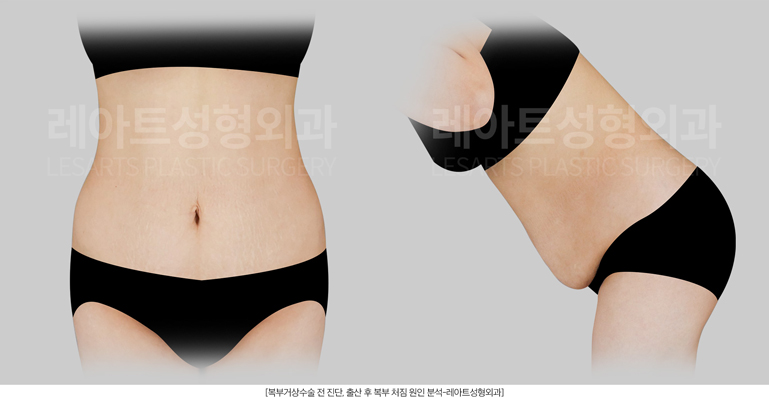
Pre-Surgery Evaluation
Causes of Postpartum Lower Abdominal Sagging
After clinical examination,
the following characteristics were identified
before performing abdominoplasty (tummy tuck surgery):
- Loose abdominal skin after cesarean section
- Significant skin sagging and folding below the navel
- More pronounced skin folding when bending forward
- Protrusion of the lower abdomen
- A relatively low belly button position
- Presence of rectus diastasis in the lower abdomen
These findings indicate that the patient’s condition
was not just related to fat, but involved
structural abdominal changes after pregnancy.

Surgical Plan
S-Type Abdominoplasty (Tummy Tuck)
Because the sagging was mainly concentrated in the lower abdomen,
an S-type abdominoplasty was planned.
This approach focuses on:
- Removing excess skin in the lower abdomen
- Creating a smoother and more natural abdominal contour transition
Rectus Muscle Repair (Abdominal Wall Tightening)
The patient also had rectus diastasis in the lower abdomen,
which required correction.
By performing rectus muscle repair,
the surgery aimed to:
- Improve core abdominal support
- Reduce lower abdominal protrusion
- Restore a more stable abdominal structure
Umbilical Floating Technique
Since the patient’s navel was positioned relatively low,
a navel repositioning surgery was not performed.
Instead, the umbilical floating technique was used.
With this method:
-The abdominal skin is pulled downward
-The belly button naturally shifts upward without creating a new incision
This technique allows for a more natural result with less visible scarring,
and it was fully explained to the patient before surgery.
Combined Abdominal Liposuction
To further enhance the surgical outcome,
liposuction of both the upper and lower abdomen
was performed together with the tummy tuck.
This helped:
- Refine the overall abdominal contour
- Create a smoother and more balanced body silhouette

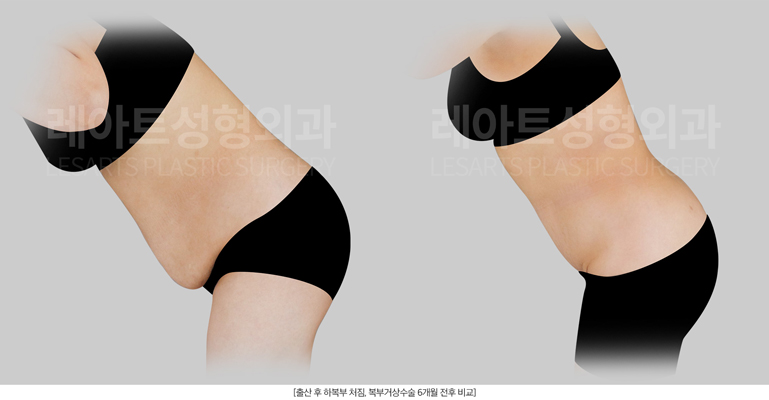
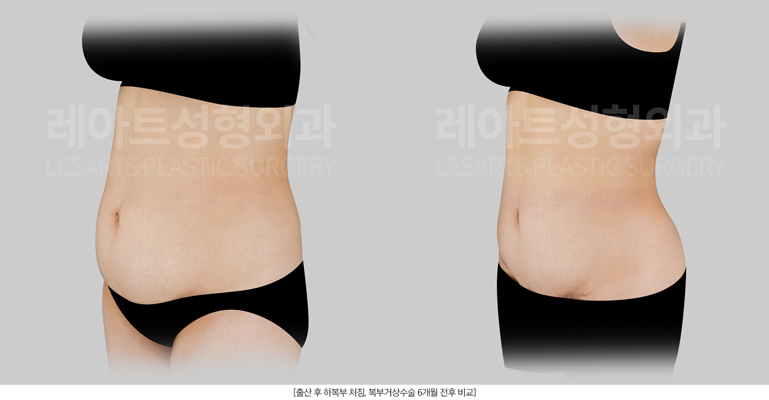
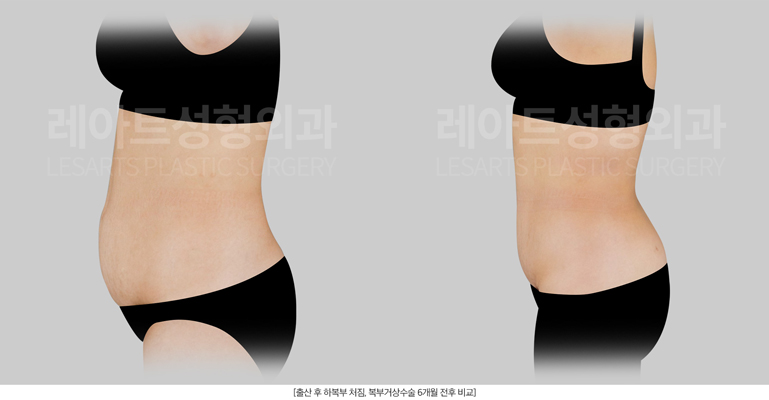
6-Month Postoperative Results
Before and After Comparison
In the pre-surgery photos, the patient showed:
- Significant lower abdominal sagging
- Visible protrusion in the lower abdomen
- Skin folding that became more noticeable when bending
After abdominoplasty surgery, the results show:
- A lifted and smoother abdominal contour
- Improved overall abdominal line from upper to lower abdomen
- Reduced protrusion due to rectus muscle repair
Improvement in Abdominal Contour and Skin Folding
One of the most noticeable changes is the improvement
in skin folding when bending forward.
Before surgery, the lower abdominal skin formed visible folds. After surgery:
- The folding significantly decreased
- The abdominal shape appears more stable and natural
In addition, the correction of rectus diastasis
improved the upper abdominal contour,
creating a smoother overall silhouette.
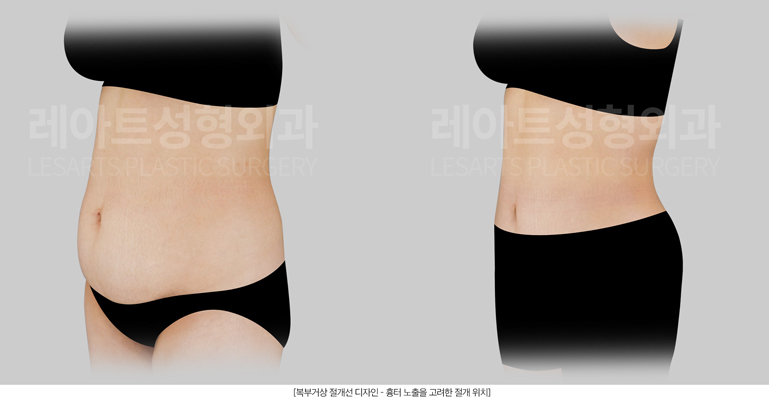
Incision Design and Scar Placement
Because the patient was concerned about visible scarring,
the incision line was carefully designed.
After surgery:
- The scar is positioned low in the lower abdomen
- It is naturally hidden under underwear or clothing
This allows for a more discreet result
while maintaining effective surgical correction.
Recovery Progress (6 Months After Surgery)
At approximately 6 months after surgery,
both the abdominal contour and scar condition are stable.
During recovery:
- The abdominal tissues gradually settled into place
- The contour continued to improve over time
Currently, the patient is in a stage
where the final results are becoming more natural and refined.
Ongoing follow-up care and scar management
at our plastic surgery hospital in Gangnam, Seoul, Korea
will help maintain and further improve the outcome.
With proper postoperative care,
patients can expect long-term stable and
satisfying results after tummy tuck surgery.
Why Structural Evaluation Matters After Pregnancy
This case highlights that postpartum abdominal changes
are not always related to fat or weight gain.
Instead, they often involve:
- Skin laxity
- Muscle separation (rectus diastasis)
- Structural changes in the abdominal wall
For this reason, accurate diagnosis and
personalized surgical planning at an experienced plastic surgery clinic in Seoul,
Korea are essential for achieving natural and balanced results.
#Abdominoplasty
#S-type


Cases finding
similar to my profile
Customer Diagnostics


Select the surgery and
area you are interestedto see real
before andafter changes.


we
make you,
the art
Clinic hours
MON - FRI
10 am – 7pm
SAT
10 am – 4pm
Holiday
SUN, HOLIDAY
Location
Lesarts Moon Clinic Tower 4-5F, 40, Nonhyeon-ro 168-gil,
Gangnam-gu, Seoul, Republic of Korea

Medical institution name Lesarts Plastic Surgery
Address Lesarts Moon Clinic Tower 4-5F, 40, Nonhyeon-ro 168-gil, Gangnam-gu, Seoul, Republic of Korea
Representative Moon sung jun
