




Online Consultation
Please accurately enter the information below.
Quick Cost Consultation
Quick Consultation & Reservation
Cases finding
similar to my profile






Cases finding
similar to my profile
Customer Diagnostics
Loose Lower Abdomen After Cesarean Delivery 6-Week Results After Full Abdominoplasty at a Plastic Surgery Clinic in Gangnam, Seoul, Korea
2026-04-04
Many patients visit a plastic surgery clinic after pregnancy because,
even when their weight returns to the level it was before pregnancy,
the shape and strength of the abdomen no longer feel the same.
In many of these cases, the problem is not simply body weight.
The abdominal skin may have lost elasticity,
and the rectus muscles may remain stretched after pregnancy,
which means the abdominal wall can no longer provide enough support.
As a result, the abdominal contour may become sagging, uneven, or weak.
If the abdomen sags more when standing, moving,
or bending with gravity, or if the center of the abdomen does not feel firm,
it is important to have an accurate evaluation for structural abdominal changes.
This patient was also in this situation. After delivering twins by cesarean section,
her body weight had returned to a stable level, but the abdominal shape had changed significantly.
Because of this, she underwent abdominoplasty (tummy tuck surgery)
at our plastic surgery clinic in Gangnam, Seoul, Korea.
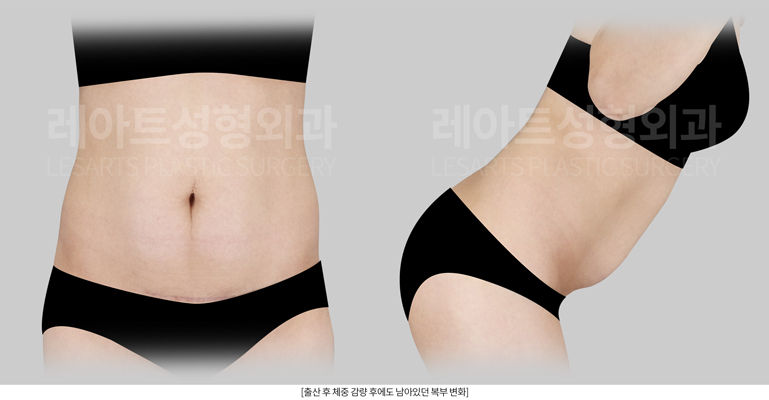
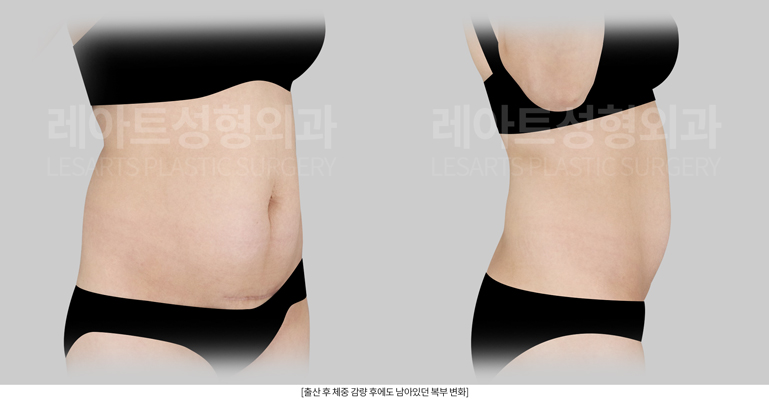
Pre-Surgery Evaluation
Postpartum Abdominal Changes That Remained After Weight Loss
Before surgery, the patient showed
the following abdominal findings:
- Loose skin centered in the lower abdomen
- Visible loss of skin elasticity in the abdominal contour
- Mild forward protrusion of the lower abdomen
- The patient did not have excessive abdominal fat,
but liposuction was still needed to refine the contour
- Additional contouring was needed in the flank and love handle area
- Stretch marks were also present on the skin surface
These findings showed that the patient’s concern
was not only about fat, but also about postpartum skin
laxity and weakened abdominal support.
Surgical Plan
Full Abdominoplasty with Muscle Repair and Liposuction
Full Abdominoplasty (M-Type)
Because the patient had ongoing loss of skin
elasticity across the abdomen after childbirth,
a full abdominoplasty (M-type tummy tuck) was planned.
The goal was to lift the skin from the upper abdomen downward and
completely improve the sagging that was most noticeable in the lower abdomen.
Rectus Muscle Repair (Abdominal Wall Tightening)
During pregnancy, the abdominal wall and rectus muscles had
stretched and did not fully recover.
This caused the abdominal wall to push forward.
To correct this structural problem, rectus muscle repair
was planned to restore support in the center of the abdomen
and create a firmer abdominal contour.
Abdominal Liposuction
Although the patient did not have a large amount of abdominal fat,
abdominal liposuction was performed together with the tummy tuck to maximize
the effect of surgery and create a smoother upper body contour.
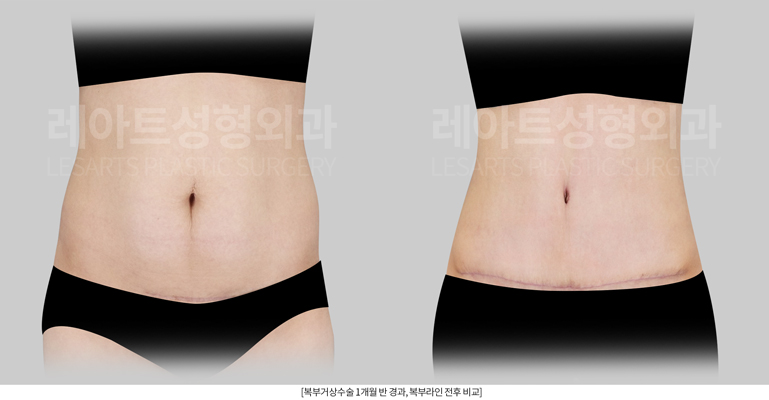

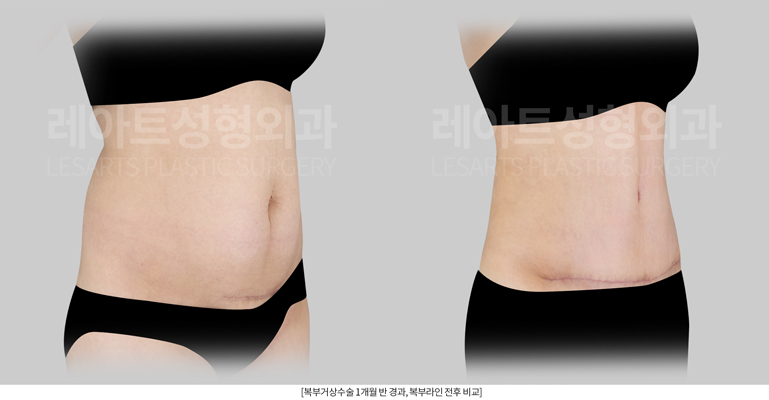
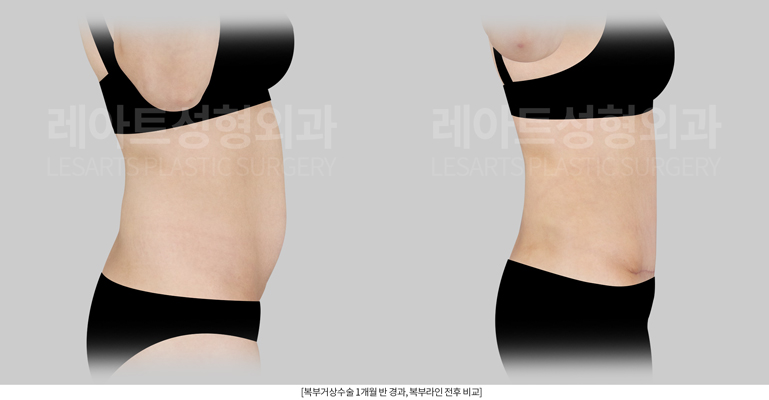
6-Week Results After Abdominoplasty
Smoother and Firmer Abdominal Contour
When comparing the before and after photos,
the abdomen that had looked poorly defined before surgery appears
much more firm and refined after surgery.
In particular, the front abdominal line,
which had protruded from the upper abdomen
down to below the belly button, became flatter and smoother.
The abdominal contour that had once looked heavy
and dull also changed to a lighter and cleaner silhouette.
Before surgery, the loose skin became more obvious
when the patient sat down or bent forward. After surgery,
this problem was greatly improved,
and the abdominal line now looks smooth in different body positions.
In addition, the lower abdomen,
which had looked more bulging and less toned than the rest of the abdomen,
appears much more tidy and naturally connected,
even though the patient is still only about 6 weeks after surgery.
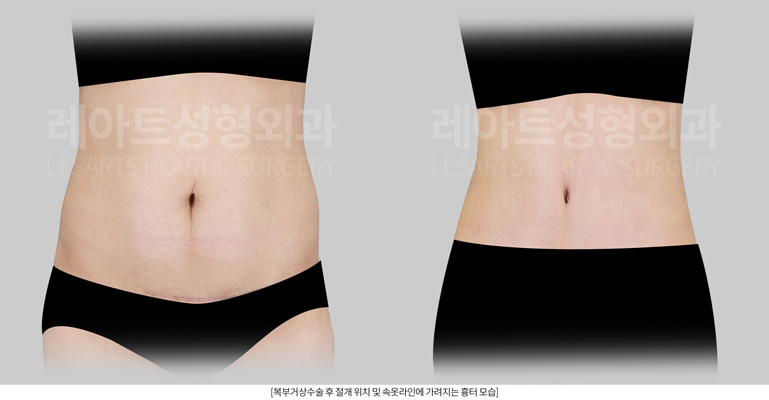
Scar Placement After Tummy Tuck
A Low Incision Hidden Under the Underwear Line
With abdominoplasty, scar placement is almost as important to
patients as the contour improvement itself.
If the incision is placed too high,
it can become visible in daily clothing or underwear.
For this reason, the incision was designed
to stay low enough to be covered by underwear.
In the patient’s postoperative photos taken about 1 month after surgery,
the scar is already positioned low enough to remain well hidden,
which helps reduce this concern.
Current Recovery Stage
6 Weeks After Surgery
At this point, the patient is about 6 weeks after abdominoplasty,
which is still considered an early stage of recovery.
Because tummy tuck surgery usually requires a relatively long recovery period,
postoperative care and long-term management are also very important.
The patient was advised that if she continues to follow the recommended recovery instructions
and aftercare plan based on her healing progress, the final result
can become even more stable and satisfying over time.
Why Structural Diagnosis Matters After Pregnancy
This case shows that even when body weight returns to normal after pregnancy,
the abdominal contour may still not recover naturally.
When postpartum abdominal changes include:
- Loose lower abdominal skin
- Reduced skin elasticity
- Muscle stretching and loss of support
- Mild abdominal protrusion
- Stretch marks and uneven contour
a combined approach such as full abdominoplasty,
rectus muscle repair, and liposuction may be more appropriate
than simple weight loss or exercise alone.
At our plastic surgery clinic in Gangnam,
Seoul, Korea, each tummy tuck is planned carefully based on the patient’s anatomy,
skin condition, and recovery needs to create a smoother,
firmer, and more balanced abdominal contour.
#Liposuction #Abdominoplasty
#Etc #M-type
#Accessory breast #Abdominal liposuction(M)


Cases finding
similar to my profile
Customer Diagnostics


Select the surgery and
area you are interestedto see real
before andafter changes.


we
make you,
the art
Clinic hours
MON - FRI
10 am – 7pm
SAT
10 am – 4pm
Holiday
SUN, HOLIDAY
Location
Lesarts Moon Clinic Tower 4-5F, 40, Nonhyeon-ro 168-gil,
Gangnam-gu, Seoul, Republic of Korea

Medical institution name Lesarts Plastic Surgery
Address Lesarts Moon Clinic Tower 4-5F, 40, Nonhyeon-ro 168-gil, Gangnam-gu, Seoul, Republic of Korea
Representative Moon sung jun
