




Online Consultation
Please accurately enter the information below.
Quick Cost Consultation
Quick Consultation & Reservation
Cases finding
similar to my profile






Cases finding
similar to my profile
Customer Diagnostics
Can a Tummy Tuck Remove Stretch Marks and a C-Section Scar? 4-Month Results After Full Abdominoplasty at a Plastic Surgery Clinic in Gangnam, Seoul, Korea
2026-04-17
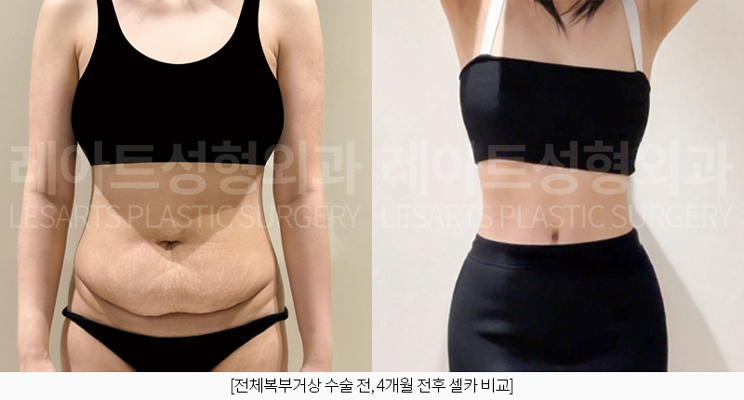
The patient in this case visited our clinic with several concerns at the same time,
including loose abdominal skin, rectus diastasis, and severe stretch marks.
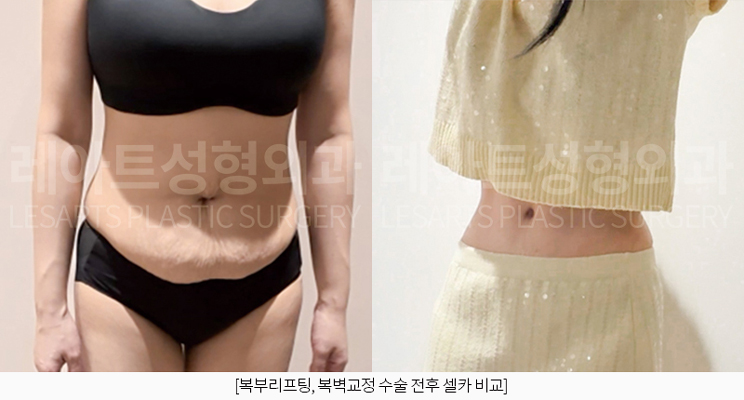
As shown in her selfies,
the combination of abdominal volume and poor skin elasticity
caused the lower abdomen to fold heavily over the underwear line.
Because of this, she felt uncomfortable in daily life,
preferred wearing loose clothing, and often avoided exposing the abdominal area.

Another major concern was the deep step-off and
skin folding around the previous C-section scar.
The patient asked whether it would be possible to remove
the old scar and replace it with a new tummy tuck scar.
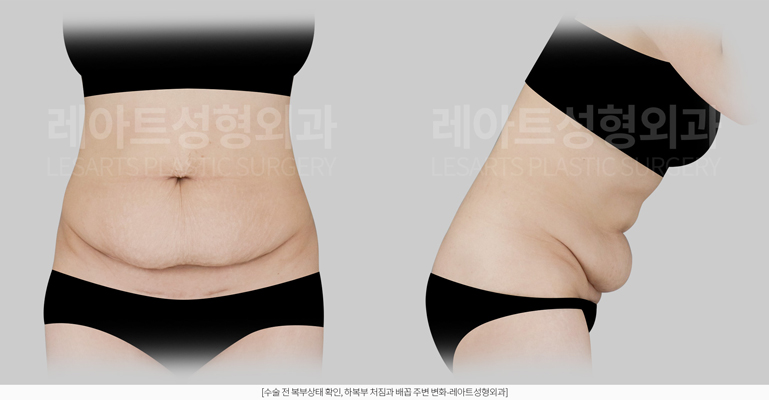
Pre-Surgery Evaluation
Lower Abdominal Sagging, C-Section Scar, and Stretch Marks
After examination, several important findings were identified.
The patient had a body structure in which the belly button was positioned relatively high,
while the C-section scar was positioned very low. Because of this,
there was a possibility that the old cesarean scar could remain even after abdominoplasty.
In addition, rectus diastasis had caused the abdominal wall to push forward,
further disrupting the balance of the abdominal contour.
The stretch marks above the belly button were also discussed.
It was explained that once the loose abdominal skin
was removed and the remaining skin was pulled downward,
these stretch marks would move lower and
the visible range would likely become smaller than before surgery.
The patient also had a natural skeletal shape
that could support a defined waistline.
For this reason, it was expected that abdominal liposuction,
abdominoplasty, and rectus muscle repair could create a very attractive contour.
However, it was also explained that if fat grafting to the hip area was not performed,
a visible step between the upper and lower body connection line could remain.
This point was fully discussed before surgery.
Surgical Plan
Full Abdominoplasty with Muscle Repair, Liposuction, and Hip Fat Grafting
The final surgical plan included:
- M-type full abdominoplasty
- Rectus muscle repair for abdominal wall correction
- Abdominal liposuction
- Fat grafting to the hip area
This plan was designed to improve the loose abdominal skin,
smooth the contour, strengthen the abdominal wall,
and create a more balanced transition between the waist and hips.
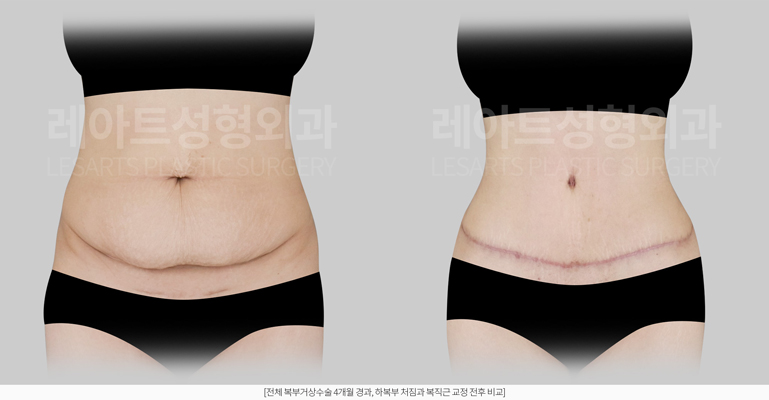
4-Month Results After Abdominoplasty
Improvement in Lower Abdominal Sagging and Abdominal Wall Support
When comparing the before and after photos taken
4 months after surgery, the changes are clear.
Before surgery, the weight and fullness of the lower
abdomen were concentrated downward,
and the skin formed a thick fold. After surgery,
this heavy appearance improved significantly,
and the abdomen changed into a firmer and smoother contour.
The step-off around the previous C-section scar also disappeared,
and the front abdominal line became much cleaner.
Fortunately, the old C-section scar was completely removed,
leaving only one tummy tuck scar line.
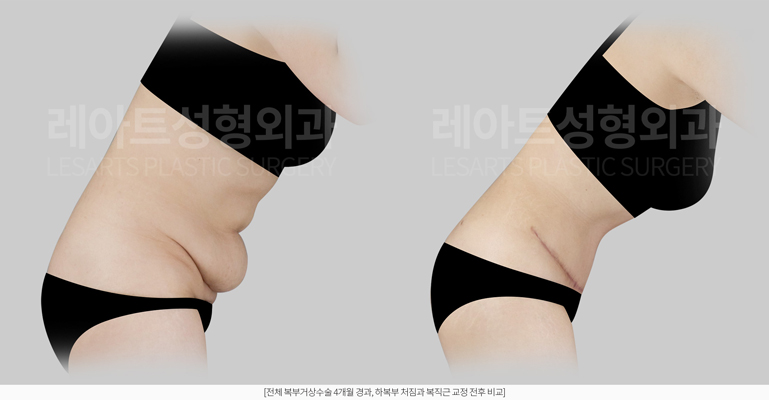
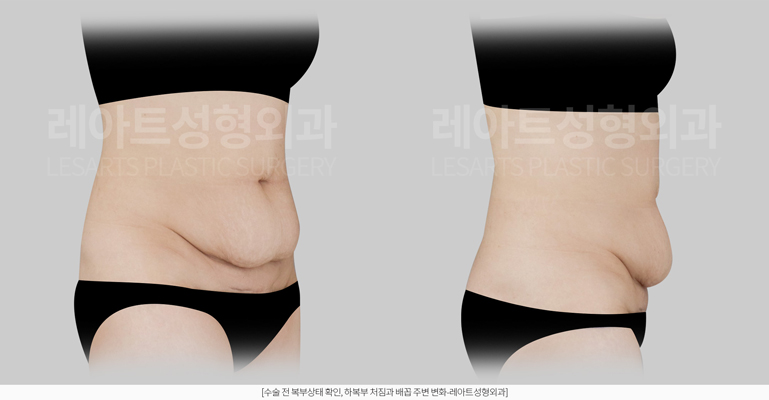
Improvement When Bending Forward
Better Support After Rectus Muscle Repair
Before surgery, the loss of skin elasticity and the abdominal bulging
became even more noticeable when the patient bent forward.
After surgery, these issues improved clearly. Because the rectus diastasis was corrected,
the abdomen now remains firmer and better supported even with changes in posture.
The separated abdominal muscles were brought back together,
and the center of the abdomen, which had previously pushed forward,
now looks much more stable and controlled,
almost as if the patient were wearing an internal corset.
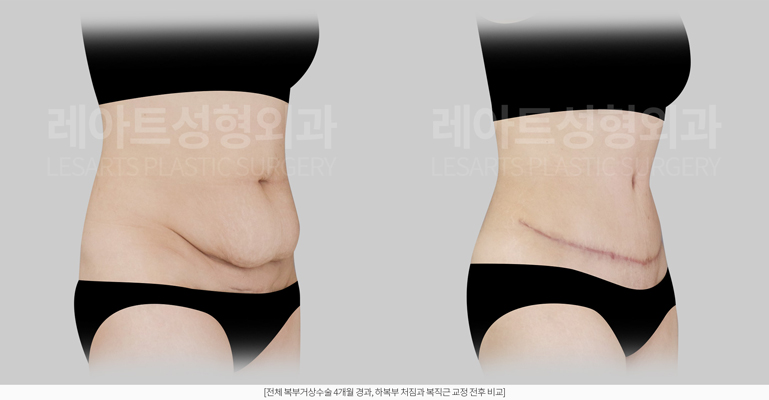
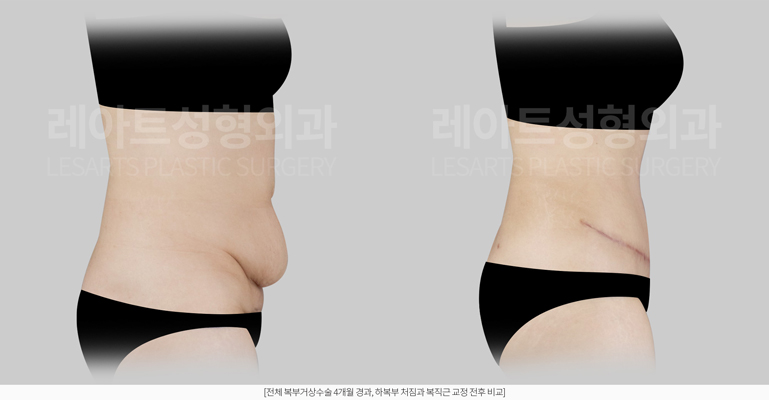
What Happened to the Stretch Marks?
Reduced Visible Range After Tummy Tuck
As expected before surgery, the stretch marks
moved downward after the loose skin was removed and
the abdominal tissue was tightened.
Compared with before surgery,
the visible range of the stretch marks
became significantly smaller.
This case shows that while abdominoplasty
cannot erase every stretch mark completely,
it can reduce how much of them can be seen by removing loose skin and
repositioning the remaining skin more favorably.
Scar Placement After Tummy Tuck
Low Incision Hidden Under Underwear
The abdominoplasty incision was placed as low as possible in the lower abdomen
so that it could be naturally hidden under the underwear line.
This helped reduce concern about visible scarring in daily life
while still allowing enough correction of the loose lower abdominal skin.
Current Recovery Stage
4 Months After Surgery
At this point, the patient is about 4 months after abdominoplasty,
and the overall recovery is progressing in a stable way.
The patient was especially satisfied because
the concerns she had before surgery—such as:
- overall abdominal sagging
- stretch marks
- the dull and heavy abdominal contour
- the uneven area around the C-section scar
had all improved significantly,
and the natural strengths of her body shape
were now more visible.
Even now, some residual swelling,
tissue firmness, and sensory recovery are still part of the healing process.
Continued scar care and follow-up management will remain
important for achieving an even more satisfying final result.
Why Careful Surgical Planning Matters in Cases Like This
This case shows that in patients with:
- loose abdominal skin
- rectus diastasis
- severe stretch marks
- a previous C-section scar
- and a disrupted waist-to-hip contour
successful treatment requires more than simple skin removal.
At our plastic surgery clinic in Gangnam, Seoul, Korea,
each tummy tuck is planned carefully based on the patient’s skin condition,
abdominal structure, scar position, and body balance to create a firmer,
smoother, and more proportionate abdominal contour.
#Abdominoplasty
#M-type
#Abdominal liposuction(M) #Hip Fat Transfer(M)


Cases finding
similar to my profile
Customer Diagnostics


Select the surgery and
area you are interestedto see real
before andafter changes.


we
make you,
the art
Clinic hours
MON - FRI
10 am – 7pm
SAT
10 am – 4pm
Holiday
SUN, HOLIDAY
Location
Lesarts Moon Clinic Tower 4-5F, 40, Nonhyeon-ro 168-gil,
Gangnam-gu, Seoul, Republic of Korea

Medical institution name Lesarts Plastic Surgery
Address Lesarts Moon Clinic Tower 4-5F, 40, Nonhyeon-ro 168-gil, Gangnam-gu, Seoul, Republic of Korea
Representative Moon sung jun
