




Online Consultation
Please accurately enter the information below.
Quick Cost Consultation
Quick Consultation & Reservation
Cases finding
similar to my profile






Cases finding
similar to my profile
Customer Diagnostics
Gynecomastia Surgery or Weight Loss First? 2-Week Results & T-Shirt Fit Change | Best Plastic Surgery Clinic in Gangnam, Seoul, Korea
2026-05-04
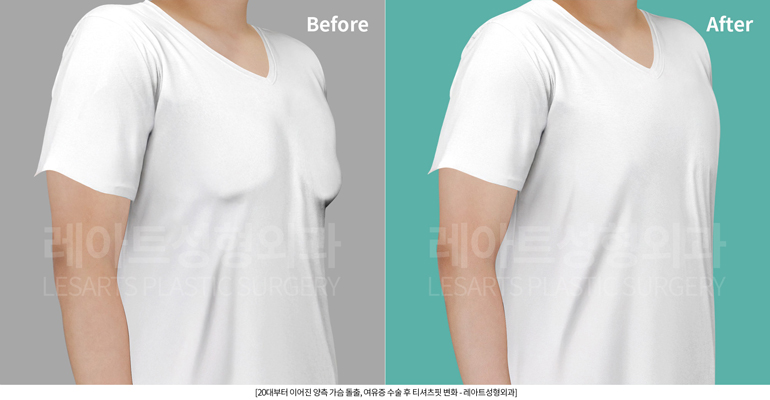
Many men who are concerned about chest protrusion
often wonder:
“Should I lose weight first,
or consider gynecomastia surgery?”
This confusion is very common because
it is difficult to determine the exact cause of gynecomastia symptoms
without proper medical evaluation.
In simple terms, it can be hard to tell
whether the chest enlargement is caused by:
- Body fat (subcutaneous fat)
- Or glandular tissue growth (true gynecomastia)
Even if weight loss reduces fat around the chest,
if the main cause is glandular tissue under the areola,
the protrusion may still remain—or even appear more noticeable.
For this reason, if you are considering treatment,
it is important to receive an accurate diagnosis at a trusted
plastic surgery clinic in Gangnam, Seoul, Korea.

Patient Information
Age: 40s
Height / Weight: 179 cm / 91 kg
BMI: 28
Diagnosis: True gynecomastia, Simon Grade 2A
Before Surgery Analysis
Before surgery, the patient showed:
- An overall body type with moderate body fat
- A chest shape that protruded forward, especially around the nipple and areola
- More noticeable central protrusion compared to surrounding fat
During examination:
- A firm mass was felt directly under the areola
- Ultrasound confirmed this as developed glandular tissue
This case clearly showed that
even with body fat present,
the main cause of the chest protrusion
was glandular tissue, not just fat.
Surgical Plan
Based on the diagnosis, the plan included:
- Removal of glandular tissue on both sides
- Liposuction to reduce surrounding fat
- Refinement of the lateral chest line (underarm area)
The goal was to:
- Smooth out the forward chest projection
- Create a natural and masculine chest contour
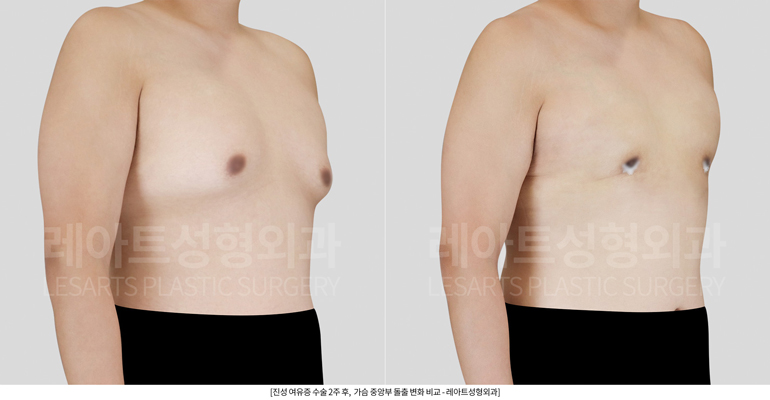
2 Weeks After Surgery Results
✔ Chest Contour Change
When comparing before and 2 weeks after surgery:
- The central chest protrusion is significantly reduced
- The area around the nipple and areola is flattened
- The chest contour becomes smooth and stable
Even in this early stage:
- The overall chest shape looks more natural
- The previously uncomfortable appearance is clearly improved
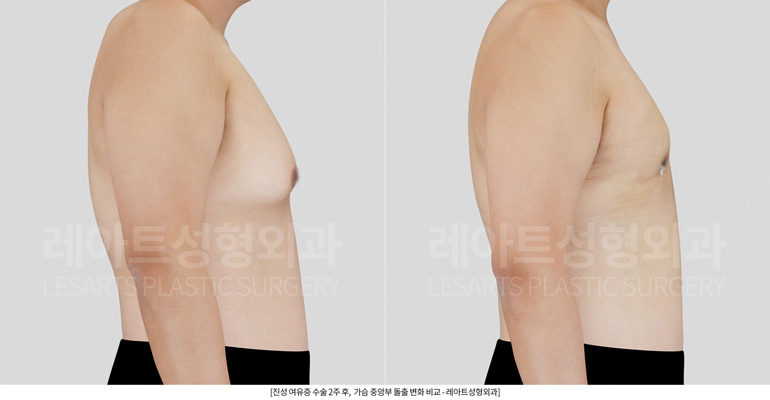
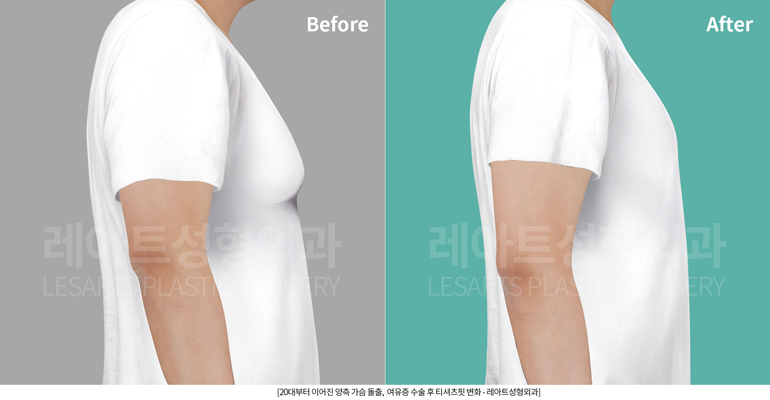
Side View & T-Shirt Fit Change
From the side view:
- The forward projection of the chest is noticeably reduced
- The upper body silhouette becomes more masculine
When wearing a T-shirt:
- The chest no longer stands out
- The outline appears clean and flat
- The burden of visible chest protrusion is significantly reduced
This is one of the most satisfying changes for patients in daily life.
Surgical Effect & Technique
The improvement was achieved through:
- Direct removal of glandular tissue
- Reduction of surrounding fat
- Tissue reshaping to prevent irregular contour or indentation
This creates a smooth connection from:
Upper chest → areola → lower chest → upper abdomen
Resulting in a firm, natural-looking chest line.
Recovery & Important Notes
Although the results are visible early,
full recovery still requires time.
Important points include:
- Swelling and tissue firmness are normal in the early stage
- Wearing compression garments is essential
- Avoid smoking, alcohol, and intense upper body movement
After about 1–2 months (depending on the individual),
gradual return to exercise can help enhance the final result.
Conclusion
If you are unsure whether to lose weight first
or consider surgery, the most important step is:
✔ Accurate diagnosis
Because if the cause is glandular tissue,
weight loss alone cannot fully solve the problem.
Through consultation at a trusted
plastic surgery clinic or hospital in Gangnam, Seoul, Korea,
you can identify the exact cause and choose the most effective treatment plan.
With proper treatment,
you can achieve a flatter chest and feel confident
even in a simple T-shirt.
#Male body contouring
#Gynecomastia
#Grade2-A #true gynecomastia #Side chest liposuction


Cases finding
similar to my profile
Customer Diagnostics


Select the surgery and
area you are interestedto see real
before andafter changes.


we
make you,
the art
Clinic hours
MON - FRI
10 am – 7pm
SAT
10 am – 4pm
Holiday
SUN, HOLIDAY
Location
Lesarts Moon Clinic Tower 4-5F, 40, Nonhyeon-ro 168-gil,
Gangnam-gu, Seoul, Republic of Korea

Medical institution name Lesarts Plastic Surgery
Address Lesarts Moon Clinic Tower 4-5F, 40, Nonhyeon-ro 168-gil, Gangnam-gu, Seoul, Republic of Korea
Representative Moon sung jun
