




Online Consultation
Please accurately enter the information below.
Quick Cost Consultation
Quick Consultation & Reservation
Cases finding
similar to my profile






Cases finding
similar to my profile
Customer Diagnostics
Teenage Gynecomastia Symptoms: 2-Week Surgery Results & T-Shirt Fit Change | Best Plastic Surgery Clinic in Gangnam, Seoul, Korea
2026-05-12
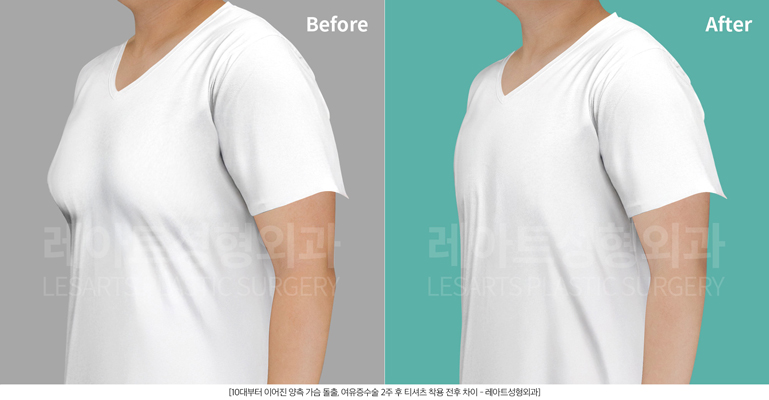
Having a larger chest as a man can cause
a lot of stress and discomfort in daily life.
When chest enlargement appears,
many people first try exercise or weight loss.
However, if the chest size and protruding shape
do not improve even with consistent workouts and body weight management,
surgical treatment may be needed.
Gynecomastia cannot be diagnosed only by looking at chest size.
Even when treatment is performed,
the goal should not be simply reducing chest volume.
For higher long-term satisfaction,
surgery should focus on creating a balanced
and natural male chest silhouette.
This case is about a patient
who first noticed gynecomastia symptoms during his teenage years,
but the symptoms continued into his 20s.
He visited a plastic surgery clinic in Gangnam, Seoul,
Korea because he wanted to feel more comfortable choosing clothes
without worrying about chest protrusion.
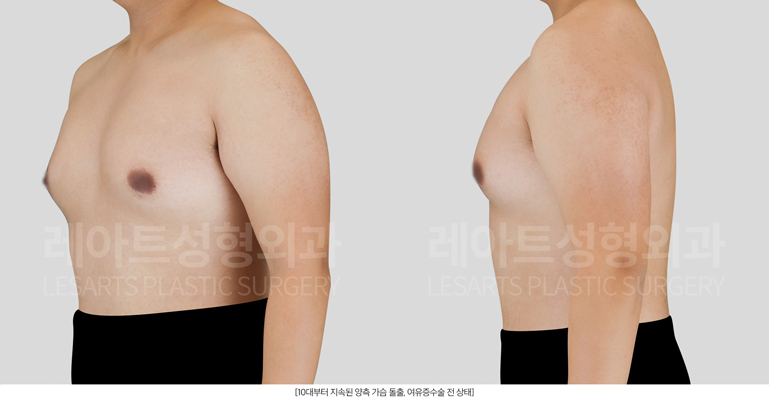
Patient Information
Age: 20s
Height: 180 cm
Weight: 78 kg
Diagnosis: True gynecomastia, Simon Grade 2A
Body condition: In the process of weight loss,
combined with weight training
Before Surgery Analysis
The patient had been consistently
working on weight loss and strength training.
However, the gynecomastia symptoms did not improve,
so he visited the clinic for consultation.
Through physical examination and ultrasound,
two main causes were identified.
1. Enlarged glandular tissue
The overgrowth of glandular tissue caused:
- Increased chest size
- Puffy areola
- Nipple protrusion
2. Subcutaneous fat distribution
Fat around the chest also made the chest line appear thicker.
It created a bulky side chest appearance
and shadowing under the lower chest.
Because both glandular tissue and fat
were contributing to the chest shape,
the surgery was planned as a combined approach.
Surgical Plan
The surgical plan included:
- Removal of glandular tissue on both sides
- Chest liposuction
- Tissue reshaping
The goal was to remove the central chest protrusion
that stood out from the front and create a more masculine chest contour.
Rather than simply making the chest smaller,
the surgery focused on improving the overall chest line
from the upper chest to the abdomen.
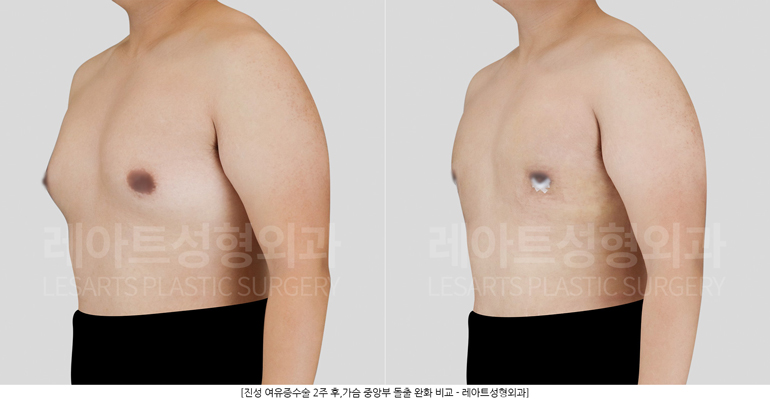
2 Weeks After Gynecomastia Surgery
When comparing the before and 2-week after photos,
the change is clearly visible.
Before surgery, the chest protruded forward around the nipple and areola.
After surgery, this rounded projection became much smoother and flatter.
Even though it was only 2 weeks after surgery,
the overall upper body change was already noticeable.
The chest size was reduced,
and the puffy areola and nipple protrusion were also improved,
creating a more masculine chest shape.
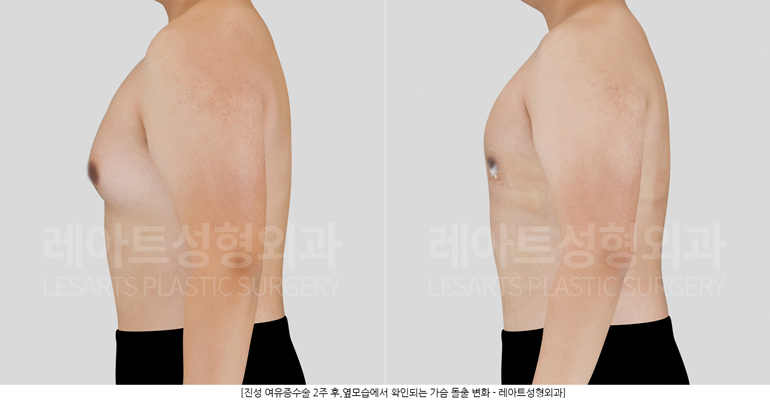
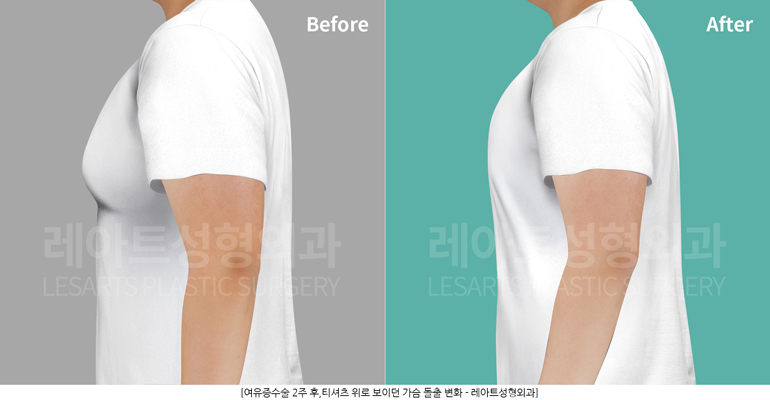
Side View Changes
From the side view, the improvement is even more noticeable.
Before surgery, the chest projected forward in a way
that made the upper body look less balanced.
After surgery, the chest line became firmer and cleaner.
The flow from the upper chest to the abdomen
also became more natural.
The feminine-looking forward projection of the chest was significantly reduced,
making the upper body appear more masculine.
T-Shirt Fit Change
One of the biggest concerns for this patient
was how the chest looked under a T-shirt.
Before surgery, the chest protrusion was visible through clothing.
After surgery, the T-shirt fit became much smoother and more natural.
Even at 2 weeks after surgery, the patient was highly satisfied
because the chest protrusion that had affected his clothing fit was clearly improved.
Early Recovery Stage
At 2 weeks after gynecomastia surgery, recovery is still in the early stage.
During this time, patients may experience:
- Bruising
- Swelling
- Tissue firmness or bio-bonding
Even with these temporary recovery symptoms,
the change in chest shape can already be visible.
Proper aftercare is still very important to support stable healing and final results.
Conclusion
Many patients develop gynecomastia during their teenage years and
continue to live with it into their 20s, 30s, or even later.
If the condition does not cause major discomfort,
treatment is ultimately a personal choice.
However, if chest protrusion has caused long-term stress or psychological pressure,
gynecomastia surgery may help improve the concern more quickly.
By removing the cause and continuing proper aftercare,
patients may experience not only a change in appearance,
but also greater comfort and confidence in daily life.
If you are concerned about chest protrusion, puffy areola,
or T-shirt fit, consultation at a trusted plastic surgery clinic or hospital in Gangnam,
Seoul, Korea can help determine the most suitable treatment plan.
#Male body contouring
#Gynecomastia
#Grade2-A #true gynecomastia #Side chest liposuction


Cases finding
similar to my profile
Customer Diagnostics


Select the surgery and
area you are interestedto see real
before andafter changes.


we
make you,
the art
Clinic hours
MON - FRI
10 am – 7pm
SAT
10 am – 4pm
Holiday
SUN, HOLIDAY
Location
Lesarts Moon Clinic Tower 4-5F, 40, Nonhyeon-ro 168-gil,
Gangnam-gu, Seoul, Republic of Korea

Medical institution name Lesarts Plastic Surgery
Address Lesarts Moon Clinic Tower 4-5F, 40, Nonhyeon-ro 168-gil, Gangnam-gu, Seoul, Republic of Korea
Representative Moon sung jun
