




Online Consultation
Please accurately enter the information below.
Quick Cost Consultation
Quick Consultation & Reservation
Cases finding
similar to my profile






Cases finding
similar to my profile
Customer Diagnostics
Male Chest Protrusion Not Improved by Chest Workouts: True Gynecomastia Surgery & 2-Week T-Shirt Fit Change | Best Plastic Surgery Clinic in Gangnam, Seoul, Korea
2026-06-15
Many men who are concerned about gynecomastia
spend a long time wondering whether they really need surgery.
This often happens because
many gynecomastia cases shown online are very severe.
Some cases show a very large chest size,
strong left-right asymmetry, or noticeable sagging.
Because of this, patients with milder
but still uncomfortable symptoms may wonder,
“Is this really gynecomastia?”
“Do I actually need surgery?”
However, instead of worrying alone,
it is better to receive an accurate examination and diagnosis.
Through consultation at a plastic surgery clinic in Gangnam, Seoul, Korea,
patients can understand whether surgery is needed,
what results may be expected, and how recovery usually progresses.
Patient Case Overview
The patient in this case visited our clinic because his chest protrusion
did not improve with weight loss or chest workouts.
He had noticed gynecomastia symptoms
since his teenage years and was now in his early 30s.
Although he had a slim body type and exercised regularly,
the chest area still looked more noticeable because of the protrusion
around the nipple and areola.
Patient Information
Age: Early 30s
Height: 172 cm
Weight: 73 kg
Diagnosis: True gynecomastia
Simon Grade: 2A
Skin elasticity: Good
Glandular tissue size: Right 22 mm / Left 22 mm
Before Surgery Analysis
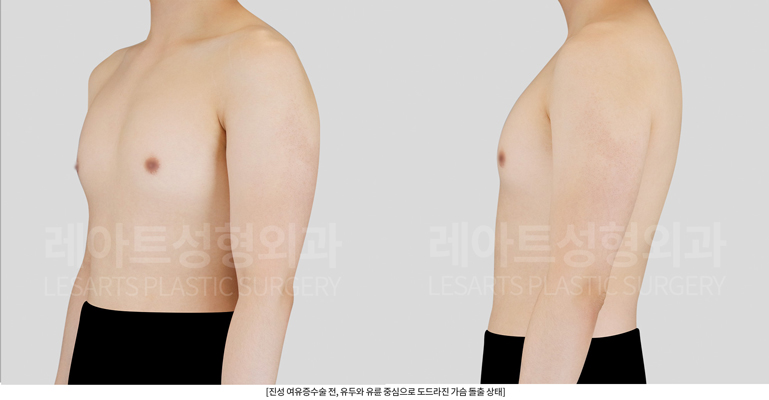
Before surgery, the patient’s chest appeared slightly
rounded and protruded mainly around the areola area.
During physical examination,
firm glandular tissue was felt under both areolas.
There was no excessive nipple protrusion itself.
Ultrasound examination confirmed that the main cause of the enlarged
chest shape was developed glandular tissue.
Since the patient had a slim body and had been exercising consistently,
the chest protrusion caused by gynecomastia was especially stressful for him.
This was not a case that could be improved
by chest workouts alone.
Surgical Plan
The goal was to remove the glandular tissue causing the gynecomastia
while creating a natural and masculine chest contour.
The surgical plan included:
- Glandular tissue removal
- Chest liposuction
- Tissue reshaping
- Natural male chest contour correction
- Pectoral line refinement
The surgery was planned not only to flatten the protruding chest,
but also to help the chest line settle naturally after gland removal.
By combining glandular tissue removal, liposuction, and tissue reshaping,
the goal was to create a smoother and more defined male chest line.
2-Week After Gynecomastia Surgery Results
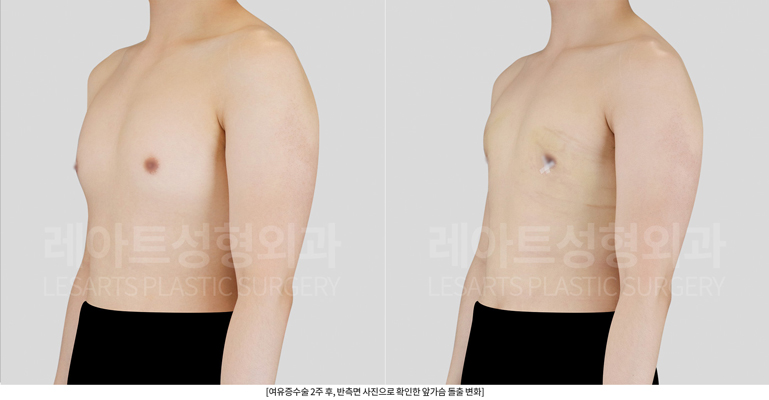
The after photos were taken 2 weeks after surgery,
on the suture removal day.
At this early stage,
swelling and tissue firmness can still be present.
Even so, the change in chest protrusion
was already visible.
Before surgery,
the chest protruded mainly around
the nipple and areola area.
After surgery:
- The rounded areola-centered protrusion improved
- The chest line became smoother
- The front chest looked flatter and more natural
- The upper-to-lower chest line looked more masculine
- The chest shape no longer looked overly rounded
Because tissue reshaping was performed together with glandular tissue removal,
the chest line changed naturally without an awkward or hollow appearance.
Side View Changes
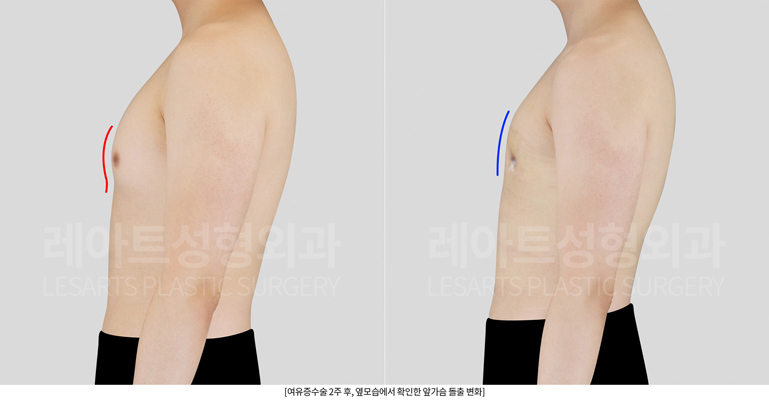
From the side view, the improvement
in chest projection was clearly visible.
Before surgery, the lower chest and upper abdomen connected
with an awkward curve because of the protruding chest volume.
After surgery,
this curve became smoother.
The chest line changed into a firmer-looking contour
from the upper chest to the lower chest.
Since this was only 2 weeks after surgery,
continued compression garment use and recovery care
were still important.
With proper aftercare,
the chest line is expected to settle
into a more stable shape over time.

T-Shirt Fit Change
For many gynecomastia patients,
the biggest concern in daily life is clothing.
In warm weather, some patients wear multiple layers, thick T-shirts,
or oversized clothes to hide the chest line.
In colder weather, they may rely on jackets or outerwear,
but still feel uncomfortable when they need to take them off indoors.
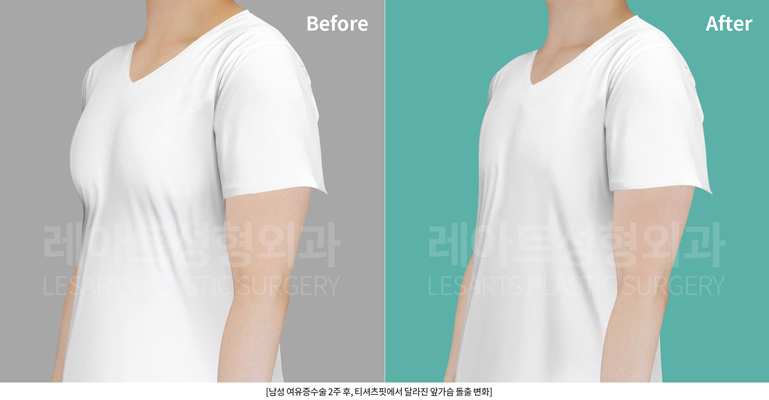
In this case, the T-shirt fit improved noticeably even at
2 weeks after surgery.
Before surgery, the chest protrusion
was visible through the T-shirt.
After surgery, the front chest line looked flatter and smoother,
creating a more comfortable T-shirt fit.
This type of change can bring a high level of satisfaction,
especially for patients who have spent a long time trying
to improve the condition through weight loss or chest workouts.
Why Chest Workouts May Not Improve True Gynecomastia
Chest workouts can strengthen the pectoral muscles,
but they cannot remove glandular tissue.
If the main cause of chest protrusion is developed glandular tissue
under the nipple and areola, exercise alone may not solve the problem.
This is why accurate diagnosis is important.
For true gynecomastia,
ultrasound examination can help confirm
whether glandular tissue is present and
whether surgery may be needed.
Conclusion
If male chest protrusion does not improve with weight loss or chest workouts,
the cause may be true gynecomastia rather than simple chest fat.
In this case, glandular tissue removal, chest liposuction,
and tissue reshaping helped improve the protruding chest and
create a smoother T-shirt fit within 2 weeks after surgery.
For men who are unsure whether they have gynecomastia or whether surgery is necessary,
consultation at a trusted plastic surgery clinic or hospital in Gangnam, Seoul,
Korea can help identify the exact cause and choose the right treatment plan.
If chest protrusion continues to cause stress despite exercise and weight management,
gynecomastia surgery in Korea may be a helpful option for creating a flatter,
more natural, and more confident male chest line.
#Male body contouring
#Gynecomastia
#Grade2-A #true gynecomastia


Cases finding
similar to my profile
Customer Diagnostics


Select the surgery and
area you are interestedto see real
before andafter changes.


we
make you,
the art
Clinic hours
MON - FRI
10 am – 7pm
SAT
10 am – 4pm
Holiday
SUN, HOLIDAY
Location
Lesarts Moon Clinic Tower 4-5F, 40, Nonhyeon-ro 168-gil,
Gangnam-gu, Seoul, Republic of Korea

Medical institution name Lesarts Plastic Surgery
Address Lesarts Moon Clinic Tower 4-5F, 40, Nonhyeon-ro 168-gil, Gangnam-gu, Seoul, Republic of Korea
Representative Moon sung jun
