




Online Consultation
Please accurately enter the information below.
Quick Cost Consultation
Quick Consultation & Reservation
Cases finding
similar to my profile






Cases finding
similar to my profile
Customer Diagnostics
Male Breast Lump and Chest Protrusion: Gynecomastia Surgery Results After 2 Weeks | Best Plastic Surgery Clinic in Gangnam, Seoul, Korea
2026-06-17
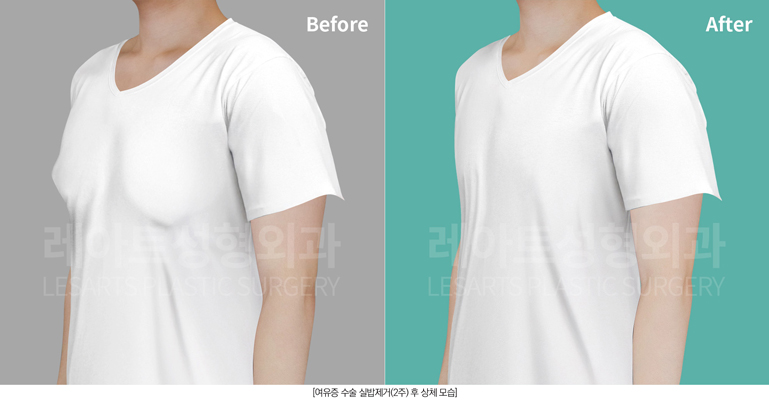
Male gynecomastia can appear temporarily
during puberty due to hormonal changes.
Because of this, many teenagers may think
that chest protrusion is not a serious concern
and delay visiting a clinic.
However, if chest protrusion that started during the teenage years continues into the 20s,
or if there is no improvement even with diet, exercise, or body management,
it is important to find the exact cause through medical examination.
This is especially true if a firm lump can be felt in the chest,
or if symptoms such as tenderness or nipple discharge are present.
In this case, the patient had gynecomastia symptoms since his teenage years,
and the condition remained into his early 20s without improvement.
He visited LesArts Plastic Surgery, a plastic surgery clinic in Gangnam,
Seoul, Korea, to improve male chest protrusion
and a palpable breast lump caused by gynecomastia.

Patient Information
Age: Early 20s
Height: 181 cm
Weight: 81 kg
Diagnosis: Mixed-type gynecomastia
Simon Grade: 2A
Skin elasticity: Good
Glandular tissue size: Right 27 mm / Left 32 mm
Before Surgery Analysis
Before surgery, the patient’s chest looked enlarged
and protruded from the front and side.
The areola area was also swollen and puffy.
Based on the Simon classification,
the condition was diagnosed
as Simon Grade 2A gynecomastia.
Ultrasound examination confirmed that overgrown glandular tissue
was the main cause of the gynecomastia symptoms.
During physical examination, a firm lump could be felt
under the areola area where the glandular tissue was located.
The patient was also aware of this lump and mentioned
it as one of the uncomfortable symptoms in daily life.
In addition to glandular tissue, the surrounding fat layer
also contributed to the enlarged chest size.
For this reason, the patient was diagnosed
with mixed-type gynecomastia, and a combined surgical plan
was recommended.
Surgical Plan
The surgery was planned to remove the main cause of gynecomastia
while creating a natural male chest contour.
The surgical plan included:
- Glandular tissue removal
- Chest liposuction
- Tissue reshaping
- Male chest contour correction
- Natural upper body line refinement
The goal was not only to remove the lump
and reduce chest volume.
The surgery also focused on creating a smoother and
more masculine chest line so that the upper body would look natural
after the glandular tissue and fat were removed.
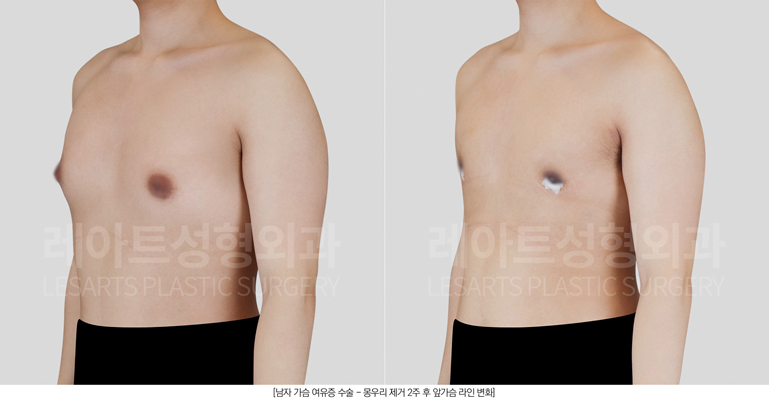
2-Week After Gynecomastia Surgery Results
The after photos were taken on the suture removal day,
2 weeks after surgery.
Even though this was still an early recovery stage,
the change in the chest line was already visible.
Before surgery, the chest protruded forward,
and the areola area looked swollen
due to glandular tissue development.
After surgery:
- The chest protrusion was reduced
- The puffy areola shape improved
- The chest line became smoother
- The palpable glandular lump was removed
- The upper body contour looked more natural
- The chest no longer looked overly rounded
Because chest liposuction and
tissue reshaping were performed together,
the result did not look awkward or hollow.
Instead, the chest changed
into a smoother and more balanced contour.
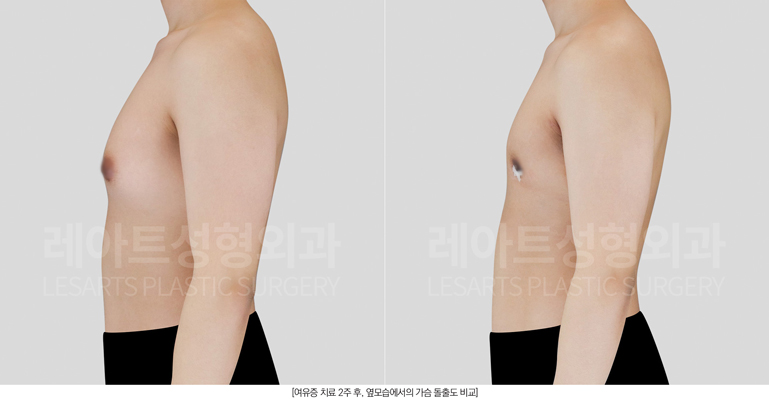
Side View Changes
From the side view, the improvement
in chest protrusion was clearly noticeable.
Before surgery, the chest projected forward,
and the connection between the upper abdomen
and chest looked unnatural.
After surgery, the protruding angle decreased,
and the chest line looked firmer and more stable.
Although swelling and tissue firmness can still be present at 2 weeks after surgery,
the result already looked natural from the outside.
The patient also shared that he did not experience major discomfort
in daily life during recovery.
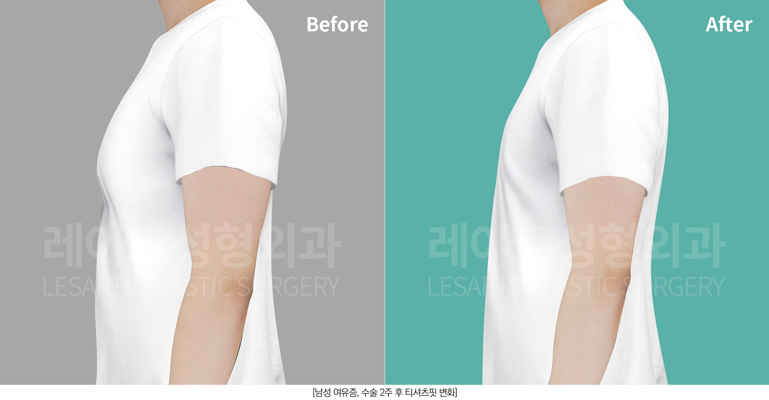
T-Shirt Fit Change
One of the biggest concerns for gynecomastia patients
is how the chest looks in clothing.
Before surgery, the patient’s chest protrusion was visible through a T-shirt,
making the chest line look awkward and uncomfortable.
After surgery, the T-shirt fit became much smoother.
The chest no longer protruded in the same way,
and the upper body looked more natural under clothing.
This change allowed the patient to dress more freely regardless of the season.
Why Accurate Diagnosis Matters
When gynecomastia begins during adolescence and continues into adulthood,
patients may feel confused about which department or clinic to visit.
If a firm lump can be felt in the chest,
it may not be a simple fat accumulation issue.
In this case, ultrasound examination confirmed developed glandular tissue,
and both glandular tissue and fat were contributing to the chest enlargement.
That is why accurate diagnosis
is important before deciding on treatment.
A proper examination can help determine
whether the chest protrusion is caused by fat,
glandular tissue, or both.
Private Consultation and Surgical Care
For male patients,
gynecomastia can be a sensitive concern.
At a specialized plastic surgery clinic or hospital in Gangnam, Seoul, Korea,
private consultation and careful surgical planning can help patients
feel more comfortable throughout the process.
In this case, the treatment focused not only on removing the cause of gynecomastia,
but also on improving the overall chest shape from a plastic surgery perspective.
This helped create a more natural and masculine chest contour.
Conclusion
If male chest protrusion that started during the teenage years continues into the 20s,
and a firm lump can be felt under the nipple or areola,
it is important to receive an accurate examination.
Gynecomastia may be caused by glandular tissue, fat, or both.
In this case, glandular tissue removal, chest liposuction,
and tissue reshaping helped improve the chest protrusion,
remove the palpable lump, and create a smoother
T-shirt fit within 2 weeks after surgery.
For men who are unsure where to treat gynecomastia
or are concerned about male breast lumps,
consultation at a trusted plastic surgery clinic in Gangnam, Seoul,
Korea can help find the most suitable treatment plan.
#Male body contouring
#Gynecomastia
#Grade2-A #true gynecomastia


Cases finding
similar to my profile
Customer Diagnostics


Select the surgery and
area you are interestedto see real
before andafter changes.


we
make you,
the art
Clinic hours
MON - FRI
10 am – 7pm
SAT
10 am – 4pm
Holiday
SUN, HOLIDAY
Location
Lesarts Moon Clinic Tower 4-5F, 40, Nonhyeon-ro 168-gil,
Gangnam-gu, Seoul, Republic of Korea

Medical institution name Lesarts Plastic Surgery
Address Lesarts Moon Clinic Tower 4-5F, 40, Nonhyeon-ro 168-gil, Gangnam-gu, Seoul, Republic of Korea
Representative Moon sung jun
