




Online Consultation
Please accurately enter the information below.
Quick Cost Consultation
Quick Consultation & Reservation
Cases finding
similar to my profile






Cases finding
similar to my profile
Customer Diagnostics
Can a Tummy Tuck Correct Sagging Belly Skin After Weight Loss? 9.5-Month L-Type Extended Abdominoplasty Results | Best Plastic Surgery Clinic in Gangnam, Seoul, Korea
2026-06-30
After gaining and losing a significant amount of weight,
many patients feel satisfied with the weight loss itself.
However, unexpected concerns can remain
after the number on the scale goes down.
One of the most common concerns
is loose skin and wrinkles.
The abdomen is especially affected by weight changes.
Even after successful dieting,
once the abdominal skin has been stretched,
it may not fully tighten again.
In some cases, weakened rectus muscles and fascia
can also make the abdomen look uneven or protruded.
This type of abdominal skin laxity can lead to daily discomfort,
including a weaker-looking abdomen,
skin irritation where the skin folds,
and difficulty getting the desired clothing fit.
In this case, the patient visited LesArts Plastic Surgery,
a plastic surgery clinic in Gangnam, Seoul, Korea,
because she was concerned about lower belly sagging,
abdominal contour, and navel shape after major weight change.
We will explain her L-type extended tummy tuck result after 9.5 months.
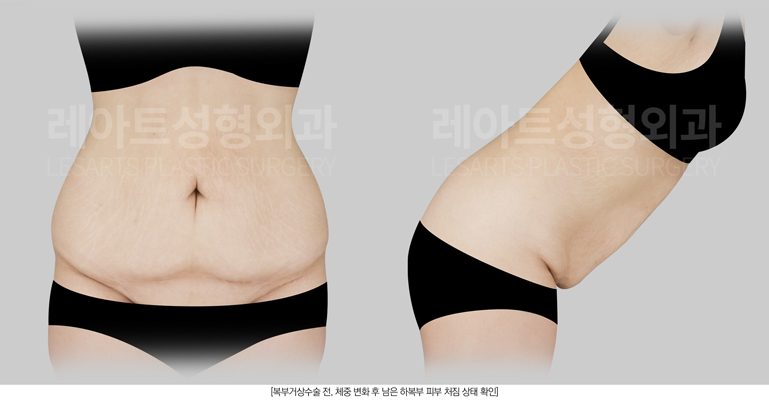
Patient Information
Age: 30
Height: 165 cm
Weight before surgery: 69 kg
Surgical areas: Tummy tuck,
abdominal liposuction, hip dip fat grafting
Before Surgery Analysis
Before tummy tuck surgery,
the patient had no history of pregnancy, childbirth,
or previous abdominal surgery.
However, she had experienced a period of significant weight gain
in the past and had maintained her current weight
through consistent weight loss.
Even after losing weight, the abdominal skin
that had once been stretched did not fully recover.
As a result, sagging and folding remained mainly below
the navel and in the lower abdomen.
Before surgery, the patient showed
skin laxity starting from the upper abdomen.
The skin sagged down toward the lower abdomen,
creating a heavy fold below the navel.
Stretch marks and wrinkles were
also widely visible around the navel.
When the patient bent forward, the remaining loose skin gathered forward,
making the abdominal sagging more noticeable
The main concerns included:
- Lower belly sagging after weight loss
- Loose abdominal skin
- Skin folding below the navel
- Stretch marks around the navel
- Wrinkles around the abdomen
- Navel shape change
- Abdominal protrusion due to weakened support
- Heavy-looking lower abdominal line
This was not simply a fat-volume problem.
The main issue was loose skin and
weakened abdominal support after major weight change.
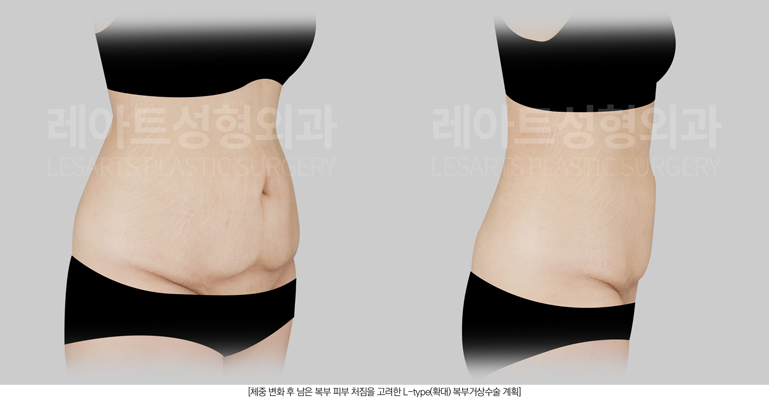
Surgical Plan
Based on the patient’s abdominal condition, an L-type extended abdominoplasty
was planned to remove the sagging lower abdominal skin below the navel.
The incision length was expected to be slightly
longer toward the upper pelvic area.
However, considering the wide skin laxity from the upper abdomen to the flank area,
an extended tummy tuck was considered more suitable
to create a clear improvement without dog-ear formation.
The surgical plan included:
- L-type extended abdominoplasty
- Rectus muscle repair
- Abdominal wall tightening
- Navel correction / umbilical correction
- Abdominal liposuction
- Flank and love handle liposuction
- Hip dip fat grafting
- Lower abdominal skin removal
- Waist-to-pelvis line refinement
Along with skin removal, rectus diastasis repair and navel correction
were planned to improve the firmness of the front abdomen
and adjust the navel shape and position.
Liposuction was planned mainly around the flanks and
love handles to create a more balanced
result with the tummy tuck.
Hip dip fat grafting was also planned to smooth the connection
between the love handles and outer buttock area,
creating a softer line from the waist to the pelvis.
Because the patient had experienced a large amount of weight change,
the abdominal skin was stretched widely from side to side.
For this reason, she was informed
that some fine wrinkles above the navel or a slight gathered-skin
appearance toward the center could remain after surgery.
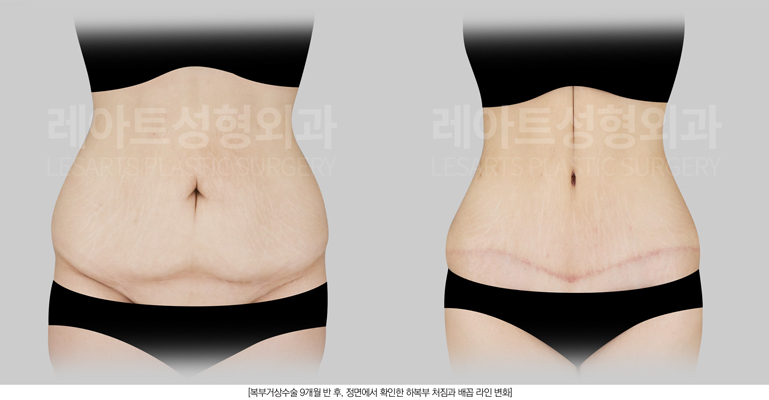
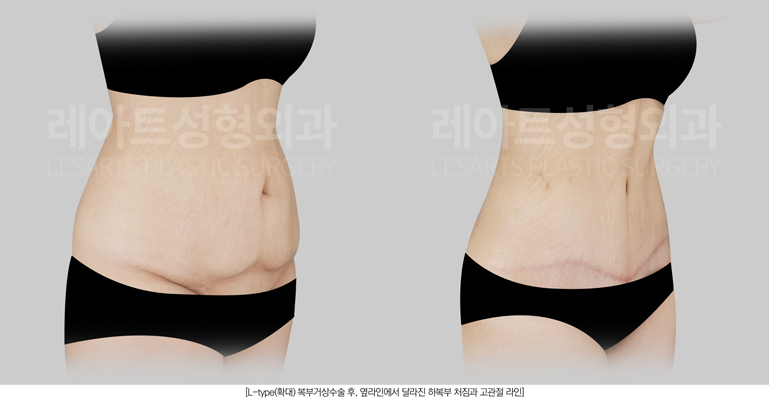
9.5-Month After L-Type Extended Tummy Tuck Results
At 9.5 months after surgery, the lower abdominal line
showed a clear improvement.
Before surgery, the skin below the navel sagged downward
and created a heavy protruding lower belly line.
After surgery:
- Lower belly sagging was reduced
- Loose skin below the navel was removed
- Stretch marks and fine wrinkles around the navel improved
- The abdominal line became smoother
- The lower abdomen looked lighter
- The navel shape became more vertical
- The waist-to-pelvis line looked softer and more balanced
The navel, which had looked round and pulled downward due to skin sagging,
was newly shaped into a more vertical form through navel correction.
Abdominal liposuction and hip dip fat grafting
also helped improve the overall line and proportion.
The dullness around the flanks and love handles was reduced,
and the connection between the love handles and
buttock area became smoother and more feminine.
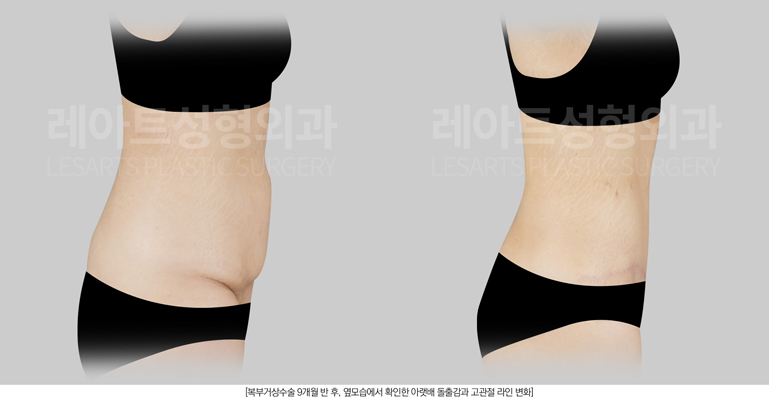
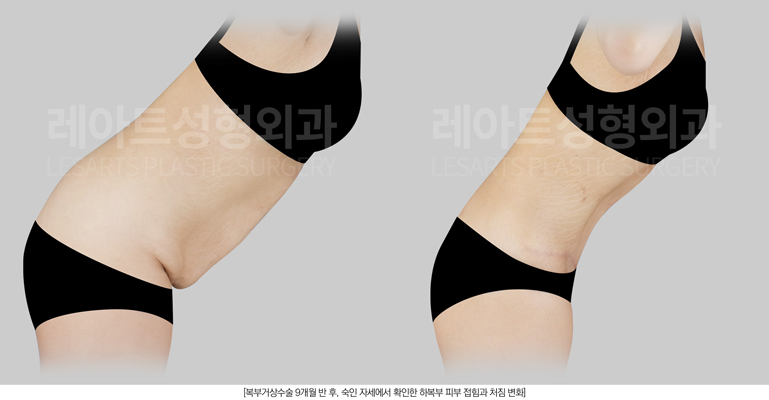
Side View Changes
From the side view, the lower belly protrusion
improved noticeably.
Before surgery, the abdomen
pushed forward and looked heavy.
After surgery, the protruding abdominal shape was reduced,
and the abdominal line changed into a firmer and smoother contour.
The lower abdomen no longer looked like it
was pulled downward by loose skin.
Instead, the line from the upper abdomen
to the lower abdomen looked lighter and more stable.
Bending View Changes
The improvement was also clear when the patient bent forward.
Before surgery, the abdominal skin and abdominal wall
pushed forward together when bending.
After surgery, the abdomen stayed more firmly supported
without the same forward spilling of loose skin.
This showed improvement not only in the visible skin sagging,
but also in the internal abdominal support.
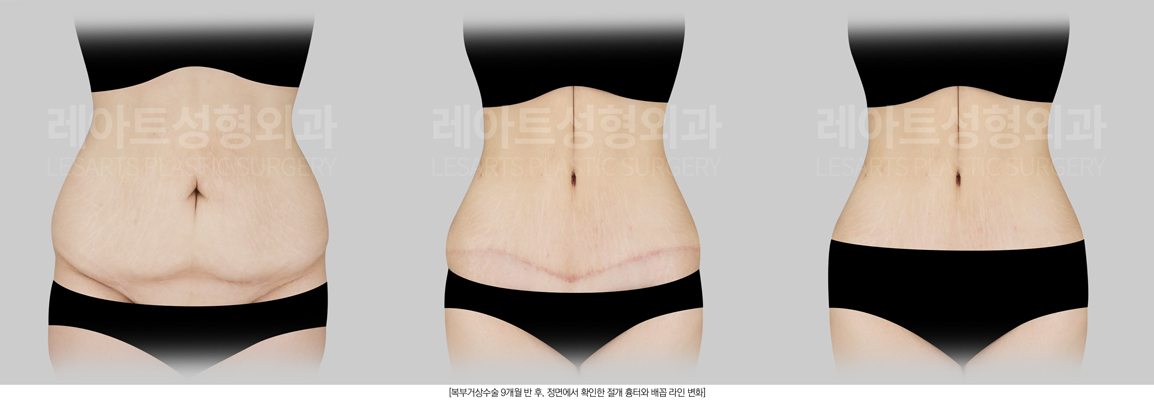
Scar and Navel Recovery
At 9.5 months after surgery,
the tummy tuck incision scar still had a slight reddish tone.
However, the scar was not widened or raised,
and it was settling in a relatively thin and stable way.
The overall surgical result and recovery condition were stable, and the patient
was advised that continued scar care could help the result improve further over time.
The navel line also looked more natural compared to before surgery.
Because navel correction was performed together with the extended tummy tuck,
the navel shape became more centered and vertically defined.
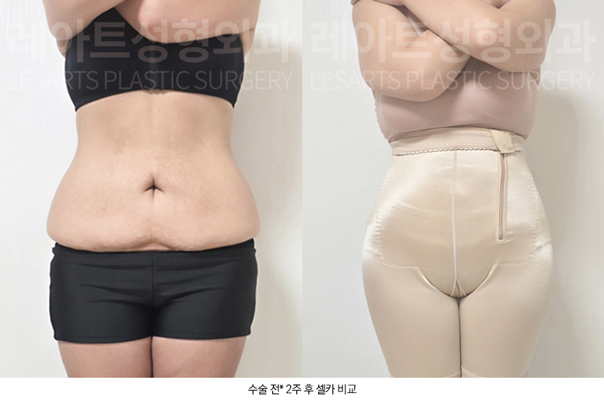

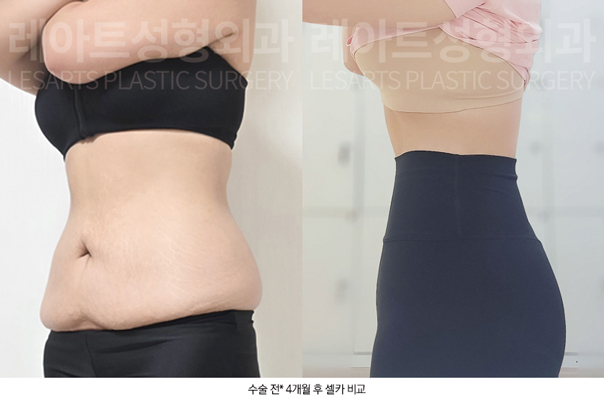
Selfie Comparison After Surgery
In the patient’s daily photos after surgery,
the change in body line was easy to see.
The heavy loose skin in the lower abdomen was removed,
and the abdominal line that had previously stood out
over clothing became much lighter.
Because abdominal liposuction and hip dip fat grafting were performed together,
the line from the waist to the pelvis looked more balanced and ideal.
This helped the patient feel more confident
in daily clothing and body-fitting outfits.
Why Extended Tummy Tuck Was Suitable
For patients who have experienced major weight change,
the skin can stretch not only vertically but also horizontally.
In this case, loose skin was not limited to only the lower center abdomen.
Skin laxity extended from the upper abdomen toward the flanks,
so a wider correction range was needed.
That is why an L-type extended tummy tuck
was planned instead of a shorter correction.
The goal was to remove the loose skin as effectively as possible
while reducing the risk of dog-ear formation and
improving the overall abdominal contour.
Why Customized Planning Matters
Tummy tuck surgery should not be planned
only by the amount of loose skin.
For natural and stable results,
the surgeon should consider:
- Weight change history
- Skin laxity range
- Stretch marks and wrinkles
- Rectus diastasis
- Abdominal wall laxity
- Navel shape and position
- Flank and love handle volume
- Hip dip and pelvic line balance
- Scar length and location
In this case, the surgery combined extended abdominoplasty,
abdominal wall tightening, navel correction, liposuction,
and hip dip fat grafting to improve
both the abdomen and body proportion.
Conclusion
After major weight loss, loose abdominal skin, wrinkles, stretch marks,
and lower belly folds may remain even when weight is well controlled.
If the abdominal skin has stretched widely and the abdominal wall support is weakened,
exercise, stretching, or skin-tightening care alone may have limitations.
In this case, L-type extended abdominoplasty with rectus muscle repair,
navel correction, abdominal liposuction,
and hip dip fat grafting helped improve lower belly sagging,
navel shape, and the waist-to-pelvis line after 9.5 months.
For patients who are concerned about sagging belly skin after weight loss,
consultation at a trusted plastic surgery clinic or hospital in Gangnam, Seoul,
Korea can help determine the most suitable tummy tuck plan.
A customized tummy tuck in Korea may help create a smoother,
firmer, and more balanced abdominal contour.
#Abdominoplasty
#L-type
#Abdominal liposuction(L) #Hip Fat Transfer(L)


Cases finding
similar to my profile
Customer Diagnostics


Select the surgery and
area you are interestedto see real
before andafter changes.


we
make you,
the art
Clinic hours
MON - FRI
10 am – 7pm
SAT
10 am – 4pm
Holiday
SUN, HOLIDAY
Location
Lesarts Moon Clinic Tower 4-5F, 40, Nonhyeon-ro 168-gil,
Gangnam-gu, Seoul, Republic of Korea

Medical institution name Lesarts Plastic Surgery
Address Lesarts Moon Clinic Tower 4-5F, 40, Nonhyeon-ro 168-gil, Gangnam-gu, Seoul, Republic of Korea
Representative Moon sung jun
