




Online Consultation
Please accurately enter the information below.
Quick Cost Consultation
Quick Consultation & Reservation
Cases finding
similar to my profile






Cases finding
similar to my profile
Customer Diagnostics
Post-C-Section Tummy Tuck and Abdominal Liposuction: 3-Month Lower Belly Sagging Results | Best Tummy Tuck Clinic in Gangnam, Seoul, Korea
2026-07-08
This case is about a patient who underwent M-Type tummy tuck surgery,
abdominal liposuction, rectus muscle repair,
and belly button reshaping to improve
lower belly sagging after C-section delivery.
After childbirth, some patients recover their body weight to a certain degree,
but still feel uncomfortable because the lower abdominal skin folds over the underwear line
or the abdominal contour does not look smooth.
This concern can appear even when the patient is not overweight.
If loose lower abdominal skin and an uneven C-section scar line remain,
the abdomen may look heavier when wearing thin or fitted clothing.
For patients who had a C-section,
the skin around the scar can sometimes look uneven,
folded, or pulled down. In this case, the patient visited LesArts Plastic Surgery,
a plastic surgery clinic in Gangnam, Seoul, Korea,
to improve lower abdominal sagging, C-section scar unevenness,
and the belly button shape.

Before Surgery Analysis
The patient was in her 50s and
had a history of one C-section delivery.
Before surgery, she was not overweight.
However, she was concerned about the loose skin in the lower abdomen
and the uneven line around the previous C-section scar.
From the preoperative photos,
the skin below the belly button sagged downward toward the underwear line.
Because of this, the lower abdomen did not look smooth or firm.
Around the C-section scar, the skin did not connect naturally.
The lower abdominal line looked slightly pressed and uneven,
making the whole abdomen appear heavier.
When the patient bent forward,
the loose skin moved downward and the folds became more noticeable.
The main concerns included:
- Lower belly sagging after C-section
- Skin folding above the underwear line
- Uneven C-section scar line
- Lower abdominal heaviness
- Loose skin below the belly button
- Rectus diastasis
- Belly button shape change
- Less smooth abdominal contour
This was not a case that could be improved only by losing more weight.
The main issue was loose skin, scar-related unevenness,
and weakened abdominal wall support.
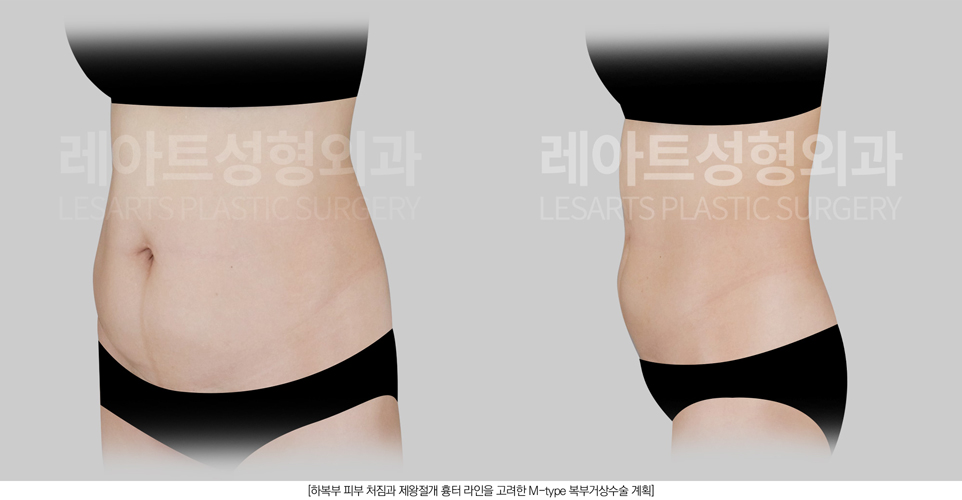
Surgical Plan
Based on the patient’s abdominal condition,
an M-Type tummy tuck was planned.
The surgery focused on improving the sagging skin below the belly button
and correcting the folded, uneven area around the previous C-section scar.
The surgical plan included:
- M-Type tummy tuck
- Abdominal liposuction
- Rectus muscle repair
- Abdominal wall tightening
- C-section scar removal
- Lower abdominal skin removal
- Belly button reshaping
- Love handle liposuction
- Abdominal contour refinement
Although the patient’s skin elasticity was relatively good and the sagging
was not extremely severe, the upper abdominal rectus muscle separation
also needed correction. For this reason,
a full abdominal lifting approach was considered necessary.
The previous C-section scar was located low on the lower abdomen.
If the upper abdominal skin could move down enough during surgery,
the old C-section scar could be removed,
leaving only the new tummy tuck incision scar.
However, if skin movement was limited,
the patient was informed before surgery
that two incision scars could remain.
In terms of fat distribution, the patient did not have a large
amount of fat throughout the abdomen.
The main fat volume was found around the flanks and love handle area,
so abdominal liposuction was planned mainly around those areas.
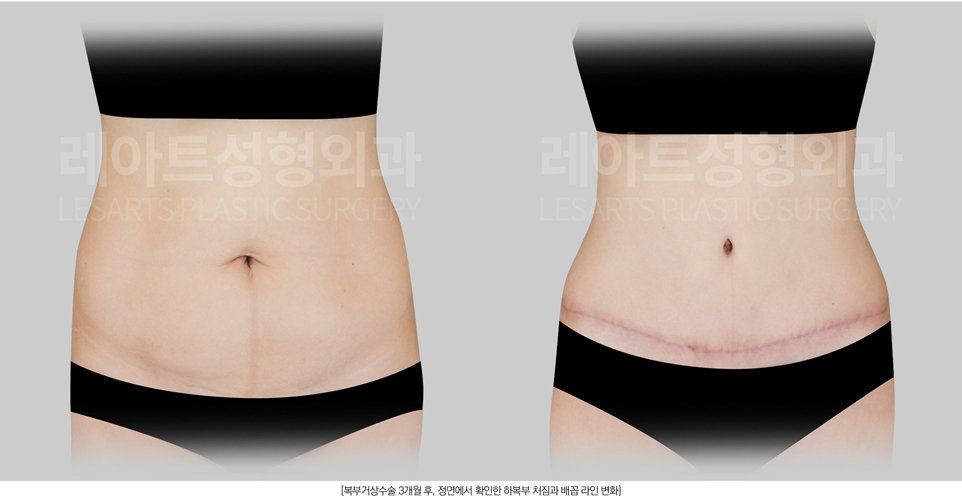
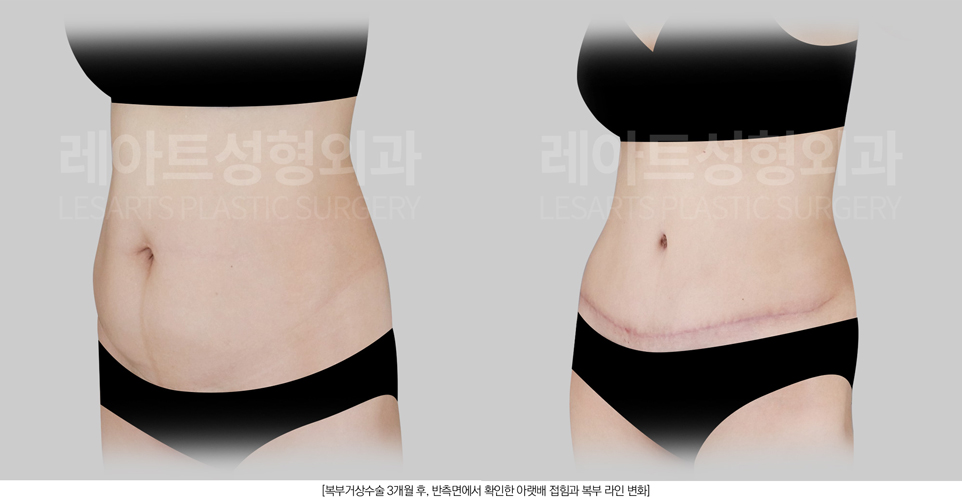
3-Month After Tummy Tuck Results
The before and after photos were compared
at 3 months after tummy tuck surgery.
Before surgery, the skin below the belly button
was loose and folded over the previous C-section scar.
The lower abdomen also looked heavy above the underwear line.
After surgery:
- Loose lower abdominal skin was removed
- The lower belly line became firmer
- The C-section scar unevenness improved
- The abdominal wall looked more supported
- The waist and love handle line became smoother
- The belly button was reshaped
- The abdominal contour looked lighter and more balanced
With rectus muscle repair,
the weak abdominal wall was also improved.
The abdomen no longer looked
pushed forward or unsupported.
Abdominal liposuction also
helped refine the flanks and love handles,
creating a more natural curve around the waist.
Front and Half-Side View Changes
From the front view, the lower abdominal sagging
that had been visible below the belly button was clearly improved.
Before surgery, the lower abdomen looked heavy
because the loose skin folded over the C-section scar.
After surgery, the lower belly line became smoother and firmer.
The area above the underwear line no longer looked folded or pressed down.
The belly button also changed.
Before surgery, the belly button shape
had been affected by the loose upper abdominal skin.
During the tummy tuck, the previous belly button was removed
and a new vertical-looking belly button was reconstructed
in a position that matched the waistline.
From the half-side view,
the abdomen looked more stable and
naturally connected to the waistline.
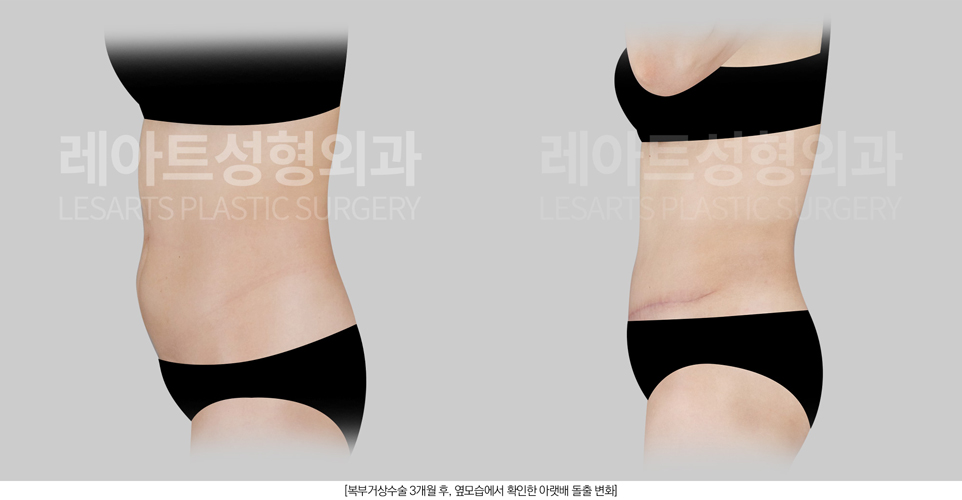
Side View Changes
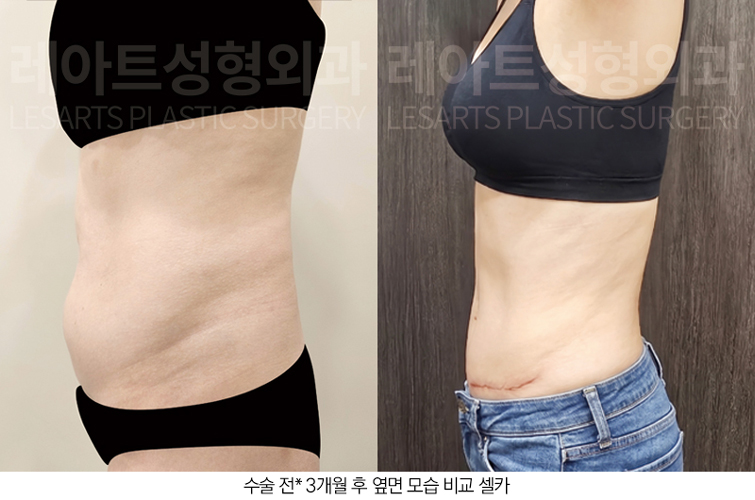
From the side view, the improvement
in the lower abdominal protrusion was more noticeable.
Before surgery, the front abdominal line looked uneven.
Although the patient did not have a large amount of subcutaneous fat,
the abdomen still looked bulky because of rectus diastasis and loose skin.
After the tummy tuck,
the front abdomen looked tighter and more lifted.
The lower belly protrusion was reduced,
and the abdominal line looked smoother from the side.
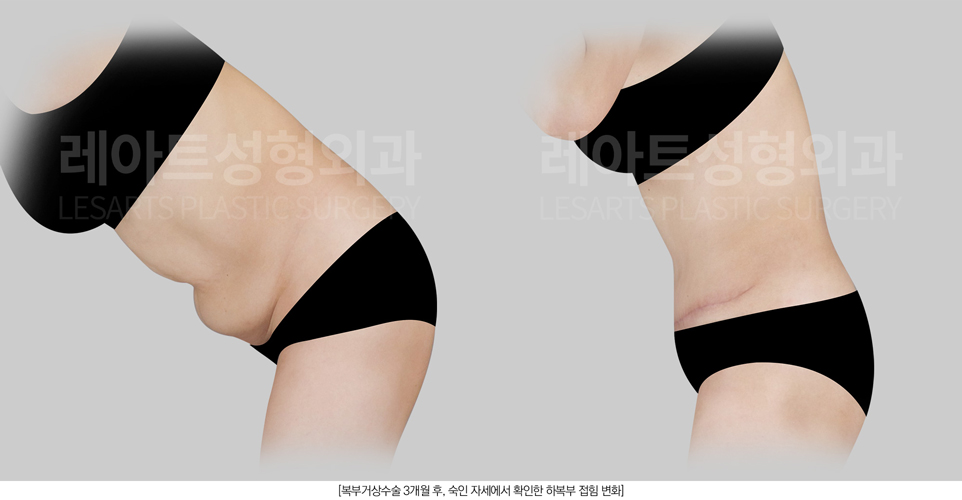
Bending View Changes
The change was also clear when the patient bent forward.
Before surgery, the loose lower abdominal skin moved downward
and folded more visibly with posture changes.
After surgery, the lower abdomen no longer folded
or dropped in the same way when bending forward.
This helped the abdomen look more stable,
even with movement or posture changes.
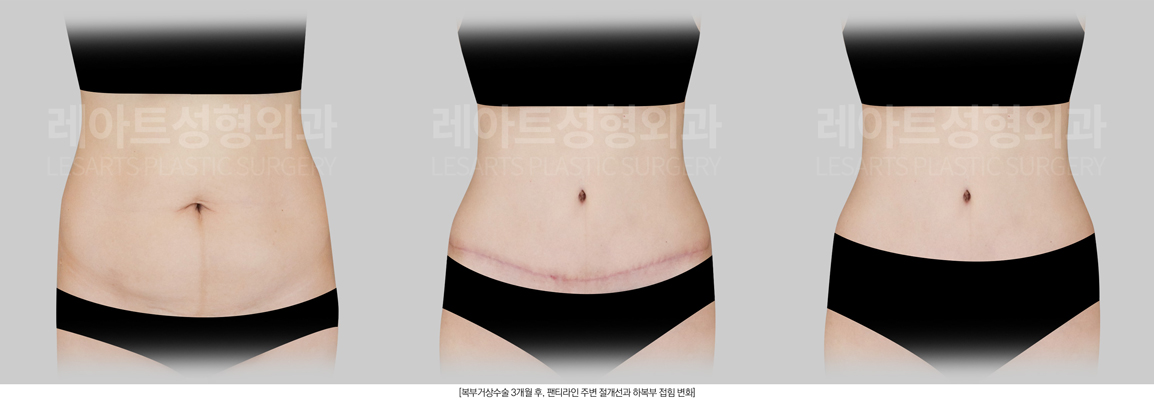
Scar Location and 3-Month Recovery
Scar location is one of the most important concerns
for many patients considering tummy tuck surgery.
In this case, the previous C-section scar was removed during surgery.
The new tummy tuck scar was placed low on the lower abdomen,
so it could be naturally hidden when wearing underwear.
At 3 months after surgery,
the scar was still in the early recovery stage.
Mild redness, firmness, and tightness around the abdomen can still remain at this time.
These are common parts of the recovery process and
usually improve gradually with time and proper care.
Scar laser toning was planned from around the 3-month mark
to help the incision line heal more smoothly and become less noticeable over time.
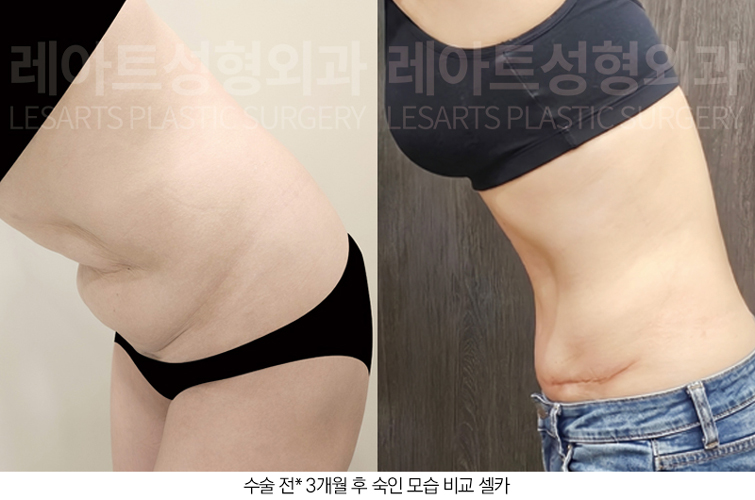
Patient Selfie Comparison: 3 Months After Surgery
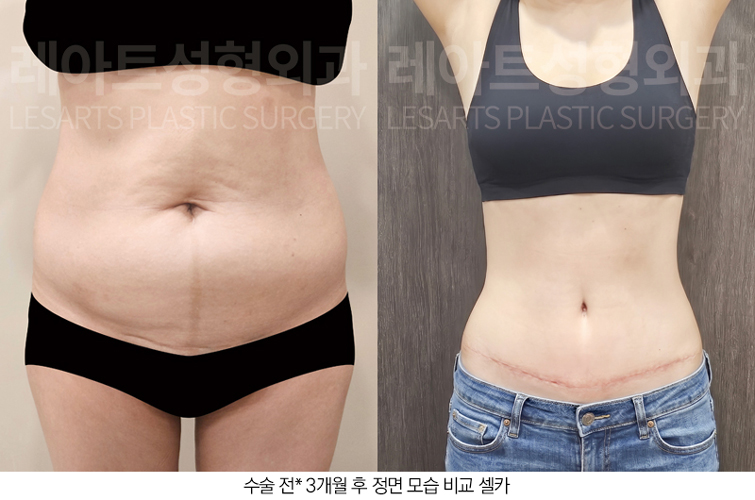
The patient also shared selfie photos
at 3 months after tummy tuck surgery.
Compared to before surgery,
the loose skin below the belly button was improved,
and the lower abdominal protrusion and folding became less noticeable.
The area around the belly button,
which had looked heavy due to skin sagging,
also became cleaner.
The patient was especially satisfied
because the abdominal line no longer looked bulky
or uncomfortable when wearing clothes.
Why M-Type Tummy Tuck Was Needed
This case was not simply about removing belly fat.
The patient needed a customized tummy tuck plan
because several issues had to be corrected together:
- Loose lower abdominal skin
- C-section scar unevenness
- Skin folding above the underwear line
- Rectus diastasis
- Weak abdominal wall support
- Belly button shape change
- Flank and love handle volume
- Overall abdominal contour imbalance
If a patient focuses only on losing more weight in this type of case,
the lower abdominal folds, wrinkles,
or belly button shape change may
become even more noticeable.
For this reason, tummy tuck surgery with rectus muscle repair
and abdominal liposuction was needed to improve
both the skin and the abdominal contour.
Conclusion
After C-section delivery, lower belly sagging
and scar-related unevenness can remain even
when body weight has mostly returned.
If the abdomen does not look smooth because of loose skin,
rectus diastasis, belly button shape change,
or C-section scar folding, diet and exercise alone may have limitations.
In this case, M-Type tummy tuck surgery with abdominal liposuction,
rectus muscle repair, and belly button reshaping helped improve lower abdominal sagging,
C-section scar unevenness, and abdominal contour at 3 months after surgery.
For patients who are concerned about lower belly sagging after childbirth or C-section delivery,
consultation at a trusted plastic surgery clinic or hospital in Gangnam,
Seoul, Korea can help determine the most suitable tummy tuck plan.
At LesArts Plastic Surgery Clinic, each tummy tuck plan
is customized based on the patient’s skin laxity, scar location,
abdominal wall condition, fat distribution, and desired body line.
A customized tummy tuck in Korea may help create a smoother,
firmer, and more balanced abdominal contour.
#Abdominoplasty
#M-type
#Abdominal liposuction(M)


Cases finding
similar to my profile
Customer Diagnostics


Select the surgery and
area you are interestedto see real
before andafter changes.


we
make you,
the art
Clinic hours
MON - FRI
10 am – 7pm
SAT
10 am – 4pm
Holiday
SUN, HOLIDAY
Location
Lesarts Moon Clinic Tower 4-5F, 40, Nonhyeon-ro 168-gil,
Gangnam-gu, Seoul, Republic of Korea

Medical institution name Lesarts Plastic Surgery
Address Lesarts Moon Clinic Tower 4-5F, 40, Nonhyeon-ro 168-gil, Gangnam-gu, Seoul, Republic of Korea
Representative Moon sung jun
