




Online Consultation
Please accurately enter the information below.
Quick Cost Consultation
Quick Consultation & Reservation
Cases finding
similar to my profile






Cases finding
similar to my profile
Customer Diagnostics
Revision Abdominal Liposuction After Weight Gain: 7.5-Month Waistline and Lower Belly Results | Best Liposuction Clinic in Gangnam, Seoul, Korea
2026-07-16
Revision Abdominal Liposuction | Waistline Changes After Becoming Thick Again Following Weight Gain
If you gained weight after abdominal liposuction, is revision surgery possible?
Even in an area that has previously undergone liposuction,
revision surgery can be considered if weight gain
has caused the fat layer to thicken again.
However, because adhesions from the initial surgery, remaining fat volume,
and skin condition all differ, the surgical scope must be decided
only after accurately evaluating the current condition of the abdomen.
▶Lesarts Revision Liposuction Information
In this post, we will share the case of a patient
who underwent abdominal liposuction again
due to weight gain.
The patient had a history of undergoing abdominal liposuction
at another clinic in the past,
but after gaining a significant amount of weight recently,
thickness from around the navel down to the lower abdomen
began to stand out again.
As fat also accumulated along the flanks and above the hips,
her waistline looked less defined than before,
leading her to plan revision abdominal liposuction
to improve the heavy feeling across her entire abdomen.
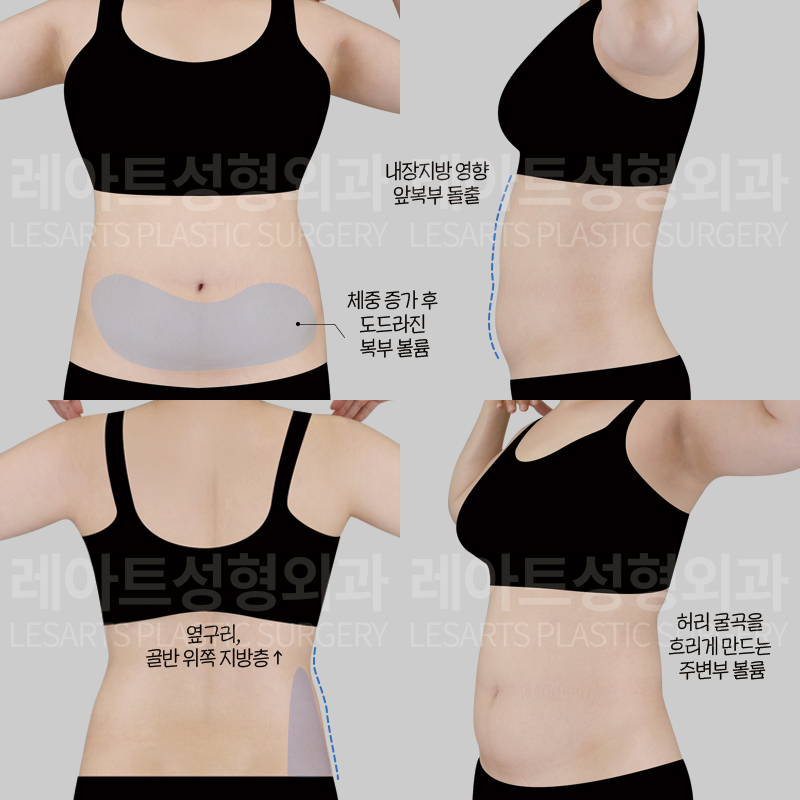
[Pre-Operative Analysis of Waistline and Lower Abdominal Volume Before Revision Abdominal Liposuction]
Before surgery, thickness around the navel and lower abdomen was noticeable,
and the line flowing from the flanks to above the hips
also needed refining.
From the front, lower abdominal volume kept
the boundary between the waist and hips from showing clearly,
while from the side, the front of the abdomen
protruded forward from around the navel down to the lower abdomen.
The fat layer along the lower back and flanks also connected together,
making the width of her torso look broad
and heavy from behind.
Rather than simply making her abdomen as thin as possible,
the patient wanted the area around the navel, lower abdomen, and flanks evenly refined
so that the line from her waist to her hips
would emerge naturally.
However, the forward protrusion of her abdomen was influenced
not only by subcutaneous fat beneath the skin,
but also by visceral fat.
Because abdominal liposuction is a procedure that contours
subcutaneous fat beneath the skin,
it cannot directly remove visceral fat
located inside the abdominal cavity.
Therefore, considering the recovery period needed for the skin and subcutaneous tissue
to adapt to the reduced fat layer after liposuction,
we advised her to focus on body management through diet and exercise
starting around 6 weeks after surgery.
Rather than aggressively reducing a single abdominal area,
this revision surgery was planned to refine thickness around the navel and lower abdomen
while smoothly connecting the fat layers of the flanks, lower back,
and upper hip area.
In particular, to prevent the flanks from indenting abruptly or leaving
a step-off above the hips, we refined the surrounding fat together
so that the overall waistline would flow smoothly.
▶View Abdominal Liposuction Cases
Let's look at how her waistline and lower abdominal thickness changed
through the before-and-after revision abdominal liposuction
photos below.

[Before and 7.5 Months After Revision Abdominal Liposuction: Front-View Comparison of Waistline and Lower Abdomen]
Comparing the front view before surgery and 7.5 months afterward,
thickness from around the navel down to the lower abdomen has decreased,
leaving the central abdomen noticeably more refined.
Flank volume that had extended broadly on both sides also decreased,
allowing the center of the waist to emerge naturally and the line from the waist to the hips
to connect more smoothly than before.
Whereas before surgery lower abdominal and flank thickness
gave her torso a straight, boxy look, after surgery
the waistline tapers inward, making the separation between her upper body
and hips much clearer.
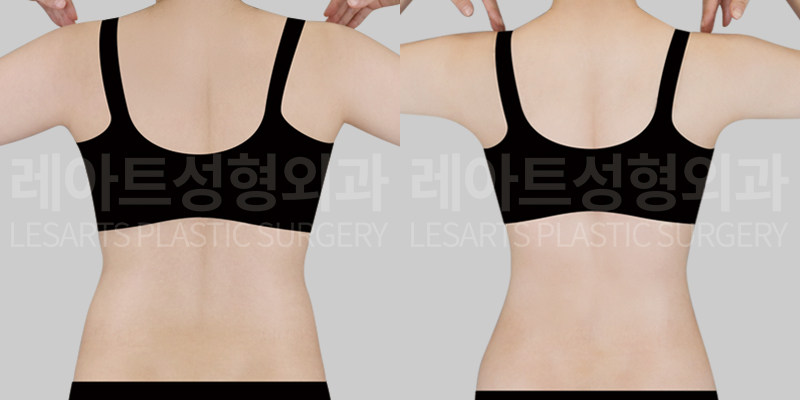
[Before and 7.5 Months After Revision Abdominal Liposuction: Back-View Comparison of Waistline Changes]
In the back view, refining the fat layer extending across the lower back
and above the hips has noticeably reduced
the heaviness of her torso.
Before surgery, the lower back and flanks blended broadly together,
keeping the curve of her waist from showing clearly.
After surgery, the center of the waist curves inward
and thickness above the hips has decreased,
making the boundary between her waist and hips more clearly defined.
With torso width narrowed not only from the front but also from behind,
her overall abdominal contour looks
noticeably lighter.
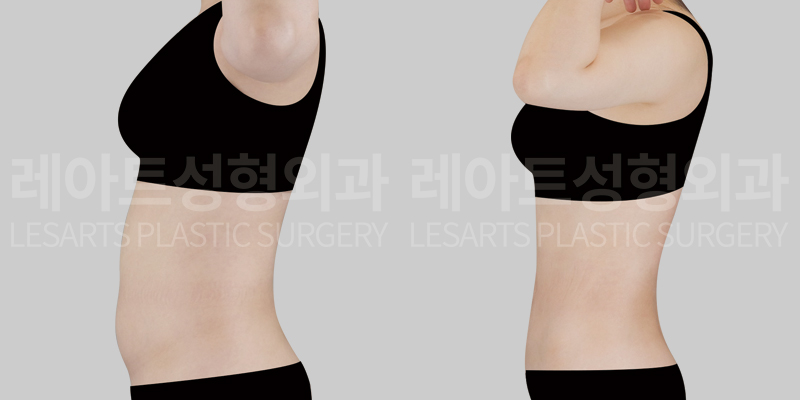
[Before and 7.5 Months After Revision Abdominal Liposuction: Side-View Changes in Abdominal Protrusion]
In the side view, the thickness of the forward-protruding abdomen has decreased,
and the curve flowing from the upper to lower abdomen
is smoother than before.
In particular, reduced volume concentrated in the lower abdomen
makes the front of the abdomen appear much flatter.
Along with contouring the subcutaneous fat layer through liposuction,
the patient's continued weight management after surgery also helped reduce
abdominal protrusion influenced by visceral fat.

[Before and 7.5 Months After Revision Abdominal Liposuction: Oblique-View Changes in Waistline and Lower Abdomen]
From an oblique angle as well, as the flanks tapered inward
and thickness above the hips decreased, her waistline
emerged naturally.
Before surgery, flank and lower abdominal volume blended together,
making her waist curve look dull,
whereas after surgery, front abdominal thickness has decreased
and the line connecting the flanks to the hips looks smoother.
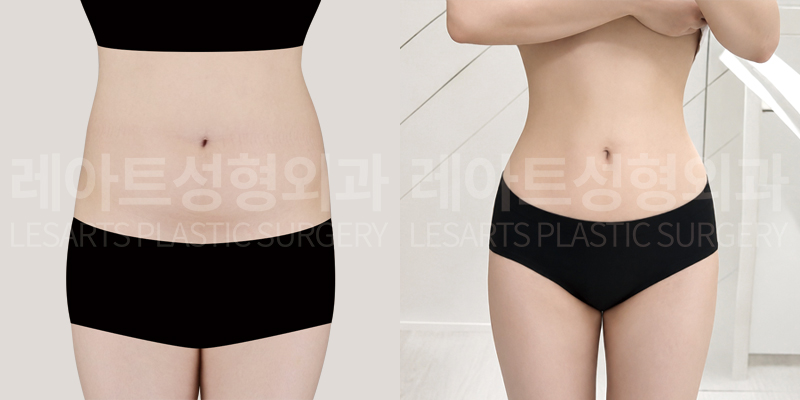
[Revision Abdominal Liposuction: Selfie Comparison Before and 9 Months After Surgery]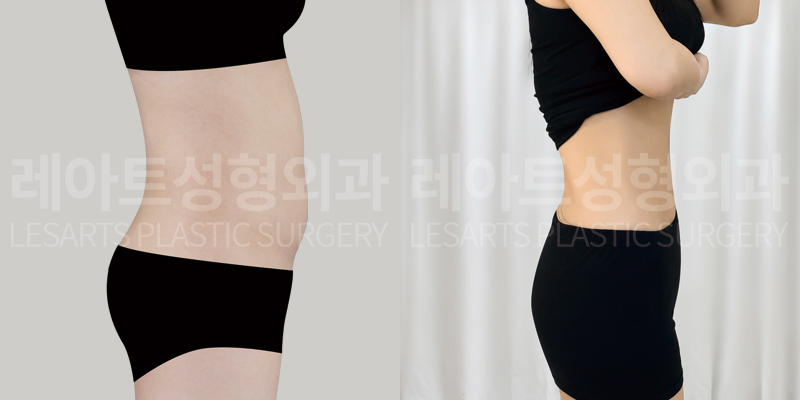
[Revision Abdominal Liposuction: Selfie Comparison Before and 9 Months After Surgery]
In selfies taken 9 months after surgery as well, both her front
and side abdominal contours remain
relatively stable.
From the front, refining around the navel and lower abdomen
revealed a natural waistline, while from the side, reduced front abdominal thickness
allowed fitted clothing to drape more smoothly than before.
Because this was a revision surgery, the patient had worried about unevenness
or step-offs remaining afterward, but she shared that
she is highly satisfied with her abdominal contours after recovery.
While liposuction reduces the number of fat cells in the treated area,
it does not prevent future weight changes.
If weight increases again after surgery, remaining
fat cells can enlarge, causing the abdomen and
surrounding areas to thicken again.
Because swelling and firmness can remain early on,
wearing a compression garment and following the clinic's
recovery care instructions are important,
and once tissues stabilize, maintaining your weight
through diet and exercise is necessary.
In particular, revision abdominal liposuction must account for
adhesions and tissue changes from the previous surgery
as well as remaining fat distribution,
which can make surgical planning more complex
than primary liposuction.
Therefore, rather than aiming solely to remove a large volume,
it is important to make your decision after thoroughly consulting on
the scope that can be safely refined in your current condition
and how your post-operative abdominal contours will connect.
Revision Abdominal Liposuction FAQ
1. If I gain weight after abdominal liposuction, does the fat come back?
Removed fat cells do not regenerate in the same number as before,
but remaining fat cells can grow larger with weight gain.
As a result, the thickness of the abdomen and surrounding areas can increase again.
2. Can an area that previously had liposuction undergo revision surgery?
Revision surgery can be considered depending on remaining fat volume, skin elasticity,
and the degree of tissue adhesion.
Because it is not possible in every case,
your current abdominal condition must first be evaluated through a medical examination.
3. Can abdominal liposuction also remove visceral fat?
Abdominal liposuction is a procedure that contours
subcutaneous fat located beneath the skin.
Because visceral fat inside the abdominal cavity cannot be suctioned directly,
management through diet and exercise is required.
4. Is revision abdominal liposuction more difficult than first-time surgery?
From the previous surgery, adhesions may have formed between the skin and subcutaneous tissue,
or tissues may have become firm.
Because remaining fat must be refined evenly while accounting for these variables,
surgical planning can be more complex.
5. When can I start exercising after abdominal liposuction?
The timing for starting exercise can vary depending on surgical scope
and recovery progress.
It is best to start with light walking early on,
and gradually increase to higher-intensity workouts
under the medical team's guidance
after checking your recovery progress.
#Liposuction
#Abdomen
#Lower abdomen #Upper abdomen #BMIbelow30(Abs)


Cases finding
similar to my profile
Customer Diagnostics


Select the surgery and
area you are interestedto see real
before andafter changes.


we
make you,
the art
Clinic hours
MON - FRI
10 am – 7pm
SAT
10 am – 4pm
Holiday
SUN, HOLIDAY
Location
Lesarts Moon Clinic Tower 4-5F, 40, Nonhyeon-ro 168-gil,
Gangnam-gu, Seoul, Republic of Korea

Medical institution name Lesarts Plastic Surgery
Address Lesarts Moon Clinic Tower 4-5F, 40, Nonhyeon-ro 168-gil, Gangnam-gu, Seoul, Republic of Korea
Representative Moon sung jun
