




Online Consultation
Please accurately enter the information below.
Quick Cost Consultation
Quick Consultation & Reservation
Cases finding
similar to my profile






Cases finding
similar to my profile
Customer Diagnostics
Teenage Gynecomastia That Did Not Go Away Naturally: 2-Week Male Chest Reduction Results | Best Gynecomastia Surgery Clinic in Gangnam, Seoul, Korea
2026-07-23
Gynecomastia Surgery | 2-Week Before & After Chest Size Comparison:
Adolescent Gynecomastia That Did Not Go Away Naturally
Does gynecomastia that develops
during adolescence disappear naturally in adulthood?
Chest changes that appear during puberty sometimes ease with growth,
but true gynecomastia involving developed glandular tissue
can persist even into adulthood.
If front chest protrusion and firm lumps remain
even after exercise or weight loss, it is important to distinguish
between fat and glandular tissue through an ultrasound examination.
When seeing gynecomastia patients,
there is often a considerable gap between when they first noticed symptoms
and when they actually began treatment.
In particular, when the chest starts to enlarge during adolescence,
many assume it is a temporary change during growth
and put off getting examined.
Quite a few also wait for a long time,
expecting it to improve naturally
if they exercise or lose weight.
Pubertal gynecomastia does indeed sometimes decrease in size
as growth finishes.
On the other hand, there are also cases where front chest protrusion
remains unchanged into adulthood or becomes
even more pronounced with weight gain.
Therefore, even if you do not decide on surgery right away,
it is necessary to accurately check the current condition
of the fat and glandular tissue in your chest.
Today, we will share the case of a patient who had been concerned
about chest protrusion and bilateral lumps since adolescence
and underwent **Male Gynecomastia Surgery**
in his 20s.
 [2 Weeks After Male Gynecomastia Surgery: Front Chest Protrusion Changes Seen Through a Short-Sleeve T-Shirt]
Before surgery, his front chest stood out prominently
through a thin short-sleeve T-shirt,
and rounded volume extending to the lower chest
made his upper body feel heavy.
At 2 weeks after surgery, with front chest protrusion reduced,
the T-shirt no longer catches on his chest
and drapes relatively naturally downward.
Although this is still an early recovery stage when swelling and bruising may remain,
the change in chest size and thickness showing through clothing
is already visible.
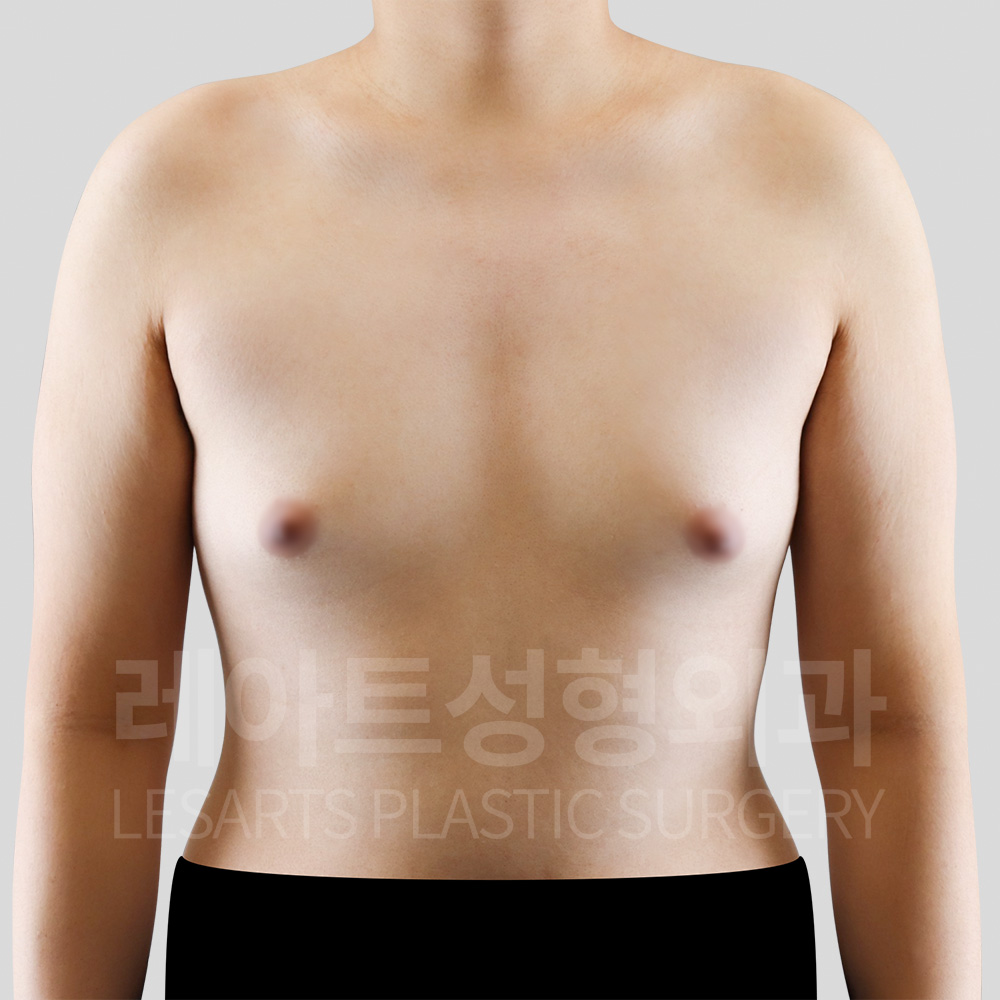
[Pre-Operative Condition: Front Chest Protrusion and Bilateral Lumps Persisting Since Adolescence]
[Patient Information and Gynecomastia Examination Results]
Age: 20s
Height: 183 cm
Weight: 86 kg
Gynecomastia Diagnosis: Simon Grade 2A, True Gynecomastia
Skin Elasticity: Moderate
This was a case in which chest changes that began in adolescence
did not go away naturally and persisted
into his 20s.
In the pre-operative front view, both sides of his chest
were enlarged overall, and forward protrusion at the center
of the front chest was pronounced.
In addition to the visual changes, firm lumps
were palpable on both sides of his chest.
High-resolution ultrasound examination confirmed overdeveloped glandular tissue,
leading to a diagnosis of true gynecomastia rather than
pseudogynecomastia caused simply by accumulated body fat.
Even with similar chest protrusion,
the ratio of fat to glandular tissue
can differ from patient to patient.
Therefore, rather than judging by outward appearance alone,
it is first necessary to distinguish your current condition
through gynecomastia examination and diagnostic methods.
 [Pre-Operative Condition Confirming Front Chest Protrusion, Bilateral Lumps, and Chest Thickness]
In the oblique and side views,
not only central front chest protrusion,
but also thickness extending from the lower chest
to the outer chest was confirmed.
The firm central lumps were caused
by developed glandular tissue,
while subcutaneous fat also contributed considerably
to the rounded volume along the lower and outer chest.
Accordingly, rather than removing only glandular tissue,
we planned the following procedures together:
- Removal of developed glandular tissue
- Liposuction across the entire chest
- Chest contour refinement through tissue repositioning
If only glandular tissue is removed while surrounding fat is left behind,
the center of the front chest can look sunken
or a step-off can appear between areas.
Conversely, if only fat is suctioned, firm glandular tissue remains
and front chest protrusion and lumps may not improve sufficiently.
Therefore, we appropriately removed both glandular tissue and fat,
and evenly repositioned the remaining tissue to create a natural transition
from the center of the chest outward.
Before & After Comparison 2 Weeks After Gynecomastia Surgery
Two weeks after surgery is the time to check overall healing
and remove sutures from the incision sites.
Although it is still too early to judge final results
because residual swelling and bruising may remain,
you can see how much the previously prominent front chest protrusion
and overall chest thickness have changed.
 [2 Weeks After Male Gynecomastia Surgery: Front-View Changes in Front Chest Protrusion]
Before surgery, the center of both sides of the front chest stood out,
and the contour flowing from the lower chest
toward below the underarms also appeared rounded.
At 2 weeks after surgery, as central protrusion and overall chest size
decreased, the chest contour seen from the front
looks noticeably flatter.
Although this is an early stage with some swelling and bruising remaining,
healing appeared stable,
and the shape of both sides of the chest looks relatively balanced.
 [2 Weeks After Male Gynecomastia Surgery:
Side-View Changes in Chest Thickness and Lower Chest Line]
In the side view, the reduction in thickness of the chest
that had previously protruded forward
is even more distinct.
With the firm central glandular tissue and surrounding fat
refined together, the forward-projecting appearance
of the chest has diminished.
The angled protrusion that had formed along the lower chest
has also softened, creating a straighter upper-body line
flowing from below the collarbones down to the abdomen.
 [2 Weeks After Male Gynecomastia Surgery:
Oblique-View Changes in Front Chest Protrusion]
From an oblique angle, you can see that both central front chest
and outer chest volume
have decreased together.
Before surgery, the center projected forward
with rounded volume extending down to the lower chest,
whereas after surgery, the entire chest sits closer to the torso.
By combining tissue repositioning with glandular removal and liposuction,
no single area looks overly sunken,
and the center of the chest blends naturally with surrounding areas.
 [2 Weeks After Gynecomastia Surgery:
Side-View Changes in Front Chest Protrusion Wearing a Short-Sleeve T-Shirt]
Before surgery, even when wearing a T-shirt,
front chest protrusion showed through the fabric,
pushing the shirt outward
at the chest area.
At 2 weeks after surgery, with reduced chest thickness, the T-shirt
no longer catches on his front chest and hangs
relatively naturally along his torso.

[2 Weeks After Gynecomastia Surgery:
Front Chest Contour Changes Seen Through a Short-Sleeve T-Shirt]
From an oblique angle as well, reduced volume in the chest
that had stood out before surgery
makes his upper body feel noticeably lighter.
The patient had been self-conscious about his front chest showing
whenever getting dressed since adolescence,
and expressed satisfaction that his chest now looks natural
even when wearing just a thin short-sleeve T-shirt.
Pubertal Gynecomastia: Is It Okay to Just Wait?
During puberty, hormonal changes can cause temporary breast development,
which sometimes decreases naturally as growth progresses.
Therefore, not every chest change that occurs during adolescence
requires surgery.
However, if any of the following persist for a long period,
it is advisable to get an accurate examination:
- Chest size does not decrease even after growth is complete
- Firm lumps are palpable at the center of the front chest
- Chest protrusion remains even after exercise and weight loss
- One or both sides of the chest remain persistently enlarged
- Chest prominence through thin clothing causes discomfort in daily life
While fat accumulation from weight gain can make the chest look larger,
if glandular tissue has also developed, dieting alone
may not eliminate central front chest protrusion and lumps.
Two Weeks After Gynecomastia Surgery Is Not the Final Result
At 2 weeks after surgery, early changes such as reduced chest size and front protrusion
can be seen,
but recovery is not yet fully complete.
Residual swelling, bruising, and firmness may remain in the chest,
and it takes time for the skin and underlying tissues
to settle into place.
Early on, wear a compression garment as directed by the medical team,
and avoid exercises that place strong strain on the chest
as well as heavy upper-body workouts.
Start with light activity according to your healing progress,
and gradually resume gym or strength training
after confirmation from your medical team.
Because swelling and firmness in the surgical area
gradually soften over several months,
rather than judging your final chest shape from 2-week photos alone,
continue with regular follow-up checks.
Additionally, if you have firm lumps or pain,
do not automatically assume it is gynecomastia—
have an ultrasound examination to rule out other conditions as well.
Adolescent gynecomastia includes both cases that ease naturally
and cases that persist into adulthood.
Therefore, rather than concluding it is simply a “growth-phase change” or
“chest enlargement from weight gain,”
it is important to accurately understand your current condition
and potential treatment options.
Gynecomastia Surgery FAQ
1. Does adolescent gynecomastia disappear naturally in adulthood?
When caused by temporary hormonal changes during puberty,
it can ease with growth.
However, in some cases developed glandular tissue persists
into adulthood, so if there is no change over a long period,
it is advisable to get examined.
2. Can gynecomastia be eliminated through exercise and dieting?
Fat accumulated in the chest can decrease with weight loss,
but developed glandular tissue cannot be removed through exercise alone.
If central front chest protrusion and lumps remain
even after dieting, you should check for glandular tissue.
3. If a firm lump is felt in the chest, is it true gynecomastia?
Developed glandular tissue can feel like a firm lump,
but the cause cannot be confirmed by palpation alone.
An ultrasound examination is needed to evaluate glandular development
and check for the possibility of other conditions.
4. Does gynecomastia surgery only require removing glandular tissue?
This depends on the distribution of glandular tissue and fat.
When surrounding fat is also developed, combining glandular removal
with chest liposuction is needed to naturally refine
overall chest thickness and contour.
5. Can I exercise 2 weeks after gynecomastia surgery?
At 2 weeks, internal tissues are still healing,
so strength training that puts heavy strain on the chest should be avoided.
Generally, patients are advised to check healing progress after one month
and increase workout intensity gradually.
#Male body contouring
#Gynecomastia
#Grade2-A #true gynecomastia


Cases finding
similar to my profile
Customer Diagnostics


Select the surgery and
area you are interestedto see real
before andafter changes.


we
make you,
the art
Clinic hours
MON - FRI
10 am – 7pm
SAT
10 am – 4pm
Holiday
SUN, HOLIDAY
Location
Lesarts Moon Clinic Tower 4-5F, 40, Nonhyeon-ro 168-gil,
Gangnam-gu, Seoul, Republic of Korea

Medical institution name Lesarts Plastic Surgery
Address Lesarts Moon Clinic Tower 4-5F, 40, Nonhyeon-ro 168-gil, Gangnam-gu, Seoul, Republic of Korea
Representative Moon sung jun
