




Online Consultation
Please accurately enter the information below.
Quick Cost Consultation
Quick Consultation & Reservation
Cases finding
similar to my profile






Cases finding
similar to my profile
Customer Diagnostics
Abdominal Liposuction for Stubborn Love Handles: 1.5-Month Waistline Results | Best Liposuction Clinic in Gangnam, Seoul, Korea
2026-07-28
Abdominal Liposuction | Flank Fat That Won't Go Away With Dieting: Waistline Changes After 1.5 Months
Can slim body types also see a change in their waistline through abdominal liposuction?
Even if overall fat volume is not high,
when fat is concentrated in the flanks and around the navel,
the waistline can look flat and undefined.
By evaluating current fat distribution along with ribcage and pelvic structure
and contouring the necessary areas, the line flowing from the waist to the hips
can be made more clearly defined.
▶ Lesarts Liposuction Surgery Information
Among people researching abdominal liposuction,
some think that once they undergo surgery they will no longer
need to diet,
while others think that if they simply lose enough weight,
liposuction will not be necessary.
However, dieting and liposuction do not produce the exact same change—
each plays a different role.
Dieting helps reduce overall body weight and body fat,
but it can have limits when it comes to sculpting stubborn areas
such as the flanks or around the navel into a desired shape.
Conversely, liposuction is not a procedure
that replaces weight loss either.
It is best understood as a method that evaluates where fat is concentrated
and your body-type characteristics, contours the necessary areas,
and supports ongoing body management
afterward.
In this post, we will look at waistline changes after abdominal liposuction
through the case of a patient who had a generally slim build overall
yet was concerned about flank fat that did not come off easily
even with exercise.
Although this patient had a slim figure overall,
what bothered her most was that remaining flank fat
kept her waistline from showing clearly.
She wanted to reduce flank thickness
so that the contour from her waist to her hips
would look more tapered and defined.
[Patient Information]
Height: 160 cm
Weight: 48.8 kg
BMI: 19.1
Although she did not have a large amount of fat overall,
subcutaneous fat was concentrated in her flanks,
making her waistline look spread outward.
Because she had a relatively generous distance between her ribcage and pelvis,
we expected that reducing flank thickness would allow the natural waistline
of her frame to emerge clearly.
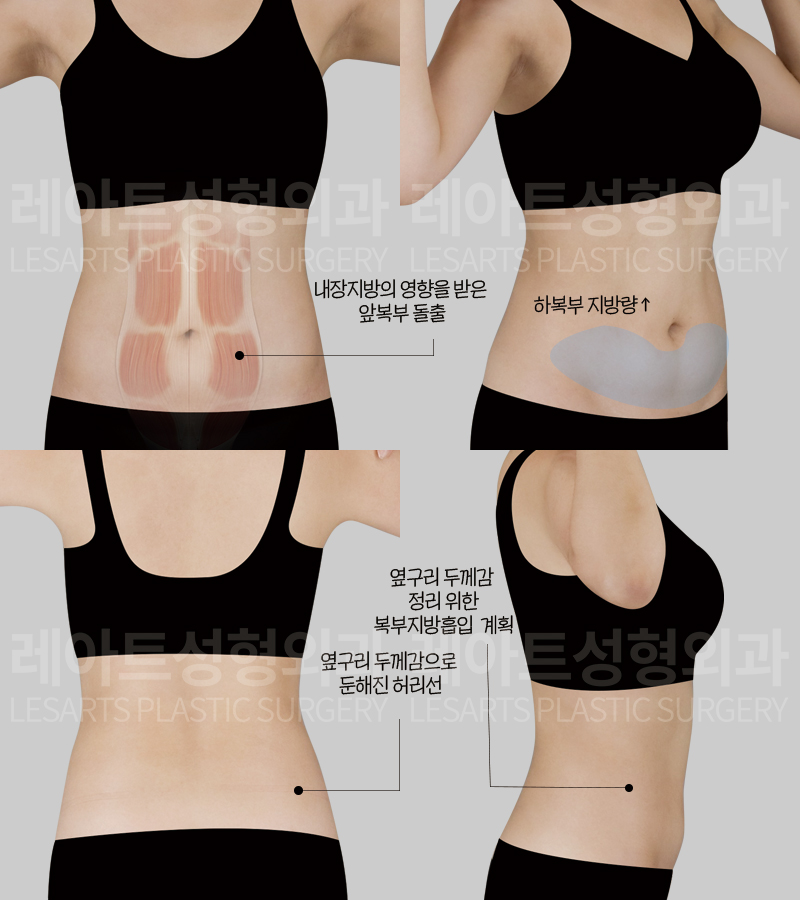
[Pre-Operative Condition: Flat-Looking Waistline Due to Flank Fat Remaining Even After Exercise]
Because the flanks were the patient's primary concern,
we focused on reducing thickness in that area.
However, rather than simply removing a large amount of fat,
it was important to adjust suction depth by area
so that the flow from the waist to the hips would look natural.
Since some left-right skeletal asymmetry was also noted,
rather than removing the exact same amount from both sides,
we planned the surgery to balance her proportions as naturally as possible.
In the front abdomen, protrusion that appeared to be influenced
by visceral fat as well as subcutaneous fat was also observed.
Because visceral fat is not removed through liposuction,
we explained in advance that ongoing lifestyle management—
including diet and exercise—would still be needed after surgery.
▶ View Abdominal Liposuction Before & After Cases
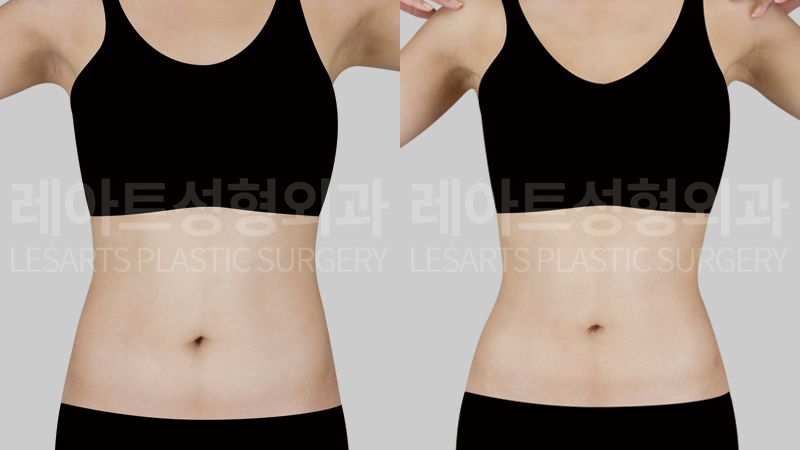
[1.5 Months After Abdominal Liposuction: Front-View Changes in Flanks and Waistline]
Let's look at the changes through photos taken
1.5 months after abdominal liposuction.
Before surgery, flank thickness made her waistline
appear spread outward, whereas after surgery,
reduced volume on both sides revealed
a much more clearly defined waistline.
As the tapered waistline flows naturally into the hips,
her overall body proportions look noticeably more balanced.
Because she had a slim build overall, rather than aggressively
removing excessive fat, we focused on refining
the protruding areas of the flanks so that the natural strengths
of her existing frame
could shine through.
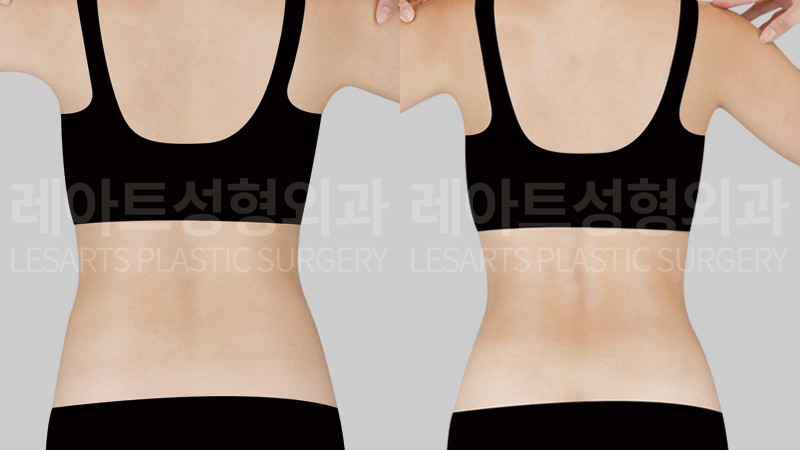
[1.5 Months After Abdominal Liposuction: Back-View Changes in Flanks and Waistline]
In the back view as well, reduced volume on both sides of the waist
allowed her previously hidden hip line to show more naturally than before.
This patient had left-right skeletal asymmetry.
By adjusting suction depth and scope on each side,
we aimed to create a natural sense of balance
without accentuating the existing asymmetry.
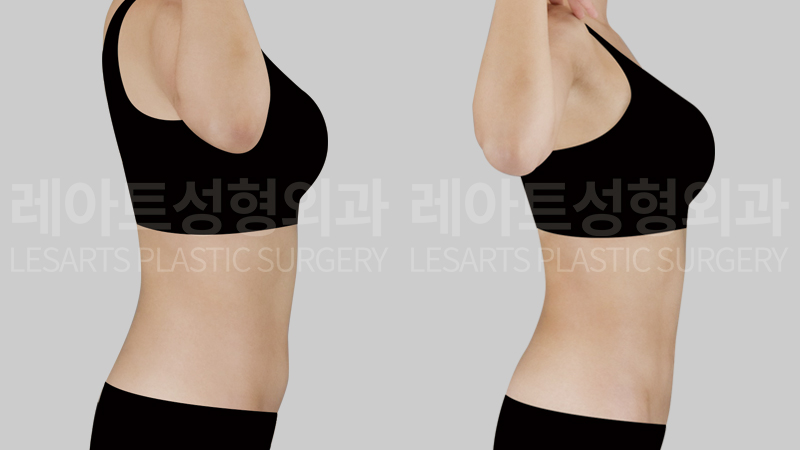
[1.5 Months After Abdominal Liposuction: Side-View Changes in Abdominal Thickness and Lower Abdomen]
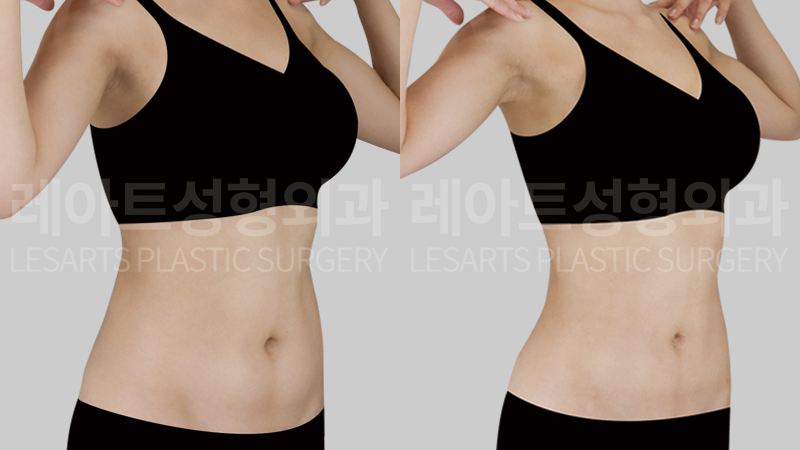
[1.5 Months After Abdominal Liposuction: Oblique-View Changes in Flanks and Waist Curve]
In the side view, changes in both front abdominal and flank thickness are visible together.
Before surgery, the lower abdomen rounded forward,
making the upper body feel somewhat heavy,
whereas after surgery, with subcutaneous fat contoured,
the abdominal contour looks lighter and cleaner than before.
However, because visceral fat also played a role in the front abdomen,
rather than trying to eliminate all protrusion through liposuction,
we focused on refining removable subcutaneous fat
and continuing with lifestyle management afterward.
From an oblique angle, the change in her flanks—
the area that concerned her most—is even clearer.
As the flanks tapered inward, the curve of her waist emerged,
and the hip line below it also became
more naturally accentuated than before.
With the line from the waist to the hips and lower body
connecting smoothly, her overall
body proportions look noticeably lighter.
Although this patient had a slim build overall,
refining stubborn fat in her flanks and around her navel
allowed the natural strengths and proportions
of her frame to stand out.
She also continued paying attention to body management after surgery
through diet and exercise
to care for the front abdomen affected by visceral fat.
Maintaining healthy habits and weight management after abdominal liposuction
can help preserve the refined
waistline over time.
If you are frustrated that flank fat
does not decrease easily despite repeated dieting,
have your current fat distribution, bone structure, and causes of abdominal protrusion
accurately assessed to consult on the surgical direction
best suited to your desired waistline.
▶ Learn About Abdominal Liposuction Methods
Abdominal Liposuction FAQ
1. Can slim body types also undergo abdominal liposuction?
Even if overall body weight is low,
abdominal liposuction can be considered if removable
subcutaneous fat is present in the flanks or around the navel.
Eligibility is determined after checking actual fat thickness
and skin condition.
2. Can flank fat be refined with abdominal liposuction?
When subcutaneous fat concentrated in the flanks makes the waistline look wide,
reducing thickness in that area
can create a more clearly defined waistline.
3. Can liposuction also remove visceral fat?
Abdominal liposuction removes subcutaneous fat located beneath the skin.
Visceral fat located inside the abdomen cannot be removed with liposuction
and requires management through diet and exercise.
4. Is abdominal liposuction possible even with skeletal asymmetry?
While bone structure itself cannot be changed, adjusting fat thickness
and suction depth on each side can be planned
to soften visible outward differences.
5. Do I still need to diet after abdominal liposuction?
Liposuction is not a substitute for weight loss.
Consistently managing diet and exercise after surgery
helps maintain your refined abdominal contours stably.
#Liposuction
#Abdomen
#Lower abdomen #Upper abdomen #BMIbelow20(Abs)


Cases finding
similar to my profile
Customer Diagnostics


Select the surgery and
area you are interestedto see real
before andafter changes.


we
make you,
the art
Clinic hours
MON - FRI
10 am – 7pm
SAT
10 am – 4pm
Holiday
SUN, HOLIDAY
Location
Lesarts Moon Clinic Tower 4-5F, 40, Nonhyeon-ro 168-gil,
Gangnam-gu, Seoul, Republic of Korea

Medical institution name Lesarts Plastic Surgery
Address Lesarts Moon Clinic Tower 4-5F, 40, Nonhyeon-ro 168-gil, Gangnam-gu, Seoul, Republic of Korea
Representative Moon sung jun
