




Online Consultation
Please accurately enter the information below.
Quick Cost Consultation
Quick Consultation & Reservation
Cases finding
similar to my profile






Cases finding
similar to my profile
Customer Diagnostics
Mini Tummy Tuck or Full Tummy Tuck? 1 Year 10 Month Results for Lower Belly Folding | Best Tummy Tuck Clinic in Gangnam, Seoul, Korea
2026-08-19
Tummy Tuck | Lower Belly Folding: How Do You Choose Between a Mini and Full Tummy Tuck?
If only the lower belly looks saggy, is a mini tummy tuck enough?
Even when wrinkles or folds appear concentrated in the lower belly,
the skin sagging may actually extend
from the upper abdomen.
Also, a mini tummy tuck does not necessarily mean
a short incision,
so the surgical method should be decided after assessing where the sagging begins, how much skin needs to be removed,
and the extent of any diastasis recti.
▶ View Lesarts Tummy Tuck Cases
When researching tummy tuck surgery, some people consider
a mini tummy tuck from the outset
because they are concerned about a long incision.
Rather than correcting the entire abdomen, they want
only the folded lower belly skin removed
through a short incision.
However, a mini tummy tuck
does not always leave a shorter scar.
Even if the sagging appears limited to the lower belly,
loose skin from the upper abdomen may actually be descending
and gathering in the lower abdomen.
In addition, the incision length for a tummy tuck
is not determined simply by the name of the procedure,
but also relates to the extent of excess skin
that actually needs to be removed.
Even when sagging is limited to the lower abdomen, a large amount
of skin to remove may require a longer incision than expected.
This patient also initially requested a mini tummy tuck
because she was concerned about a long incision.
However, after examining her abdomen, we determined
that an M-Type full tummy tuck was needed.
 [Before Surgery: Skin Sagging Above the Belly Button and Lower Abdominal Condition]
[Patient Information]
Age: 40s
Height: 163 cm
Weight: 52.9 kg
BMI: 19.9
The patient had experienced two vaginal deliveries,
as well as significant weight changes and previous abdominal liposuction.
Judging by her overall body shape, she did not have
a particularly large amount of abdominal fat.
The main concern was the condition of her skin and abdominal wall rather than fat.
Her skin had lost elasticity and was sagging loosely from the upper abdomen,
while diastasis recti allowed the abdominal wall to push forward,
making her abdomen look disproportionately bulky for her frame.
In particular, when she bent forward, the excess skin
shifted down toward the lower belly,
making the multiple layers of folds even more noticeable.
Why a Full Tummy Tuck Was Chosen Instead of a Mini Tummy Tuck
The procedure the patient initially wanted
was an S-Type mini tummy tuck.
However, examination showed that treating only the area below the belly button
would not be sufficient to achieve her desired changes.
Because the skin was sagging from the upper abdomen,
tightening only the lower abdominal skin would leave
the excess skin above the belly button untreated.
Her diastasis recti was also not limited
to the lower belly, so repair extending
to the upper abdomen was needed as well.
We therefore explained that an S-Type mini tummy tuck alone
would have difficulty sufficiently correcting both skin sagging above the belly button
and diastasis recti in the upper abdomen.
After a thorough consultation, we ultimately decided on an M-Type full tummy tuck
combined with abdominal wall plication and belly button correction.
Ultimately, what mattered for this patient was not simply
keeping the incision short,
but how comprehensively we could improve
the abdominal concerns that actually bothered her.
▶ View More Tummy Tuck Before & After Cases
 [1 Year 10 Months After Tummy Tuck: Front-View Changes in Skin Around the Belly Button and Lower Abdominal Contours]
Let's compare her appearance
1 year and 10 months after surgery.
Before surgery, loose skin around the belly button
extended downward, creating uneven contours
from the upper to the lower abdomen.
After surgery, with the excess skin removed, the abdominal contour
flows much more naturally from above the belly button
to the lower belly.
Creases around the belly button have also decreased,
and with the downward-sagging skin addressed,
the center of the abdomen looks flatter and less bulky than before.
Remaining fat around the belly button and waistline
was also reduced through abdominal liposuction.
In addition, the belly button, which had widened horizontally due to skin sagging,
was reshaped vertically and positioned in the center of the abdomen,
allowing the waistline to appear more natural.
 [1 Year 10 Months After Tummy Tuck: Side-View Changes in Abdominal Protrusion and Lower Abdominal Contours]
The side view shows more clearly how rectus muscle repair
has changed the shape of the front abdomen.
Before surgery, the abdominal wall pushed forward,
giving the entire abdomen a rounded, protruding shape.
During surgery, the separated rectus muscles were brought together with sutures
to restore abdominal wall support, creating a firmer contour
from the upper to the lower abdomen.
In particular, with less forward projection of the lower belly,
the front abdomen has a flatter profile
when viewed from the side.
 [1 Year 10 Months After Tummy Tuck: Changes in Lower Abdominal Skin Sagging and Folding When Bending Forward]
This patient's skin sagging
was especially noticeable when she bent forward.
Before surgery, bending forward caused the loose skin
to gather toward the lower belly and form deep folds.
The abdominal wall also lacked support,
appearing to bulge downward as if spilling forward.
After surgery, even when bending forward, the excess skin
that gathered in the lower belly is greatly reduced, and the previously protruding
abdominal wall remains firmer than before.
 [1 Year 10 Months After Tummy Tuck: Lower Abdominal Incision Scar Healing]
One of the patient's biggest concerns before surgery
was scarring.
Choosing a full tummy tuck also meant accepting
a longer incision than a mini tummy tuck.
After surgery, she continued regular laser toning treatments
focused on the lower abdominal incision and the area around the belly button.
In the photo taken 1 year and 10 months later,
the scar can be seen fading from both ends.
The incision is also positioned where it is naturally covered by underwear,
and the patient said the scar causes very little discomfort
or concern in her daily life.
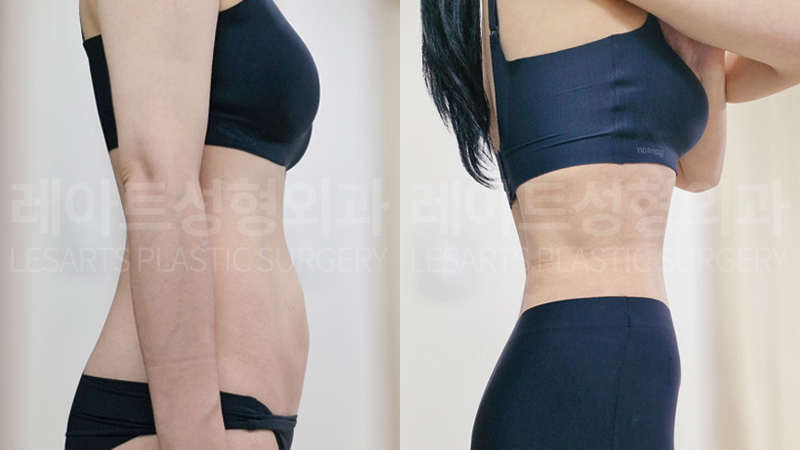
[Selfie Comparison: Before vs. 2 Months After Tummy Tuck]
Early changes are also visible
in photos taken by the patient herself.
Before surgery, the lower abdominal skin pushed forward,
giving the center of the abdomen a thick appearance.
Two months later, lower abdominal volume has decreased,
and the waistline looks noticeably less bulky.
Although this is still early in recovery and the surgical area has not fully settled,
the abdomen already appears firmer
even in everyday postures.
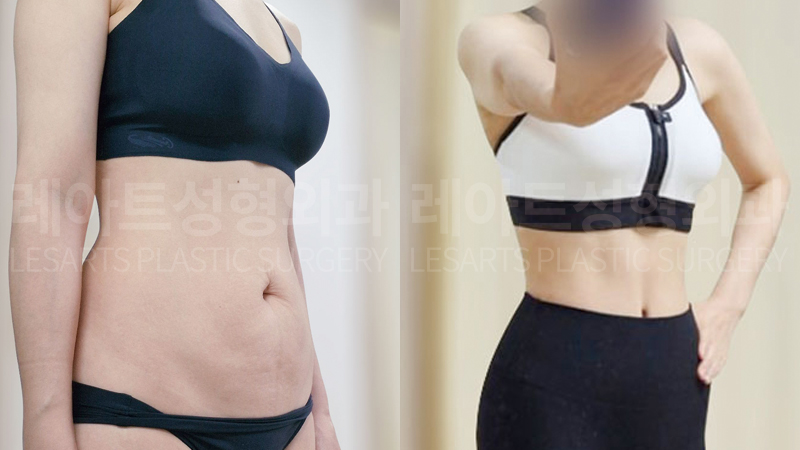
[Selfie Comparison: Before vs. 5 Months After Tummy Tuck]
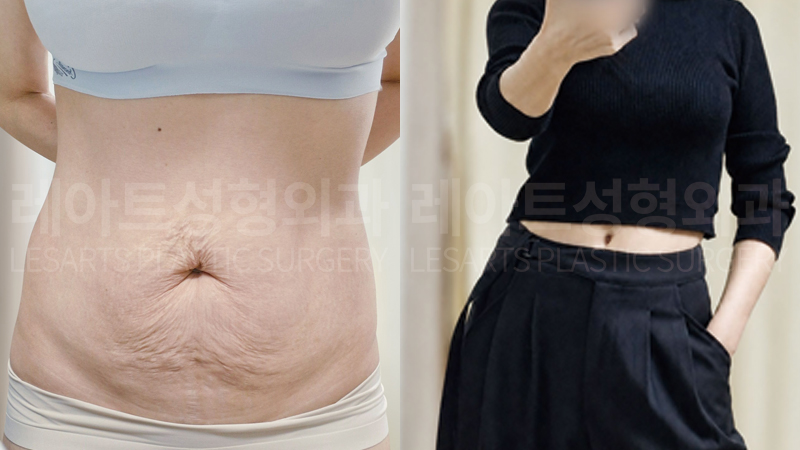
[Selfie Comparison: Before vs. 5 Months After Tummy Tuck]
At 5 months after surgery, the abdominal contour
has settled into a more natural appearance.
The patient's own photos also show that the previously
loose, sagging skin around the belly button and lower belly has been reduced,
with the waist curve appearing more natural than before.
The reduction in central abdominal thickness and
skin folding is especially noticeable even in everyday clothing.
At her initial consultation, this patient wanted a mini tummy tuck
because she was concerned about a long incision.
However, examination of her abdomen showed
that the sagging was not limited to the lower belly.
Skin that had lost elasticity extended
downward from the upper abdomen.
Diastasis recti was also present in both the upper and lower abdomen,
making it difficult for an S-Type mini tummy tuck alone
to sufficiently address the full extent of her concerns.
We therefore performed an M-Type full tummy tuck together with abdominal wall plication and belly button correction.
At 1 year and 10 months, the excess skin
around the belly button and lower belly had been reduced,
and there was a significant reduction in the lower abdominal skin
that previously formed multiple folds when she bent forward.
Rectus muscle repair also provided firmer support to the previously protruding abdominal wall,
while the lower abdominal incision, one of the patient's biggest concerns,
was healing in a position
concealed by underwear.
With tummy tuck surgery, the priority is not simply
choosing the procedure with the shortest incision.
What matters first is how fully the areas
that concern you most can actually be corrected.
Even if only the lower belly appears saggy,
the skin may actually be loose from the upper abdomen downward,
and the necessary surgical method also depends
on how far the diastasis recti extends.
If you are deciding between a mini and full tummy tuck,
rather than comparing incision lengths first,
have an accurate assessment of where the skin sagging begins,
how much excess skin needs to be removed,
and whether the abdominal wall also needs repair
before deciding on the necessary scope of surgery.
▶ View More Lesarts Tummy Tuck Cases
Mini & Full Tummy Tuck FAQ
1. If only my lower belly sags, should I have a mini tummy tuck?
Even if sagging appears concentrated in the lower belly,
skin laxity may actually extend from the upper abdomen.
The surgical method should be decided after assessing
where the sagging begins and how far it extends.
2. Does a mini tummy tuck always leave a short scar?
Not necessarily.
If a large amount of lower abdominal skin needs to be removed
or the sagging extends over a wide area, the incision may also be longer.
3. Can a mini tummy tuck also repair diastasis recti in the upper abdomen?
The extent of correction possible depends on the surgical method
and the current condition of the abdominal wall.
This patient had diastasis recti extending to the upper abdomen,
so an M-Type full tummy tuck was chosen.
4. Does a full tummy tuck also involve creating a new belly button shape?
An M-Type full tummy tuck involves extensive repositioning of the skin,
so reshaping the belly button and adjusting its position
may also be necessary.
5. Do tummy tuck scars fade over time?
Scar healing varies from person to person.
This patient received regular laser toning treatments
along the incision and around the belly button,
and at 1 year and 10 months,
the scar could be seen fading from both ends.
#Abdominoplasty
#M-type


Cases finding
similar to my profile
Customer Diagnostics


Select the surgery and
area you are interestedto see real
before andafter changes.


we
make you,
the art
Clinic hours
MON - FRI
10 am – 7pm
SAT
10 am – 4pm
Holiday
SUN, HOLIDAY
Location
Lesarts Moon Clinic Tower 4-5F, 40, Nonhyeon-ro 168-gil,
Gangnam-gu, Seoul, Republic of Korea

Medical institution name Lesarts Plastic Surgery
Address Lesarts Moon Clinic Tower 4-5F, 40, Nonhyeon-ro 168-gil, Gangnam-gu, Seoul, Republic of Korea
Representative Moon sung jun
