




Online Consultation
Please accurately enter the information below.
Quick Cost Consultation
Quick Consultation & Reservation
Cases finding
similar to my profile






Cases finding
similar to my profile
Customer Diagnostics
M-Type Full Tummy Tuck After C-Section: 2-Month and 1 Year 2 Month Lower Belly Results | Best Tummy Tuck Clinic in Gangnam, Seoul, Korea
2026-08-24
Tummy Tuck | Lower Belly Sagging After C-Section Delivery: 2-Month and 1 Year 2 Months Changes
[ If your lower belly remains saggy and protruding after childbirth, is a full tummy tuck necessary? ]
Even if sagging appears concentrated in the lower belly,
if actual skin laxity extends from the upper abdomen
or diastasis recti is also confirmed,
a method that corrects only the lower abdomen
may not achieve the desired level of improvement.
It is important to determine the necessary tummy tuck scope
by checking the range of skin sagging, belly button position,
and abdominal wall condition together.
▶ View Lesarts Tummy Tuck Cases
After going through pregnancy and childbirth,
abdominal changes that were not there before can remain.
Skin stretched during pregnancy may not fully recover
after delivery and sag toward the lower belly,
or a forward-protruding feel may not easily improve
even when engaging the abdominal muscles.
If these changes remain even after continuing weight management and exercise,
it is worth checking whether it is simply a matter of remaining fat
or whether changes in the skin and abdominal wall are also present.
After a C-section delivery, this patient was most concerned about
skin sagging appearing concentrated below her belly button
and lower belly volume.
After undergoing an M-Type full tummy tuck,
let's compare her early progress at 2 months
with her appearance more than 1 year later at 1 year and 2 months.
 [Before Surgery: Lower Abdominal Skin Sagging and Lower Belly Volume]
[Patient Information]
Age: 40s
Height: 155 cm
Weight: 56.2 kg
BMI: 23.4
The patient had a history of C-section delivery,
and felt most uncomfortable about her lower abdomen
sagging below her belly button.
Looking at her pre-operative photos, fat and stretched skin
were concentrated in the lower abdomen,
making her lower belly look large and heavy.
Although her abdominal wall was not severely pushed forward,
diastasis recti was confirmed, and skin sagging
did not start only in the lower belly,
but continued downward from the upper abdomen.
Because her belly button position was also relatively low,
we determined it was necessary to correct the entire abdomen together
rather than refining only the visible lower belly.
[ Why a Full Tummy Tuck Was Chosen Even Though Her Main Concern Was the Lower Belly ]
Although the area that bothered the patient most was her lower abdomen,
actual diagnosis showed that skin sagging began in the upper abdomen.
In addition, because diastasis recti was confirmed together,
simply reducing lower belly fat or skin alone would make it difficult
to sufficiently refine the overall abdominal shape.
Accordingly, we planned the surgery to repair stretched skin
and the abdominal wall through an M-Type full tummy tuck,
while combining abdominal liposuction to reduce
remaining volume together.
In this way, for a tummy tuck, rather than deciding the scope
based only on the spot that looks most saggy on the outside,
you must check where skin stretching begins,
as well as rectus muscle condition and belly button position together.
▶ View More Lesarts Tummy Tuck Before & After Cases
 [Tummy Tuck Recovery: Front-View Comparison at 2 Months and 1 Year 2 Months]
Let's compare her front-view appearance before surgery,
at 2 months, and at 1 year and 2 months.
Before surgery, skin and volume gathered below the belly button,
making her lower abdomen feel heavy.
At 2 months, as sagging skin and lower belly volume greatly decreased,
the line flowing from above the belly button to the lower abdomen became much smoother.
With volume on both sides of the waist reduced as well,
a natural waist curve that had not stood out before emerged.
In the photo taken 1 year and 2 months later as well,
you can see these changes maintained stably without losing shape.
 [Tummy Tuck at 2 Months & 1 Year 2 Months: Side-View Lower Belly Changes]
From the side view, the improvement in the lower belly
that bothered the patient most is even clearer.
Before surgery, the area below her belly button
protruded roundly forward.
By removing stretched skin
and combining abdominal liposuction with abdominal wall repair,
you can see lower belly thickness and protrusion
clearly reduced starting from 2 months after surgery.
Even at that early stage, the front abdomen flowing from upper to lower abdomen
was refined much more firmly and smoothly than before,
and this line remains well maintained at 1 year and 2 months.
 [Tummy Tuck at 2 Months & 1 Year 2 Months: Oblique-View Progress Comparison]
From the oblique view as well, volume concentrated in the lower belly decreased,
and you can see the line flowing from the waist to the lower abdomen
transformed naturally.
Although 2 months after surgery is still an early recovery stage, the forward-bulging
and downward-sagging area was already greatly refined.
Even more than 1 year later, the flat abdominal shape
and waist curve remain stably maintained.
The patient also expressed great satisfaction that her biggest concern—her lower belly—was refined,
eliminating the stress she used to feel when getting dressed.
 [1 Year 2 Months After Tummy Tuck: Lower Abdominal Incision Scar Status and Position Covered by Underwear]
When considering a tummy tuck, something patients worry about
just as much as the results is the incision scar.
This patient also has a tummy tuck incision line on her lower abdomen,
positioned so that it can be concealed inside her underwear.
The incision line that looked red in the early post-operative period
has gradually faded in color starting from both ends over 1 year and 2 months of healing,
settling much more naturally.
Because scar remodeling does not stop immediately
once 1 year has passed, it can continue to change gradually
through ongoing maturation afterward.
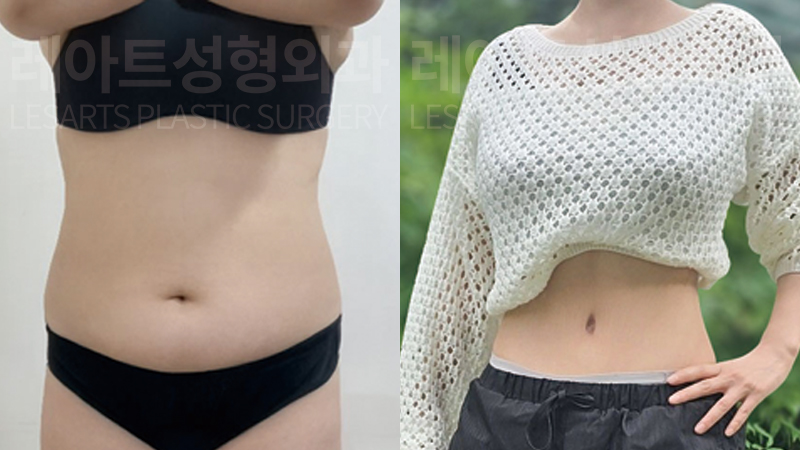
[Selfie Comparison: Before vs. 6 Months After Tummy Tuck]
Not only in standardized before-and-after photos taken at the clinic,
but also in everyday photos sent directly by the patient,
the transformation in her abdomen is clearly visible.
Before surgery, her lower belly protruded forward
with volume concentrated below her belly button.
Six months later, with her lower abdomen lightly refined,
her waistline emerges naturally.
In the selfie on page 4 in particular, even when wearing a cropped top,
you can see that the forward-pushing feel of her lower belly has decreased
and her waist curve looks natural.
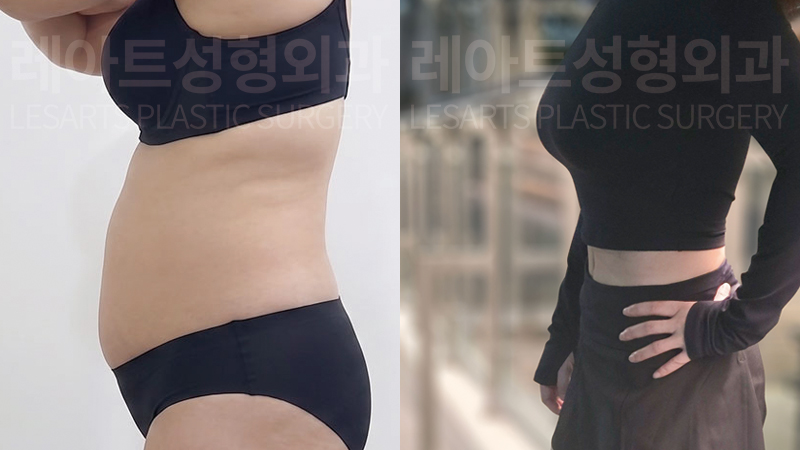
[Selfie Comparison: Before vs. 9 Months After Tummy Tuck]
In everyday photos 9 months later as well, the improvement
in her front abdomen continues stably.
Whereas before surgery her lower belly stuck out from the side
making her entire abdomen feel heavy,
9 months later, it flows much more flatly from the upper abdomen to the lower abdomen.
The patient shared that her most satisfying change was how beautifully
her waistline now shows when wearing cropped tops
or fitted clothes compared to before.
This patient was most concerned about her saggy, protruding lower belly
remaining below her belly button after a C-section delivery.
Although the lower abdomen looked like the main issue on the outside, actual diagnosis
showed that skin sagging continued from the upper abdomen,
along with diastasis recti and a low belly button position.
Accordingly, we repaired stretched skin and the abdominal wall
through an M-Type full tummy tuck combined with abdominal liposuction.
Starting from 2 months after surgery, the thickness of her forward-protruding lower belly
greatly decreased and her waistline emerged naturally,
and at 1 year and 2 months as well, we confirmed that the abdominal line
flowing from upper to lower abdomen remained stably maintained.
The patient was also very pleased that her lower belly—her biggest source of clothing stress—was refined,
allowing her waistline to look natural
even in cropped or fitted outfits.
A tummy tuck is not a surgery that simply cuts away
visible lower belly skin alone.
The necessary surgical scope must be decided by checking
where skin sagging begins, how the shape and position of the belly button have changed,
and what condition the rectus muscles are in.
This is precisely why, even when the area that bothers you most
is the lower belly—as with this patient—
actual diagnosis may show that a full tummy tuck
is needed.
Therefore, if you are considering a tummy tuck,
rather than deciding on incision length or surgical scope in advance,
we recommend accurately checking the condition of your abdominal skin and abdominal wall first
and consulting on the surgical method suited to you.
▶ View More Lesarts Tummy Tuck Cases
Tummy Tuck FAQ
1. Can a full tummy tuck be needed even if only the lower belly looks saggy?
Yes, it can. Even if visible sagging is concentrated in the lower abdomen,
if actual skin laxity continues from the upper abdomen,
overall skin redraping and correction may be needed.
2. If diastasis recti is present, can it be repaired together with a tummy tuck?
If diastasis recti is confirmed while planning a tummy tuck,
abdominal wall repair can be considered together depending on your current abdominal wall condition.
3. Are changes clearly visible even 2 months after a tummy tuck?
In this case, even at the 2-month mark,
we could see that lower belly protrusion and thickness
had greatly decreased.
However, because it is still an early recovery stage,
the abdominal line and scar continue to settle afterward.
4. Are tummy tuck results maintained even after more than 1 year?
For this patient, even at 1 year and 2 months,
the abdominal line flowing from upper to lower abdomen
remained stably maintained.
Long-term maintenance of results can be influenced by
weight fluctuations and lifestyle habits.
5. How does a tummy tuck scar look after 1 year?
Although scar healing varies by individual,
in this case, over 1 year and 2 months,
the color gradually faded starting from both ends
and settled much more naturally.
#Abdominoplasty
#M-type
#Abdominal liposuction(M)


Cases finding
similar to my profile
Customer Diagnostics


Select the surgery and
area you are interestedto see real
before andafter changes.


we
make you,
the art
Clinic hours
MON - FRI
10 am – 7pm
SAT
10 am – 4pm
Holiday
SUN, HOLIDAY
Location
Lesarts Moon Clinic Tower 4-5F, 40, Nonhyeon-ro 168-gil,
Gangnam-gu, Seoul, Republic of Korea

Medical institution name Lesarts Plastic Surgery
Address Lesarts Moon Clinic Tower 4-5F, 40, Nonhyeon-ro 168-gil, Gangnam-gu, Seoul, Republic of Korea
Representative Moon sung jun
