




Online Consultation
Please accurately enter the information below.
Quick Cost Consultation
Quick Consultation & Reservation
Cases finding
similar to my profile






Cases finding
similar to my profile
Customer Diagnostics
Thigh Liposuction With Low Skin Elasticity: 4-Month Inner Thigh and Saddlebag Results | Best Liposuction Clinic in Gangnam, Seoul, Korea
2026-08-25
Thigh Liposuction | Thighs With Reduced Skin Elasticity: Is High-Volume Liposuction Okay?
If there is a lot of thigh fat, is it best to suction as much as possible?
Even if there is plenty of removable fat in the thighs,
unconditionally suctioning a large amount does not
always lead to a good result.
When skin elasticity is reduced or skeletal characteristics
are prominent, over-removing fat can cause
sagging or wrinkling,
or even make the leg shape look awkward,
so it is necessary to distinguish between areas to reduce sufficiently and areas where needed volume should be preserved.
▶ Learn About Lesarts Thigh Liposuction
Every time they look in the mirror,
“If only my inner thighs and saddlebags
were a little slimmer, my legs would look so much thinner.”
is a regret many people feel.
Because of this, when researching thigh liposuction,
it is easy to think that removing as much fat as possible from problem areas
will naturally create long, slender
legs.
However, in actual thigh liposuction,
just as important as the amount of fat that can be suctioned
is examining current skin elasticity, bone structure, and muscle shape
together.
In particular, if fat is removed excessively when skin elasticity is poor,
even though thigh thickness itself decreases,
remaining skin can sag or look wrinkled,
making the overall contour look less appealing.
Therefore, for this body type, rather than suctioning a large amount
equally across all areas, it is important to design the surgery by dividing
areas that should be sufficiently reduced from areas where volume must be preserved
for a natural shape.
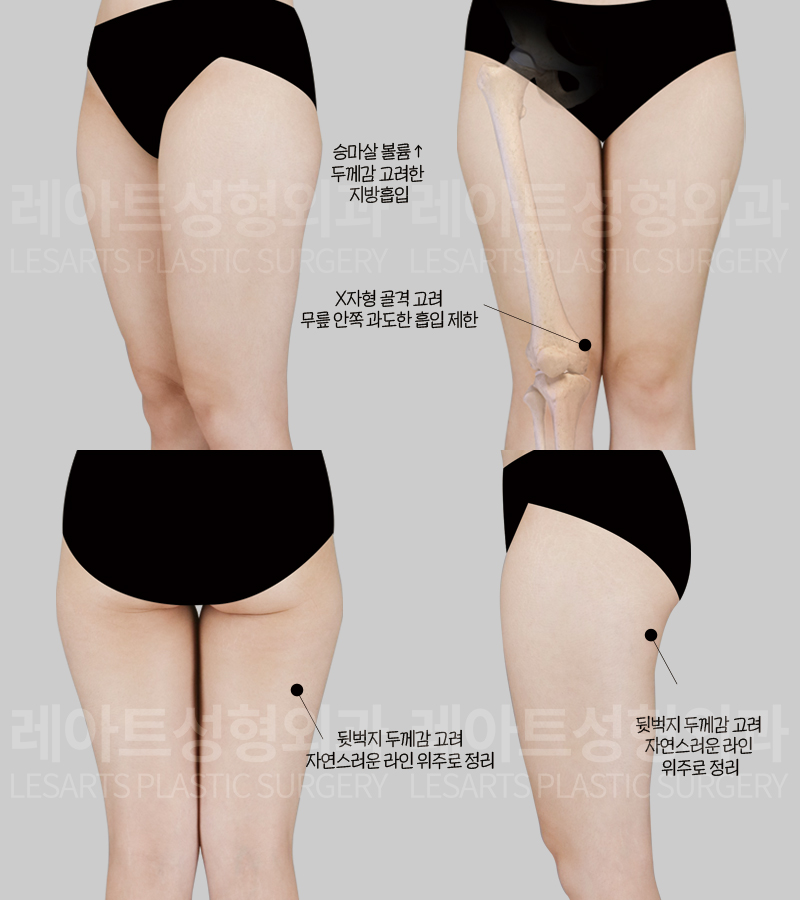
[Before Thigh Liposuction: Assessment of Inner Thigh and Saddlebag Lines]
This patient's biggest concerns were her inner thighs
and saddlebags.
Overall, she wanted to reduce thigh thickness
and achieve slim, straight legs flowing cleanly from top to bottom.
[Patient Information]
Age: 20s
Height: 169 cm
Weight: 55 kg
BMI: 19.3
From the front view before surgery, due to inner thigh fat,
both legs pressed together with no gap,
and saddlebags stood out on the outer sides.
Because of this, the horizontal width of her upper thighs looked relatively wide,
making her legs feel short and heavy compared to her actual frame.
[Surgical Plan Considering Both Skin Elasticity and X-Shaped Bone Structure]
Although the patient had plenty of fat in her thighs that could be refined,
her skin elasticity was not very strong despite being in her 20s.
For this reason, we had to avoid making every area as thin as possible
just because there was a lot of fat.
This is because over-removing fat right beneath the skin
can prevent the skin from contracting smoothly into the emptied space,
potentially causing sagging or wrinkling.
Another important factor we examined
was her X-shaped (knock-kneed) skeletal structure.
If inner thigh fat were unconditionally removed as much as possible,
the inward-angling bone structure would be directly exposed,
moving her further away from the straight legs she wanted.
Therefore, we reduced inner thigh thickness enough to create a gap,
while adjusting suction depth differently by location
so the area above the inner knees would not dip inward all at once.
For the saddlebags, we sufficiently reduced the outward-protruding thickness,
and for the back thighs as well, considering her current fat volume and skin condition,
we planned to refine them just enough without causing excessive hollowing.
▶ View More Thigh Liposuction Before & After Cases
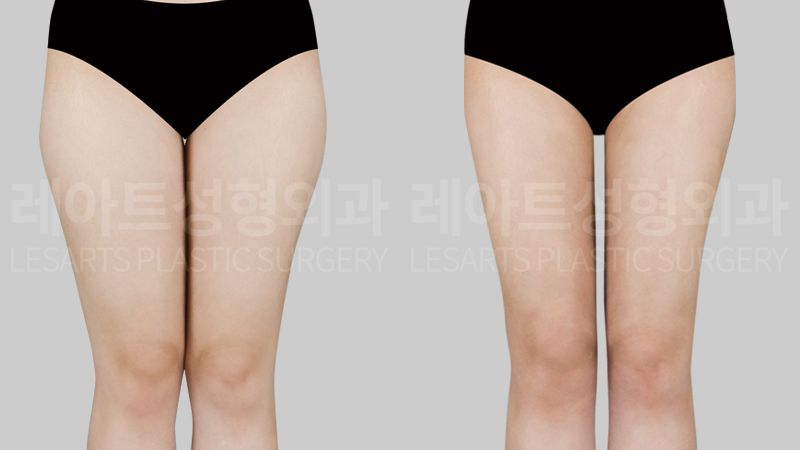
[4 Months After Thigh Liposuction: Front-View Changes in Inner Thighs and Saddlebag Line]
Let's compare her photos 4 months after surgery.
The first thing that catches the eye is the transformation
of her previously touching inner thighs.
Before surgery, her inner thighs pressed together widely from the top,
but 4 months later, as volume in that area decreased,
a natural gap was created.
In particular, because we adjusted suction volume by location rather than
unconditionally removing inner fat deeply,
you can see a straight line flowing naturally from top to bottom
without overly exposing her X-shaped bone structure.
With the outer saddlebags reduced as well,
the horizontal width of her upper thighs narrowed.
As a result, the starting point of her legs appears higher than before,
and along with slimmer thighs overall, her legs
look noticeably longer.
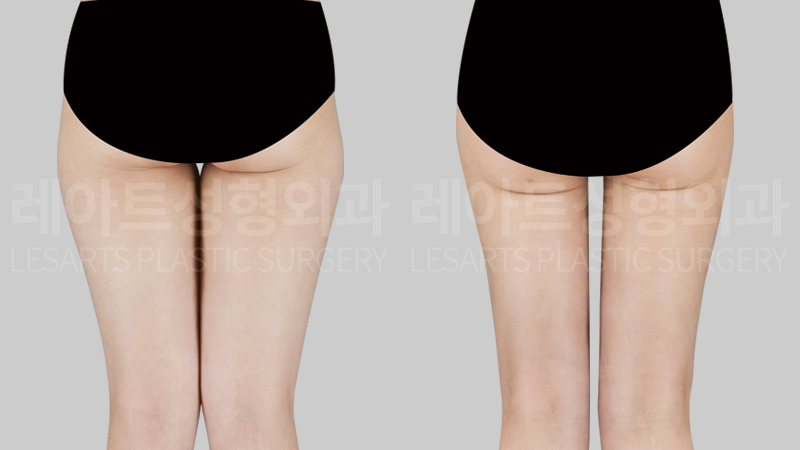
[4 Months After Thigh Liposuction: Back-View Changes in Back Thighs and Under-Buttock Line]
From the back view as well, as inner thigh width decreased,
you can see her entire legs flowing straighter and lighter than before.
In this surgery, we did not simply remove a large amount
of fat from the back thighs.
This is because over-removing fat from the back thighs and under the buttocks
when skin elasticity is reduced can leave loose skin
or cause the under-buttock crease to hollow awkwardly.
Therefore, we refined only the necessary amount suited to her current thickness
so that the line flowing from under the buttocks to the thighs
would remain natural.
In the 4-month photo as well, you can see a smooth transition into her slimmer thigh circumference
without any sudden hollowing beneath the buttocks
or irregular skin folding.
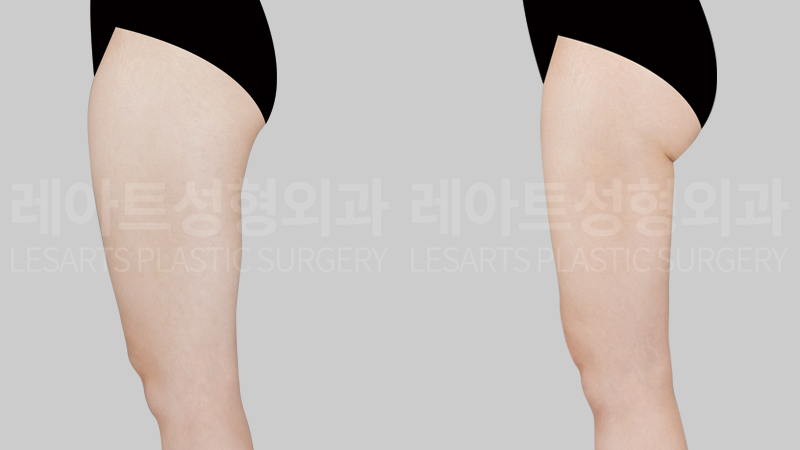
[4 Months After Thigh Liposuction: Outer Line Changes from Saddlebags to Thighs]
From the side view, the improvement in the saddlebags
that bothered the patient most is even clearer.
Before surgery, compared to her overall frame,
the area connecting her upper thighs to her hips
protruded thickly outward.
Four months later, as volume in this area decreased,
overall thigh circumference became lighter, and the boundary between her hips and thighs—
previously hidden by fat—emerges more naturally than before.
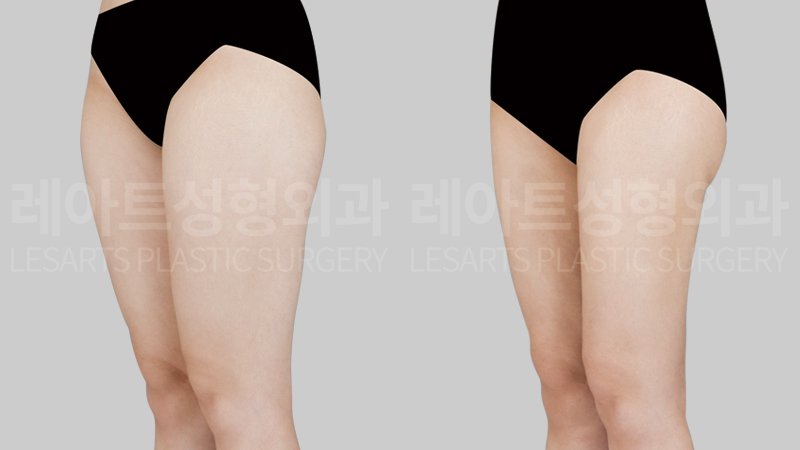
[4 Months After Thigh Liposuction: Thickness Changes from Front Thighs to Above the Knees]
From an oblique angle, you can also see that the thickness
of her front thighs has decreased.
If only upper thigh volume is reduced while leaving the area above the knees untouched,
an abrupt step-off can appear in the middle of the legs.
For this patient, while avoiding over-reducing the inner knees due to her X-shaped bone structure,
we adjusted overall thickness so it flows naturally from the front thighs to above the knees.
As a result, you can see a slimmer, straighter leg line in both front
and oblique views without any specific area dipping inward.
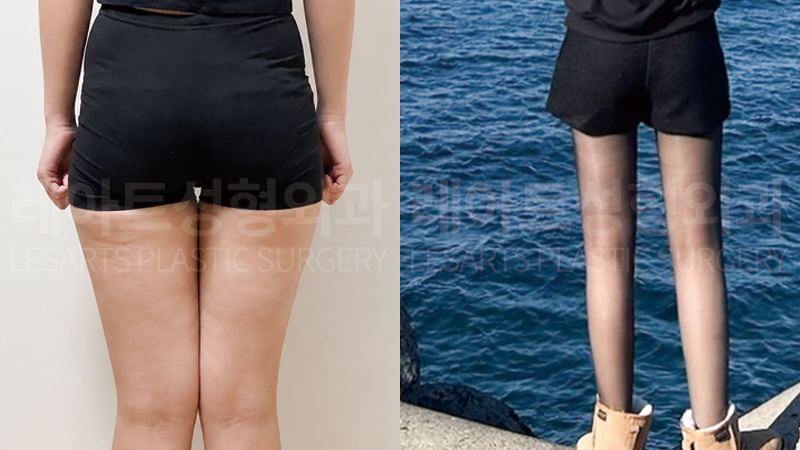
[Selfie Comparison: Before vs. 2 Months After Thigh Liposuction]
Even in photos taken directly by the patient,
you can clearly see the overall transformation of her legs.
At 2 months, as initial swelling subsided to some extent,
a gap formed between her previously touching inner thighs,
and saddlebag thickness also decreased.
Even in everyday postures, as upper thigh horizontal width narrowed,
her legs look noticeably slimmer and longer than before.
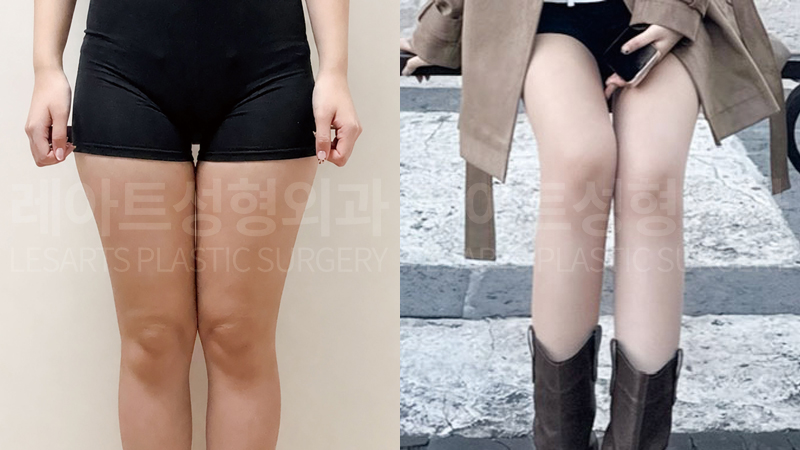
[Selfie Comparison: Before vs. 4 Months After Thigh Liposuction]
At 4 months after surgery, as her inner thighs and saddlebags
settled even more naturally, her overall leg line stabilized further.
The patient also expressed great satisfaction that her two biggest concern areas were refined
and her legs look slimmer and longer than before.
In particular, she shared that as thigh thickness decreased,
her everyday leggings and pants fit differently, and she could feel
her slimmer leg line even more clearly
when getting dressed compared to before surgery.
When researching thigh liposuction, hearing that you have plenty of fat
can make you want to remove as much as possible.
However, although this patient had sufficient fat, her skin elasticity was not strong
and she also had an X-shaped skeletal structure, making it a case where deciding ‘how much to remove for a natural look’
was more important than ‘how much can we remove.’
While sufficiently reducing the inner thighs and saddlebags to lighten upper thigh thickness,
we adjusted suction levels around the inner knees so her bone structure would not stand out excessively.
For the back thighs as well, we preserved necessary volume
to prevent skin sagging or an unnatural under-buttock crease.
As a result, 4 months later, a natural gap formed between her inner thighs
without highlighting her X-shaped bone structure,
and reducing her saddlebags narrowed upper thigh width significantly.
We could also confirm the slim, longer-looking,
straighter leg transformation the patient desired.
Even if thigh thickness bothers you, rather than making high-volume liposuction itself
the goal, it is important to examine current skin elasticity, bone structure, and muscle shape
together to decide which areas should be sufficiently reduced
and which areas should retain some fat.
If you have a lot of thigh fat but worry about skin sagging,
or want to reduce inner thigh fat and saddlebags while creating straight legs,
we recommend planning your surgical direction after thoroughly consulting
on the possible changes and limits for your current body type.
▶ View More Lesarts Thigh Liposuction Cases
Thigh Liposuction FAQ
1. If I have a lot of thigh fat, is it okay to remove as much as possible?
Suction volume is not decided by fat amount alone.
When skin elasticity is reduced, excessive removal
can cause sagging or wrinkling,
so suction volume must be adjusted by area.
2. Can I get thigh liposuction even if my skin elasticity is not good?
After checking the current degree of sagging and skin condition, surgery can be planned
by distinguishing areas where fat should be sufficiently reduced
from areas where superficial volume should be preserved.
3. Can X-shaped legs also look straight with liposuction?
While contours emphasized by fat can be adjusted,
bone structure itself cannot be changed with liposuction.
Removing too much fat can actually make
an X-shaped bone structure stand out more, so suction range must be carefully adjusted.
4. Can removing a lot of saddlebag fat cause the buttocks to sag?
Over-removing fat in the area connecting the buttocks and thighs
carries a risk of making the boundary look awkward
or sagging.
It is important to refine only the necessary range
according to current fat distribution.
5. Can you see the final leg line 4 months after thigh liposuction?
In this case, at 4 months, volume in the inner thighs
and saddlebags had decreased, and a straighter
leg line was clearly and stably
visible.
#Liposuction
#Thigh
#BMIbelow20(thigh)


Cases finding
similar to my profile
Customer Diagnostics


Select the surgery and
area you are interestedto see real
before andafter changes.


we
make you,
the art
Clinic hours
MON - FRI
10 am – 7pm
SAT
10 am – 4pm
Holiday
SUN, HOLIDAY
Location
Lesarts Moon Clinic Tower 4-5F, 40, Nonhyeon-ro 168-gil,
Gangnam-gu, Seoul, Republic of Korea

Medical institution name Lesarts Plastic Surgery
Address Lesarts Moon Clinic Tower 4-5F, 40, Nonhyeon-ro 168-gil, Gangnam-gu, Seoul, Republic of Korea
Representative Moon sung jun
