




Online Consultation
Please accurately enter the information below.
Quick Cost Consultation
Quick Consultation & Reservation
Cases finding
similar to my profile






Cases finding
similar to my profile
Customer Diagnostics
Full Tummy Tuck After Twin Pregnancy: 1-Year Lower Belly Sagging and Scar Results | Best Tummy Tuck Clinic in Gangnam, Seoul, Korea
2026-08-27
Tummy Tuck | Lower Belly Sagging After Twin Delivery: 1-Year Changes in Scar and Abdominal Line
For a stretched lower belly after giving birth to twins, should I get a full tummy tuck despite a long scar?
A tummy tuck requires an incision of a certain length
to sufficiently remove stretched skin. However, rather than deciding the surgical scope
based solely on scar length, you need to check how far the skin has stretched,
how much the abdominal wall has loosened, and what level of improvement
you desire.
Even for abdomens that look similar, the necessary scope of correction and incision length
can vary depending on the condition of the skin, fat, and muscle layers.
▶ View Lesarts Tummy Tuck Cases
When considering a tummy tuck, something that worries patients
just as much as how much stretched skin can improve
is the scar remaining after surgery.
This is because a tummy tuck directly removes sagging skin,
requiring a relatively long incision.
On the other hand, if you have been stressed for a long time by lower belly folding
or skin sagging remaining after childbirth,
some patients place greater weight on whether stretched skin can be sufficiently refined
rather than unconditionally keeping the scar
as short as possible.
This patient was also a woman in her 30s whose biggest concern
was abdominal skin sagging remaining after giving birth to twins.
Let's look step by step at her pre-operative abdominal condition, surgical plan,
and how her skin sagging and scar changed 1 year after her tummy tuck.

[Before Tummy Tuck: Abdominal Sagging After Twin Delivery]
The patient did not have a body type
with a very large amount of overall abdominal fat.
However, skin was loosely stretched from around the belly button to the lower belly,
and further down, excess skin gathered in one area,
making folding very noticeable.
In particular, the lower abdomen was not simply bulging from fat,
but had stretched excess skin gathered together,
giving a strong overall heavy and sagging feel.
Her abdominal wall had also stretched significantly during pregnancy.
Even when engaging her core, the center did not hold firmly,
and it pushed forward and spread widely.

[Before Tummy Tuck: Surgical Plan Considering High Belly Button Position and Abdominal Wall Condition]
Rather than unconditionally keeping the incision scar short,
the patient placed greater importance on sufficiently improving
the abdominal sagging remaining after childbirth.
Therefore, rather than limiting the surgical scope,
we decided to sufficiently refine the skin that had lost elasticity
and sagged downward through a full tummy tuck.
Rather than stopping at just pulling the skin,
we planned to restore support to the stretched abdominal wall
through rectus muscle plication.
In addition, because the existing belly button overlaps with the excised skin range
when shifting skin widely, we also planned to perform umbilicoplasty
to match the new abdominal position.
Finally, so that the upper and lower abdomen connect naturally
and the waistline is smoothly refined after the tummy tuck,
we also combined abdominal liposuction.

[1 Year After Tummy Tuck: Changes in Lower Abdominal Skin Sagging and Around the Belly Button]
Let's compare her front-view appearance 1 year after surgery.
Before surgery, skin stretched loosely from around the belly button to the lower belly,
bulging forward.
One year later, with excess skin refined,
the area from around the belly button to the lower abdomen flows much more smoothly.
Deep creases created by overlapping skin on the lower belly were also removed,
and stretch marks on the lower abdomen included within the sagging skin
were also refined along with the excised range.

[1 Year After Tummy Tuck: Changes in Lower Belly Protrusion and Waistline]
From the side view, the improvement from repairing the abdominal wall together is even clearer.
Before surgery, as the stretched abdominal wall pushed forward,
the center of her abdomen looked loose and spread out.
After plicating the rectus muscles to restore abdominal wall support,
the center of her front abdomen is refined much more firmly than before.
With abdominal liposuction performed together, not only front abdominal volume
but also the area around the waist was lightly refined, making the line flowing from upper to lower abdomen
much more natural.

[1 Year 1 Month After Tummy Tuck: Changes in Lower Abdominal Skin Sagging and Folding When Bending Forward]
Postpartum skin sagging often appears much more clearly
when bending forward than when standing upright.
For this patient as well, before surgery, bending forward caused excess skin
to gather heavily downward with gravity, folding her lower belly.
At 1 year and 1 month after surgery, this excess skin has greatly decreased,
so the skin no longer hangs downward as before even when bending forward.
Even when posture changes, you can see that her front abdomen
remains much firmer.

[1 Year 1 Month After Tummy Tuck: Side-View Changes in Lower Abdominal Protrusion and Front Abdominal Line]
From the side view, the front abdomen that had bulged forward before surgery
flows much more flatly and smoothly than before.
In addition to refining excess skin and the abdominal wall through the tummy tuck,
combining liposuction allowed the thickness from the upper abdomen
to the lower abdomen to connect naturally.
With unnecessary volume in the flanks and love handles also reduced,
the curve flowing from the waist to the hips
became much slimmer and softer.

[1 Year After Tummy Tuck: Lower Abdominal Incision Scar Healing Status]
One of the things patients worry about most with a tummy tuck
is the long incision scar.
This is because a horizontal incision line remains on the lower abdomen
in order to sufficiently remove stretched skin.
This patient steadily monitored her progress after surgery
and continued necessary treatments and aftercare.
One year later, you can see that the color of the scar has faded significantly compared to the early stage,
and the incision line is settling stably.
Because aftercare is just as important as the surgery itself for scars,
it is best to continue care suited to the scar's condition
while observing long-term progress.

[Selfie Comparison: Postpartum · Before Surgery · 1 Month After Surgery]
The transformation is also clearly visible in everyday photos taken directly by the patient.
Before surgery, stretched skin and volume remaining in the lower abdomen
made the line flowing from the waist to the lower belly feel somewhat bulky.
One month after surgery, her waistline tapered inward
and flowed smoothly down to her lower belly,
revealing a much more natural waist curve
even when wearing fitted clothes.
The patient also expressed great satisfaction that she can directly feel
her trimmer, firmer waistline when getting dressed in daily life.
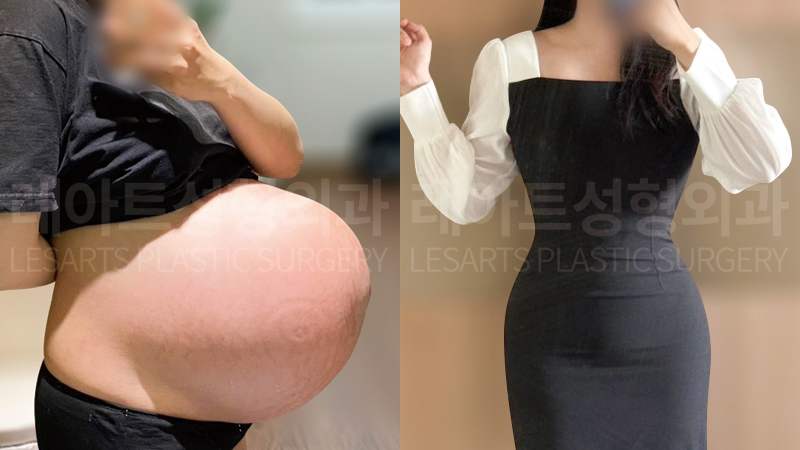
[Selfie Comparison: Abdomen During Pregnancy · 1 Month After Surgery]
In the final photo, you can compare her greatly stretched abdomen during pregnancy
with her figure after tummy tuck surgery.
Because her abdominal skin and abdominal wall stretched significantly during her twin pregnancy,
skin sagging and abdominal protrusion remained even after her weight stabilized postpartum.
After surgery, with both stretched skin and the abdominal wall refined together,
a completely different line was created from her waist to her lower belly.
When abdominal skin stretches and folds down over the lower belly
after giving birth to twins,
losing weight alone may not bring
the level of improvement desired.
This patient did not have a large amount of overall fat either,
but skin was loosely stretched from around the belly button to the lower abdomen,
and her abdominal wall was also very relaxed, causing her front abdomen to push forward without support.
Above all, rather than keeping the scar short,
the patient prioritized sufficiently refining the abdominal sagging
that had remained for a long time after childbirth.
Accordingly, we removed stretched skin through a full tummy tuck
and performed rectus muscle plication, umbilicoplasty, and abdominal liposuction together.
One year after surgery, loose skin and folding extending from around the belly button to the lower belly
had decreased, and even when bending forward,
the skin no longer hung downward as before.
With the abdominal wall refined together, her previously forward-pushing front abdomen became much flatter,
and a waistline flowing naturally through the flanks and love handles was created.
In addition, the lower abdominal incision scar—which she worried about most before surgery—
gradually faded in color and settled stably
through steady follow-up and care over 1 year.
In this way, rather than deciding on a tummy tuck based solely on scar length,
it is important to examine the remaining range of skin sagging, abdominal wall condition,
and your desired degree of change together.
If lower belly skin sagging or abdominal protrusion still remains even after sufficient time has passed
and your weight has stabilized postpartum,
we recommend first checking whether it is simply a fat issue
or whether changes in the skin and abdominal wall remain together.
▶ View Lesarts Tummy Tuck Cases
Tummy Tuck FAQ
1. Can sagging skin after giving birth to twins be reduced through dieting?
While body fat can decrease with weight loss,
skin itself that has lost elasticity and stretched during pregnancy
may not recover as much as desired.
If abdominal wall laxity is also present,
there may be limits to changing abdominal shape through exercise alone.
2. Is a tummy tuck scar very long?
Incision length varies depending on the range of stretched skin being removed.
Rather than unconditionally keeping the scar short, it is important to decide on a scope
that sufficiently corrects current skin sagging
while creating a natural abdominal line.
3. Why is rectus muscle plication performed together?
If the abdominal wall has stretched after pregnancy and childbirth
and the front abdomen pushes forward without support, a bulging look
may remain even if only skin is removed.
Depending on abdominal wall condition, the rectus muscles can be repaired together.
4. Is umbilicoplasty also needed for a full tummy tuck?
Because the position and shape of the existing belly button change
when shifting and excising skin widely,
umbilicoplasty can be performed together so it sits naturally in its new position.
5. Does a tummy tuck scar still remain after 1 year?
While the incision scar itself remains, its color and thickness
can change over time.
In this case, through 1 year of follow-up
and aftercare, we confirmed that the scar faded
and settled stably.
#Abdominoplasty
#M-type


Cases finding
similar to my profile
Customer Diagnostics


Select the surgery and
area you are interestedto see real
before andafter changes.


we
make you,
the art
Clinic hours
MON - FRI
10 am – 7pm
SAT
10 am – 4pm
Holiday
SUN, HOLIDAY
Location
Lesarts Moon Clinic Tower 4-5F, 40, Nonhyeon-ro 168-gil,
Gangnam-gu, Seoul, Republic of Korea

Medical institution name Lesarts Plastic Surgery
Address Lesarts Moon Clinic Tower 4-5F, 40, Nonhyeon-ro 168-gil, Gangnam-gu, Seoul, Republic of Korea
Representative Moon sung jun
