




Online Consultation
Please accurately enter the information below.
Quick Cost Consultation
Quick Consultation & Reservation
Cases finding
similar to my profile






Cases finding
similar to my profile
Customer Diagnostics
L-Type Extended Tummy Tuck After Pregnancy and Weight Loss: 5.5-Month Sagging and Scar Results | Best Tummy Tuck Clinic in Gangnam, Seoul, Korea
2026-09-15
Extended Tummy Tuck | Postpartum Sagging Belly: Scar Changes 5.5 Months After L-type Surgery
Q. If abdominal skin after childbirth is stretched and folded all the way to the flanks,
is an extended tummy tuck needed rather than a standard tummy tuck?
A. If skin sagging extends broadly beyond the upper and lower abdomen
out to the flanks, the range of skin requiring correction
also becomes larger.
In such cases, not only the extent of skin sagging, but also diastasis recti
and subcutaneous fat condition must be checked together
to determine the necessary tummy tuck scope.
[ Learn More About Lesarts Tummy Tuck Surgery ]
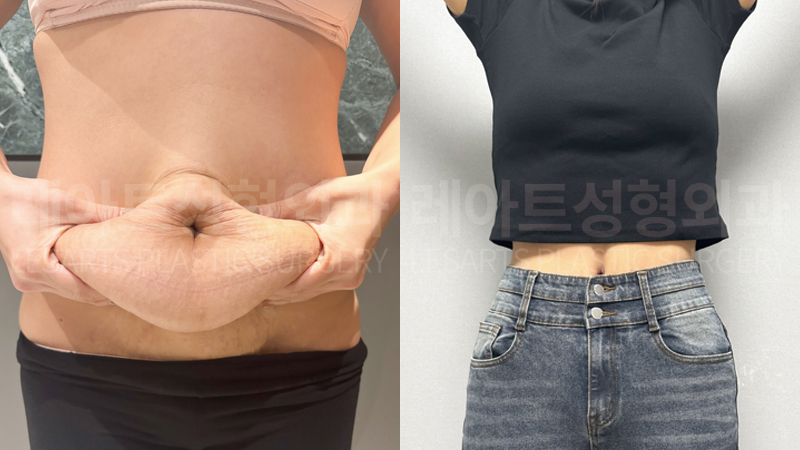
[Postpartum Abdominal Sagging: Selfie Comparison Before vs. 3 Months After Tummy Tuck]
Even when patients want to remove loose abdominal skin through a tummy tuck,
many hesitate to make a decision because of the long incision scar
that remains after surgery.
During consultations as well, we thoroughly explain scarring
and guide patients to decide after carefully considering
the surgical scope and recovery process.
In particular, when an extended tummy tuck—where the incision extends above the hip bones—
is needed, concerns about scarring inevitably grow even larger.
During the long recovery process, laser care can be performed for tummy tuck scars,
and because the speed at which scars settle and fade
can vary depending on skin condition,
consistently following the recommended scar care routine
is also very important.
In this post, we will explain the case of a patient who was worried
about the long tummy tuck incision scar due to concerns
about keloid-prone skin.

[Before Tummy Tuck: Remaining Abdominal Skin Sagging After Childbirth and Weight Changes]
The patient was in her 30s
and had severe remaining abdominal skin sagging
after giving birth to three children and experiencing major weight changes.
Although she had lost a lot of weight after childbirth,
skin that had lost elasticity and stretched from her upper to lower abdomen
remained, making her abdominal bulk look even larger.
As her upper abdominal skin sagged downward, her belly button had been deformed into an inverted V shape,
and its position had also dropped lower.
In addition, as skin sagging and pushing down from above
gathered toward the lower belly,
the excess skin folded deeply
all the way out to her flanks.
Furthermore, diastasis recti was also present across
both her upper and lower abdomen.
Because of this, her front abdomen appeared to protrude forward,
and the central abdomen also looked loosely spread
to the left and right.

[Surgical Plan Considering Abdominal Skin Sagging and Diastasis Recti]
The patient's skin sagging was not limited to her lower belly alone.
Skin was stretched across both the upper and lower abdomen,
and excess skin folded deeply out to the flanks.
Therefore, we explained that an L-type extended tummy tuck was needed
to improve the extensive upper and lower abdominal skin sagging
while removing the excess skin extending to the flanks.
In addition, not only skin sagging, but also diastasis recti
and subcutaneous fat were affecting her current abdominal shape,
requiring simultaneous correction.
Because the patient was worried about having keloid-prone skin,
she decided on surgery after carefully considering
the wide surgical scope and long incision scar.
Before surgery, we thoroughly explained scar prevention at the incision site
along with treatments and care that might be needed
during the recovery process.

[5.5 Months After Tummy Tuck: Changes in Lower Abdominal Skin Sagging and Long Incision Scar]
This is how she looks 5.5 months after surgery.
Before surgery, heavy skin folding over her flanks and bikini line
gave her entire lower belly
a heavy appearance.
After surgery, with this excess skin removed,
you can see her lower belly line smoothed out flatly.
As the extensive skin sagging spanning from the upper abdomen to the lower abdomen and flanks
was corrected together,
the overall shape of her front abdomen also changed dramatically.
Where subcutaneous fat and diastasis recti had previously hidden her waistline
and made her central abdomen look spread apart,
after surgery her waistline is clearly defined
and her abdomen now flows
firmly and smoothly.

[Changes in Lower Belly Protrusion, Waistline, and Belly Button Shape]
We also corrected her belly button, which had been deformed into an inverted V shape
and dropped downward due to upper abdominal skin sagging.
After surgery, a new vertically oriented belly button was created
and positioned to match her waistline height.
As the extensively stretched skin was tightened and the curve of her waistline emerged,
the shape of her central abdomen also changed completely compared to before.

[5.5 Months After Tummy Tuck: Changes in Lower Abdominal Skin Sagging and Folding When Bending Forward]
Before surgery, when bending forward, the loose skin
shifted heavily downward with gravity,
creating a deep fold in the lower belly.
After surgery, with the long-hanging excess skin
removed,
you can see that the heavy shifting and folding of skin
when bending forward has been greatly reduced.

[5.5 Months After Tummy Tuck: Lower Abdominal Incision Scar Recovery Status]
This patient underwent an L-type extended tummy tuck
to correct a wide range of skin sagging extending out to the flanks.
Because the range of skin to be corrected was wide,
the incision line also remained relatively long,
extending above the hip bones.
We designed the incision location as low on the lower abdomen as possible
so that it could be naturally covered
when wearing underwear.
This photo was taken 5.5 months after surgery,
and some redness in the scar is still noticeable.
However, no keloid formation—which the patient had worried about before surgery—
appeared,
and compared to her 3–4 month follow-up, we confirmed that the scar color
is gradually fading and settling.
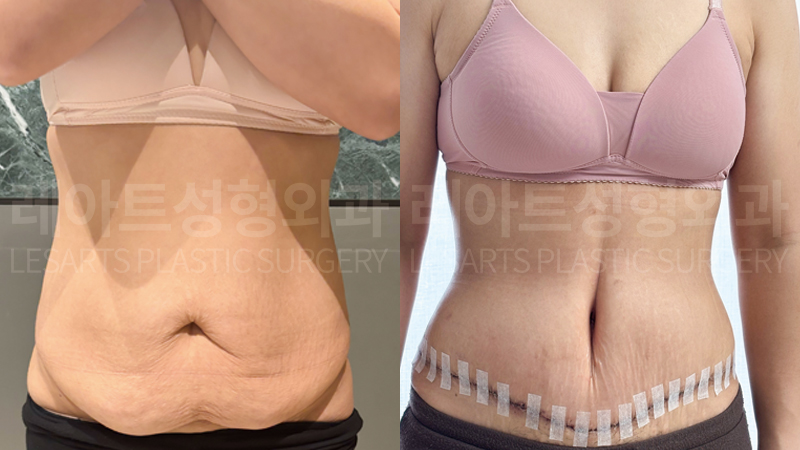
[Selfie Comparison: Before vs. 2 Weeks After Surgery]

[Selfie Comparison: Before vs. 2 Weeks After Surgery]
Even in photos taken by the patient herself during early recovery,
you can see that the long-hanging abdominal skin
has been removed.
Because 2 weeks after surgery is a time when taping on the incision site
and early recovery are still visible,
the appearance at this point is not the final result.
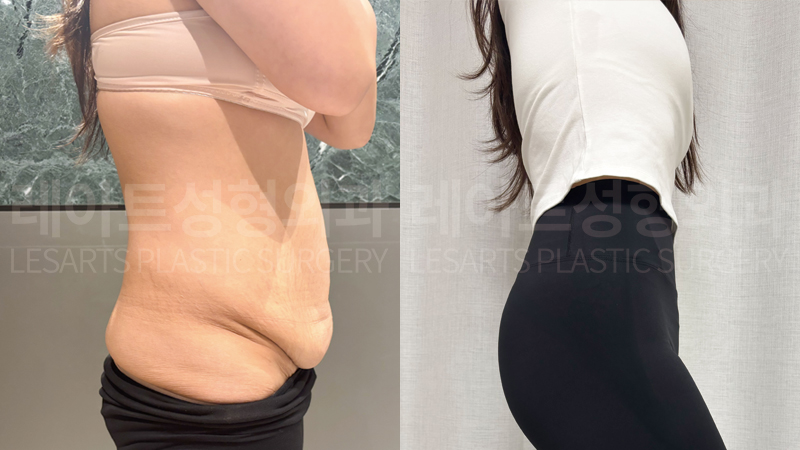
[Selfie Comparison: Before vs. 3 Months After Surgery]
The patient shared that her satisfaction in everyday life
after the tummy tuck is also
very high.
Before surgery, she was bothered by loose skin hanging
over her clothes,
and she also expressed satisfaction that the itching and chafing
inside the deeply folded skin are now gone.
In the 3-month photo taken and sent directly by the patient,
you can see her waistline curving inward when wearing fitted clothes
and flowing smoothly down to her lower belly.
A tummy tuck is a surgery that can correct both abdominal skin sagging
and diastasis recti remaining after childbirth or major weight changes.
However, because removing stretched skin leaves
a long incision scar on the lower abdomen,
it is important to decide on surgery after fully understanding not only the abdominal contour changes,
but also the process through which the incision scar heals.
In particular, when the range of skin requiring correction is wide—as in an extended tummy tuck—
the incision length also becomes longer.
Therefore, if you are considering a tummy tuck,
we recommend deciding after thorough consultation on how far your abdominal skin currently sags,
whether diastasis recti is present,
and what care will be needed for the remaining scar
and recovery process afterward.
[ View More Lesarts Tummy Tuck Cases ]
Extended Tummy Tuck FAQ
Q1. If skin sags not only on the lower belly, but all the way to the flanks after childbirth, is an extended tummy tuck needed?
If skin sagging extends broadly beyond the upper and lower abdomen out to the flanks,
an extended tummy tuck that removes a wide range of skin together can be considered.
The actual surgical scope is determined after checking skin sagging and abdominal wall condition.
Q2. Does an extended tummy tuck leave a long incision scar?
If the range of skin requiring correction is wide, a relatively long incision
extending toward the pelvis may be needed.
Incision length is not determined by the procedure name alone,
but varies depending on the actual range of skin that must be removed.
Q3. Can a belly button shape that changed after childbirth also be corrected with a tummy tuck?
If the shape or position of the belly button changed as upper abdominal skin sagged,
both the shape and position of the belly button
can be corrected together during the tummy tuck.
Q4. Can the scar still look red 5 months after a tummy tuck?
Around 5 months after surgery,
some redness in the scar may still remain.
Because the speed of settling varies depending on skin condition,
it is important to continue necessary scar care while monitoring progress.
Q5. Is a tummy tuck a surgery that only removes loose skin?
Not only skin sagging, but also diastasis recti
and subcutaneous fat can affect abdominal shape.
Therefore, skin, fat, and abdominal wall condition are checked together before surgery
to determine the necessary scope of correction.
#Abdominoplasty
#L-type


Cases finding
similar to my profile
Customer Diagnostics


Select the surgery and
area you are interestedto see real
before andafter changes.


we
make you,
the art
Clinic hours
MON - FRI
10 am – 7pm
SAT
10 am – 4pm
Holiday
SUN, HOLIDAY
Location
Lesarts Moon Clinic Tower 4-5F, 40, Nonhyeon-ro 168-gil,
Gangnam-gu, Seoul, Republic of Korea

Medical institution name Lesarts Plastic Surgery
Address Lesarts Moon Clinic Tower 4-5F, 40, Nonhyeon-ro 168-gil, Gangnam-gu, Seoul, Republic of Korea
Representative Moon sung jun
