




Online Consultation
Please accurately enter the information below.
Quick Cost Consultation
Quick Consultation & Reservation
Cases finding
similar to my profile






Cases finding
similar to my profile
Customer Diagnostics
Thigh Liposuction for Protruding Front Thighs: 3.5-Month Straight Leg Results | Best Liposuction Clinic in Gangnam, Seoul, Korea
2026-09-17
Thigh Liposuction | Front Thigh Protrusion & Saddlebags: Straight Leg Changes at 3.5 Months
Legs with Protruding Front Thighs: Are Straight Legs Possible with Thigh Liposuction?
Q. Even if my front thighs protrude puffily, can thigh liposuction create straight legs?
A. Protrusion of the front thighs can be influenced not only by fat, but also by muscle development
and bone structure.
Therefore, there may be limits to creating completely straight legs
simply by removing a lot of fat,
and it is important to check muscle, bone structure, and skin condition
to adjust the suction scope by location.
[ Learn More About Lesarts Thigh Liposuction Cases ]
Among those looking into thigh liposuction,
many assume that all the curves or thickness
that bother them in their legs are due to fat,
expecting that removing enough fat will create
the straight legs they want.
However, when examining the legs during an actual consultation,
there are cases where factors other than fat influence the contour,
creating limits to what liposuction alone can improve.
This is because thigh shape depends not only on where and how much fat is distributed,
but also on the degree of muscle development and bone structure.
Therefore, when planning thigh liposuction,
rather than checking fat volume alone, it is important to assess muscle development,
bone structure, and skin elasticity and thickness together,
and finely adjust the degree of suction by area.
Let's explain in detail through an actual patient's thigh liposuction case.
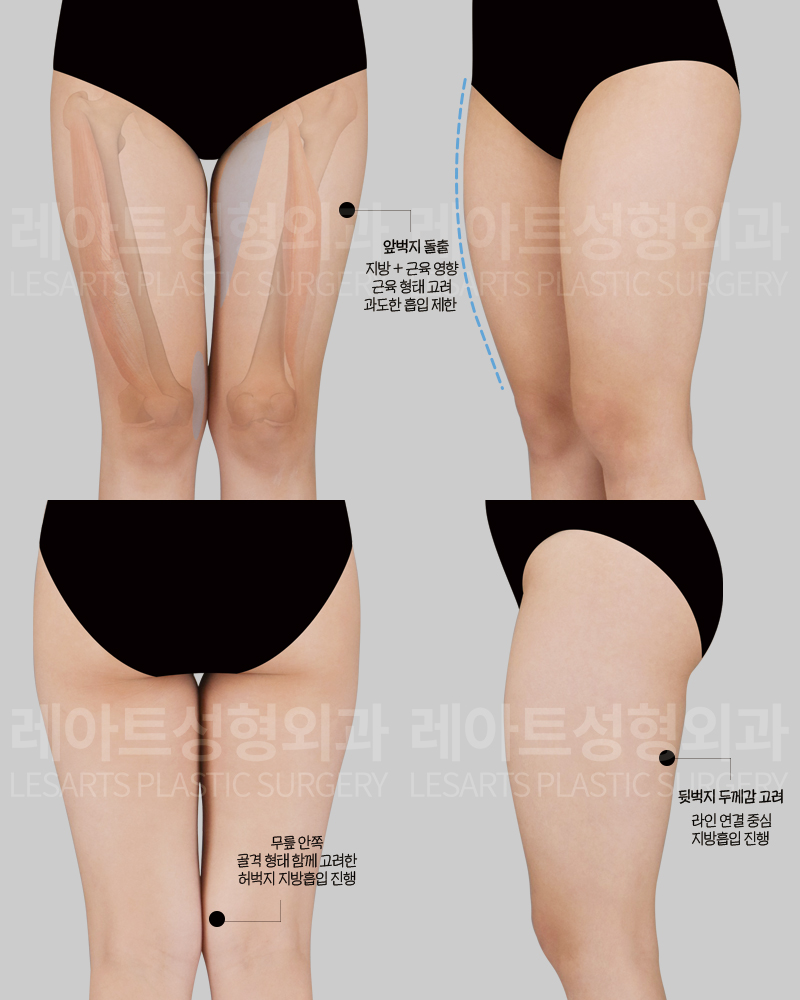
[Before Thigh Liposuction: Condition of a Patient Who Wanted a Straight Leg Line]
This patient wanted to reduce overall thigh thickness
and achieve a slim, straightly falling leg line.
[Patient Information]
Age: 31
Height: 160 cm
Weight: 53 kg
BMI: 20.7
*Even with similar physical conditions, liposuction results may vary from person to person
depending on fat distribution, muscles, bone structure, and skin condition.
Before surgery, sufficient fat was distributed across her thighs overall,
so we could expect a reduction in heavy thigh thickness
and actual circumference.
However, her front thighs—which bulged forward—
were influenced not only by fat, but also by
muscle.
We explained that removing fat excessively in this area
could expose existing muscle lines directly,
resulting in a line different from the smooth straight shape
the patient desired.
Furthermore, the contour around her knees was not determined
by fat alone.
Her inner knees were influenced by bone structure and knock-kneed (X-shaped) alignment,
and the area above her knees was also influenced by skin.
Therefore, rather than focusing only on reducing thigh circumference,
we needed a design that considered overall transitions
so that awkward contours would not form in specific areas due to bone structure and skin thickness.
Finally, the patient's skin elasticity was on the lower side.
Especially in areas with thin skin like the inner thighs, removing fat
excessively can make it difficult for the line to flow smoothly,
so we planned the surgery to refine the line
while adjusting the degree of suction considering skin condition.
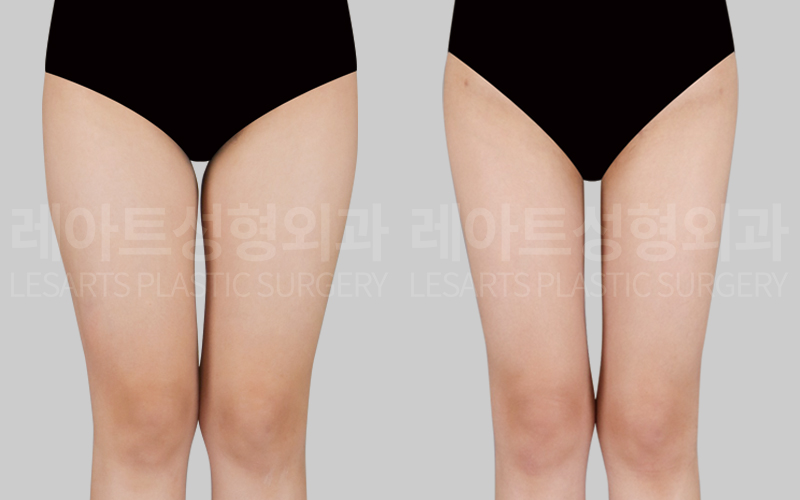
[3.5 Months After Thigh Liposuction: Front-View Changes in Thigh Thickness and Straight Leg Line]
These are photos taken 3.5 months after surgery.
As the fat distributed across the entire thighs was refined,
you can see thigh width decrease and the inner line
flowing smoothly.
Before surgery, her inner thighs
pressed together, giving a heavy impression,
but after surgery, as inner volume decreased,
space between her legs appeared, creating the slim,
straightly flowing leg line the patient wanted.
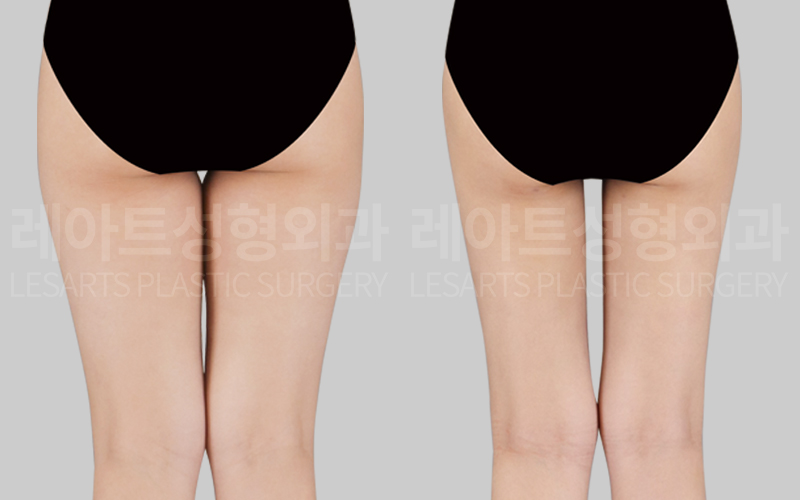
[3.5 Months After Thigh Liposuction: Back-View Changes in Thigh Thickness and Straight Leg Line]
From the back view as well, you can see a reduction
in overall thigh width.
In particular, as the outward-protruding saddlebags were refined,
the outer leg contour changed into a longer-flowing shape.
As the touching area on the inner thighs was also refined together,
her overall lower body line flows slimmer.
However, due to her underlying bone structure present before surgery,
there was a limit to creating a completely straight gap
from the inner thighs down to the knees when standing with legs together.
Although liposuction is not a surgery that changes such skeletal conditions,
a clear change toward the slim, straightly extended
leg line the patient desired was achieved.
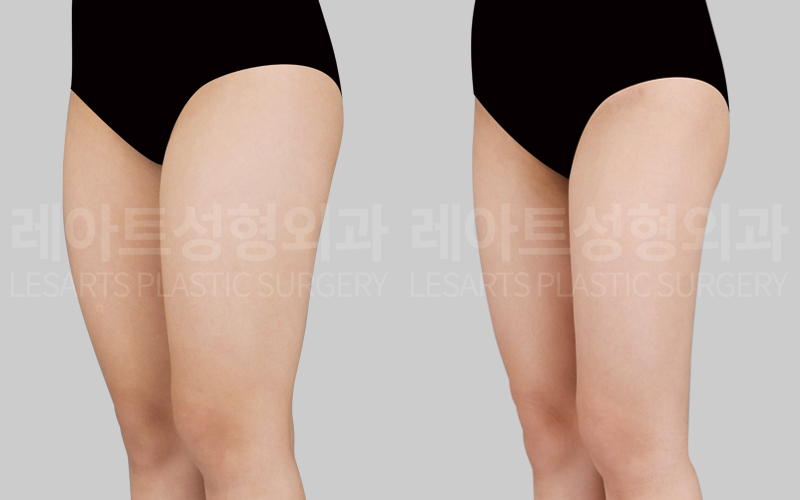
[3.5 Months After Thigh Liposuction: Oblique-View Changes in Outer Thigh Volume and Straight Leg Line]
Before surgery, as the saddlebag area stood out outward,
her upper thigh width looked wide and her outer leg line felt short.
After surgery, as outer volume decreased,
you can see the line flowing from the upper thigh downward
smoothed out cleanly.
By adjusting both inner and outer thickness together,
overall thigh width was also reduced.
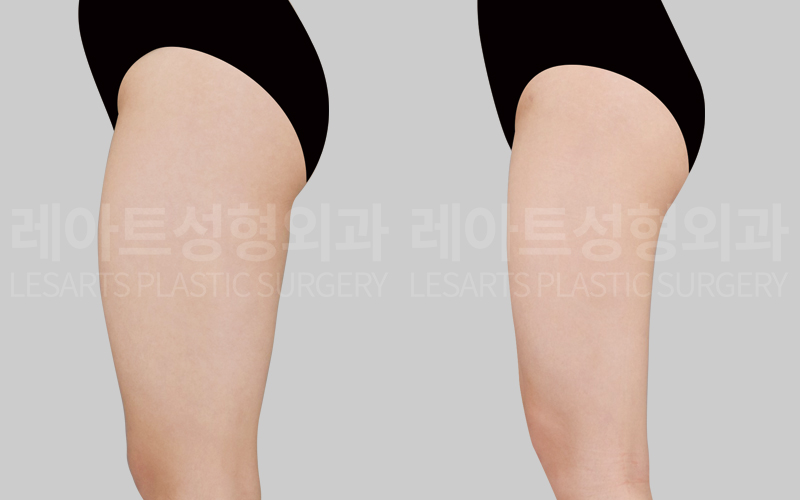
[3.5 Months After Thigh Liposuction: Side-View Changes in Front Thigh Protrusion and Thigh Thickness]
When compared from the side, the change in bulging front thigh protrusion—
which concerned the patient most—is clearly visible.
Before surgery, she was greatly bothered that her roundly protruding front thighs
made her entire thighs feel heavy
and thick.
After thigh liposuction,
as the front thigh volume added by fat decreased,
the front contour was smoothed out into a line
closer to a straight shape.
In addition, refining saddlebag fat together
reduced volume flowing from the outer thigh to the upper back thigh,
decreasing overall circumference.
Because this patient had a body type with developed front thigh muscles,
we did not approach the surgery simply by removing a large amount of fat.
While adjusting suction depth by area so muscle shapes would not be overly exposed,
we reduced volume added by fat
and performed the surgery so that the overall thigh line
could flow smoothly.
Furthermore, because skeletal influence was present at the inner knees,
skin influence was present above the knees,
and skin elasticity was on the lower side,
this was a case where simply removing a large amount based on fat volume alone
would have made it difficult to create the line the patient desired.
In this way, not only fat, but also muscle development, bone structure,
and skin thickness and elasticity can all act together on the thigh line.
Therefore, if you want to create straight legs with thigh liposuction,
it is important to accurately check not only
where sufficient fat is currently located,
but also whether there are any muscle
or skeletal characteristics limiting your desired line.
Similarly, if you are concerned about front thigh protrusion, inner thigh thickness,
or saddlebags,
we recommend thoroughly checking what liposuction can change for your current body type
as well as any limitations that may remain,
and consulting on a surgical method suited to your body shape.
[ Learn More About Lesarts Thigh Liposuction Cases ]
Thigh Liposuction FAQ
Q1. If my front thighs protrude,
can liposuction make them completely straight?
If front thigh protrusion is influenced not only by fat,
but also by muscle shape,
there may be limits to creating a completely straight shape
through liposuction alone.
The suction scope must be set after checking
how much fat and muscle each contribute.
Q2. Does removing a lot of fat create straight legs?
Removing a lot of fat does not always
create a smooth, straight line.
Reducing fat excessively can expose existing muscle contours,
so it is important to refine the line while preserving necessary fat by area.
Q3. Can saddlebag liposuction also change the leg line?
Reducing volume in outward-protruding saddlebags refines the outer contour
and reduces thigh width.
Actual changes vary depending on saddlebag fat volume and bone structure.
Q4. Can knock-kneed (X-shaped) legs also be corrected with thigh liposuction?
Liposuction is not a surgery that changes bone structure itself.
If bone structure influences the inner knee line, that shape may remain
even after fat reduction, so the achievable range of change
must be confirmed before surgery.
Q5. Can I still get thigh liposuction even if my skin elasticity is poor?
If skin elasticity is reduced, the degree of suction must be adjusted carefully,
especially on the inner thighs where the skin is thin.
It is important to check current skin thickness and elasticity together
and plan surgery within a safe, non-excessive range.
#Liposuction
#Thigh
#BMIbelow30(thigh)


Cases finding
similar to my profile
Customer Diagnostics


Select the surgery and
area you are interestedto see real
before andafter changes.


we
make you,
the art
Clinic hours
MON - FRI
10 am – 7pm
SAT
10 am – 4pm
Holiday
SUN, HOLIDAY
Location
Lesarts Moon Clinic Tower 4-5F, 40, Nonhyeon-ro 168-gil,
Gangnam-gu, Seoul, Republic of Korea

Medical institution name Lesarts Plastic Surgery
Address Lesarts Moon Clinic Tower 4-5F, 40, Nonhyeon-ro 168-gil, Gangnam-gu, Seoul, Republic of Korea
Representative Moon sung jun
