




Online Consultation
Please accurately enter the information below.
Quick Cost Consultation
Quick Consultation & Reservation
Cases finding
similar to my profile






Cases finding
similar to my profile
Customer Diagnostics
Tummy Tuck 1 Year After Surgery: Long-Term Abdominal Contour and Scar Changes
2026-10-01
Tummy Tuck | C-Section Scar & Diastasis Recti: Abdominal Contour and Scar Changes at 1 Year
1 Year After a Tummy Tuck: Contour Maintenance and Scar Changes
Q. If skin sags over a C-section scar
and the abdomen protrudes forward, can both be corrected together with a tummy tuck?
A. Not only the skin sagging above the C-section scar,
but also overall skin elasticity across the upper and lower abdomen, diastasis recti,
and subcutaneous fat distribution must be checked together.
For this patient, skin laxity extended from the upper to the lower abdomen
and abdominal wall protrusion due to diastasis recti was also confirmed,
so we planned an M-Type tummy tuck with umbilicoplasty (belly button correction), abdominal muscle plication, and abdominal liposuction,
along with hip fat grafting to supplement her hip line.
[ Learn More About Lesarts Tummy Tuck Cases ]

[Before Tummy Tuck: Remaining C-Section Scar and Skin Sagging Above the Belly Button]
In this post, we will explain a tummy tuck case of a patient in her 40s
who visited us with concerns about skin sagging that developed after a C-section delivery.
When we examined her abdomen before surgery,
skin elasticity was reduced across both the upper and lower abdomen,
and loose skin was sagging downward.
In addition, forward protrusion of the abdominal wall
due to diastasis recti was also confirmed.
With some remaining subcutaneous fat as well,
the volume in the central abdomen
appeared even more pronounced compared to other areas.
What bothered the patient most in particular
was the way skin folded and protruded
like an overhang above her existing C-section scar.

[Before Tummy Tuck: Surgical Plan Considering C-Section Scar, Diastasis Recti, and Abdominal Protrusion]
To correct this skin sagging and abdominal protrusion together
while refining the overall abdominal contour,
we planned the surgery as follows:
1. M-Type Tummy Tuck + Umbilicoplasty (Belly Button Correction)
We planned an M-Type tummy tuck to address skin laxity
extending from the upper abdomen together.
During this process, because the existing belly button is included
in the excised excess skin,
a new belly button must be created in a new position.
However, because the patient's original belly button was slightly shifted
to one side,
we explained in advance that there could be some limitations
in aligning the belly button completely to the center even after surgery.
2. Abdominal Muscle Plication (Triple Lock)
Due to diastasis recti and separation around the external oblique muscles,
the abdominal wall appeared pushed forward.
Therefore, we planned abdominal muscle plication together
to bring the separated abdominal wall together and reduce
front abdominal protrusion.
However, because the width of the underlying bone structure itself does not change,
we also explained that repairing the rectus muscles
does not drastically reduce waist width,
and that the change would be along the lines of
further defining the waistline
within her current body frame.
3. Abdominal Liposuction
Because remaining subcutaneous fat was emphasizing
abdominal bulk,
we planned abdominal liposuction together
to refine the thickness of the front abdomen
and the overall contour.
4. Hip Fat Grafting
The patient had a relatively flat hip line,
meaning there was not a large visible difference in width
between her waist and hips.
Therefore, we planned fat grafting in the hip area together
so that the contrast between her waistline and hip line
could stand out a bit more.

[1 Year After Tummy Tuck: Changes in Skin Sagging Above the Belly Button and Front Abdominal Contour - Lesarts Plastic Surgery]
This is how she looks 1 year after surgery.
Before surgery, skin sagged downward around the lower belly
and the abdomen appeared to protrude forward.
One year later, as this excess skin and front abdominal bulk were refined,
you can see the lower belly flowing flatly.
The heavy bulk that extended from above the belly button to the lower abdomen decreased,
and for her flanks, which previously had little curve, combining abdominal liposuction
with hip fat grafting
noticeably changed the line flowing
from her waist to her hips.

[1 Year After Tummy Tuck: Changes in Front Abdominal Protrusion and Waistline - Lesarts Plastic Surgery]
When compared from the side, the change in abdominal thickness
before and after surgery is even clearer.
Before surgery, the lower abdomen protruded forward
and the skin below the belly button sagged downward,
making the front abdomen feel heavy.
After surgery, as both the loose skin and abdominal bulk were refined,
the front abdomen changed into a flatly flowing contour.

[1 Year After Tummy Tuck: Changes in Front Abdominal Protrusion and Lower Abdominal Line - Lesarts Plastic Surgery]
In this surgery, rather than addressing only skin sagging,
we also repaired the separated rectus muscles and surrounding abdominal wall through muscle plication,
and reduced remaining volume with abdominal liposuction.
Through these combined corrections, the overall flow of the front abdomen
from the upper abdomen to the lower abdomen was smoothed out.

[1 Year After Tummy Tuck: Changes in Skin Wrinkles and Sagging Above the Belly Button When Bending Forward - Lesarts Plastic Surgery]
In the side view and forward-bending posture,
the changes in the loose skin above the belly button
and the forward-protruding abdominal shape seen before surgery are even more distinct.
Through an M-Type tummy tuck, this patient
had loose skin across both the upper and lower abdomen tightened together,
combined with abdominal muscle plication and abdominal liposuction.
As a result, remaining excess skin and abdominal bulk decreased,
and the separated abdominal wall was repaired together,
showing an abdominal shape clearly different from before surgery.

[1 Year After Tummy Tuck: Removal of C-Section Scar and Recovery Status of Lower Abdominal Incision Scar - Lesarts Plastic Surgery]
The existing C-section scar
was removed along with the loose
lower abdominal skin during the tummy tuck.
After surgery, a newly created lower abdominal incision line
for the tummy tuck remains.
With consistent scar care up to the 1-year mark,
you can see the incision line settling stably.
Because tummy tuck scars do not finish maturing in a short period
and change in color and texture over time,
it is important to continue monitoring progress after surgery
and maintaining necessary care.
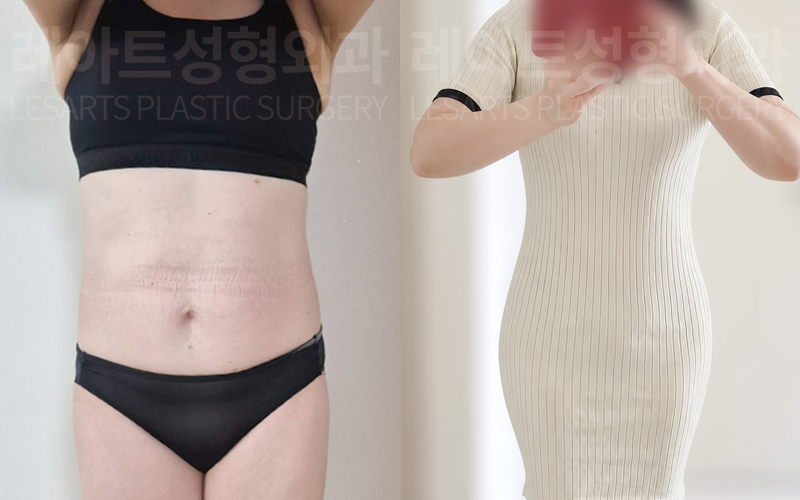
[Photo Comparison: Before vs. 1 Month After Tummy Tuck]
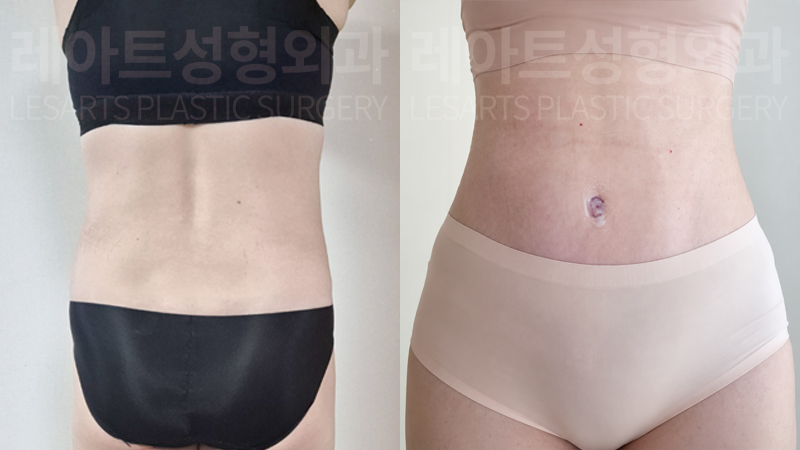
[Photo Comparison: Before vs. 1 Month After Tummy Tuck]
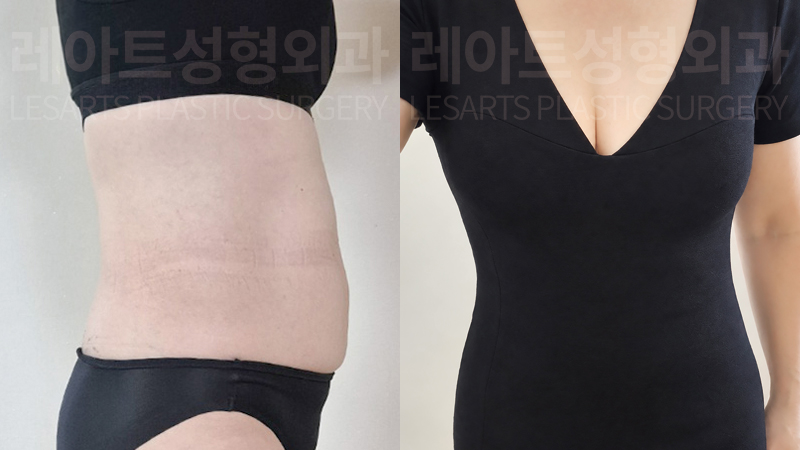
[Photo Comparison: Before vs. 1 Month After Tummy Tuck]
In everyday photos taken and sent by the patient herself
after surgery,
you can also see the changed abdominal volume
and waistline compared to before surgery.
Before surgery, the area flowing from her waist to her lower belly
lacked firmness and had little curve.
After surgery, as the front abdomen was refined,
her waistline also stands out in a different shape than before.
Even when wearing fitted workout clothes or dresses,
the changes in her front abdominal contour and waistline were clearly visible,
and the patient expressed satisfaction with these changes.
Rather than viewing a tummy tuck simply as a surgery
that removes only loose lower belly skin,
it is important to determine the surgical scope by checking where skin sagging begins, whether diastasis recti is present,
how much subcutaneous fat is distributed,
and where existing scars are located
all together.
For this patient as well, we planned the surgery considering not only skin sagging above the C-section scar,
but also overall decreased elasticity across the upper and lower abdomen, diastasis recti,
abdominal fat, and even her hip line
together.
It is also necessary to confirm before surgery what can be changed
and what may remain—for example, that repairing the rectus muscles does not drastically change skeletal waist width,
and that depending on the original position and shape of the belly button,
there may be limits to aligning it completely to the center.
If you are concerned about skin folding over your C-section scar,
loose skin sagging from above the belly button down to the lower belly,
and an abdomen that stands out forward,
we recommend first accurately checking your current skin, rectus muscles, and fat distribution,
and consulting on the tummy tuck scope suited to you
along with whether liposuction or abdominal wall repair is needed.
[ View More Lesarts Tummy Tuck Cases ]
Tummy Tuck FAQ
Q1. Can a C-section scar also be removed during a tummy tuck?
If the existing C-section scar is included within the area of skin
excised during the tummy tuck, it can be removed together.
Afterward, a new incision scar for the tummy tuck will remain.
Q2. Does a tummy tuck make the waist much slimmer?
Repairing diastasis recti and separation in the abdominal wall
can improve the waistline, but the width of the underlying bone structure
itself does not change.
Therefore, how much waist width can be reduced
varies depending on your current bone structure and abdominal condition.
Q3. Is a new belly button created during a tummy tuck?
In a full tummy tuck, as loose skin is pulled downward
and the existing belly button falls within the excision range,
a new belly button is created and positioned.
Depending on the original belly button position or left-right asymmetry,
there may be limits to aligning it completely to the center.
Q4. Why are a tummy tuck and abdominal liposuction performed together?
A tummy tuck tightens loose skin, while liposuction adjusts
the volume of remaining subcutaneous fat and surrounding contours.
If both issues are present, they can be combined depending on your condition.
Q5. Is scar care still needed 1 year after a tummy tuck?
Scars change in color and texture over a long period.
Even after about a year, necessary care can be continued
depending on your individual skin condition and scar progress.
#Abdominoplasty
#M-type


Cases finding
similar to my profile
Customer Diagnostics


Select the surgery and
area you are interestedto see real
before andafter changes.


we
make you,
the art
Clinic hours
MON - FRI
10 am – 7pm
SAT
10 am – 4pm
Holiday
SUN, HOLIDAY
Location
Lesarts Moon Clinic Tower 4-5F, 40, Nonhyeon-ro 168-gil,
Gangnam-gu, Seoul, Republic of Korea

Medical institution name Lesarts Plastic Surgery
Address Lesarts Moon Clinic Tower 4-5F, 40, Nonhyeon-ro 168-gil, Gangnam-gu, Seoul, Republic of Korea
Representative Moon sung jun
