




Online Consultation
Please accurately enter the information below.
Quick Cost Consultation
Quick Consultation & Reservation
Cases finding
similar to my profile






Cases finding
similar to my profile
Customer Diagnostics
Mini Tummy Tuck Before and After 9 Months: Loose Lower Belly Skin and C-Section Scar After Pregnancy
2026-10-06
Mini Tummy Tuck | Postpartum Lower Abdominal Skin Sagging & C-Section Scar: 9-Month Before & After Changes
Postpartum Lower Abdominal Skin Sagging: How Did It Change 9 Months After a Mini Tummy Tuck?
Q. If I have an overall slim build, but only my lower abdominal skin
sags after childbirth, can I consider a mini tummy tuck?
A. Even if you do not have much weight or body fat,
if your lower abdominal skin has stretched after childbirth and your abdominal wall
protrudes forward due to diastasis recti, a tummy tuck can be considered.
For this patient, along with lower abdominal skin sagging, diastasis recti
and subcutaneous fat around the flanks and lower belly were confirmed,
so we planned a floating-umbilicus S-Type mini tummy tuck
together with rectus muscle repair and abdominal liposuction.
[ Learn More About Lesarts Tummy Tuck Cases ]
 [Before Mini Tummy Tuck: Lower Abdominal Skin Sagging Remaining Above the C-Section Scar - Lesarts Plastic Surgery]
In this post, we will explain a mini tummy tuck case
of a patient in her 40s who visited us
with concerns about lower abdominal skin sagging
remaining after childbirth.
Although the patient maintained an overall slim figure,
her biggest concern was that the excess skin on her lower belly sagged downward,
preventing her abdominal line from flowing smoothly.
When we checked her abdominal condition before surgery,
- Lower abdominal skin sagging caused by decreased skin elasticity
- A forward-protruding abdominal wall due to diastasis recti
- Some remaining subcutaneous fat on the flanks
were all affecting her abdominal contour together.
 [Before Mini Tummy Tuck: Surgical Plan Considering Lower Abdominal Skin Sagging and C-Section Scar]
To improve the lower belly sagging that concerned the patient most
while also refining the surrounding fat and existing C-section scar,
we determined that a tummy tuck, rectus muscle repair, and abdominal liposuction
would be needed.
The specific surgical plan was as follows:
1. Floating-Umbilicus Mini Tummy Tuck (S-Type)
Although the patient's skin sagging itself was mainly below the belly button,
diastasis recti in the upper abdomen was also having an effect,
altering the shape of both the upper and lower abdomen.
In addition, her belly button was not positioned low,
whereas her existing C-section scar was positioned relatively high.
Considering these conditions,
we planned a floating-umbilicus
S-Type mini tummy tuck.
The surgery proceeded with:
- Repair of upper and lower abdominal diastasis recti
- Removal of excess lower abdominal skin
- Removal of the existing C-section scar
- Repositioning the belly button downward by about 1–2 cm
as part of the plan.
2. Abdominal Liposuction
The patient also had some subcutaneous fat distributed
along the flanks, lower belly, and love handles.
Therefore, we planned liposuction together with the tummy tuck
to enhance the curve of the waistline and reduce
lower abdominal volume at the same time.
3. Fat Grafting Above the Belly Button
Another feature we observed was that the area above the belly button
appeared relatively indented.
Once surrounding volume decreased after the tummy tuck and liposuction,
there was a possibility that this area could look even more deeply indented.
Therefore, we planned a small amount of fat grafting above the belly button
so that the front abdominal line could flow smoothly.
 [9 Months After Tummy Tuck: Changes in Lower Abdominal Skin Sagging and Lower Belly Line - Lesarts Plastic Surgery]
This is how she looks about 9 months after
the floating-umbilicus mini tummy tuck and abdominal liposuction.
Before surgery, as the front abdomen pushed forward without support,
the lower belly skin also sagged downward.
After surgery, as this lower abdominal
volume and excess skin were refined,
you can see the front abdomen flowing
more firmly than before.
In particular, as the excess skin remaining below the belly button was removed,
the sense of abdominal heaviness across her upper body also decreased.
Furthermore, in addition to tightening the skin with the tummy tuck,
suctioning fat from the flanks, lower belly, and love handles
made the curve flowing from her waist to her hips
appear much more defined than before surgery.
 [9 Months After Tummy Tuck: Changes in Front Abdominal Protrusion and Lower Belly Line - Lesarts Plastic Surgery]

[9 Months After Mini Tummy Tuck: Side-View Changes in Front Abdominal Protrusion and Lower Abdomen]
When compared from the side,
the change in the front abdomen that had protruded unevenly forward
before surgery is even clearer.
By correcting both the abdominal wall protruding from diastasis recti
and the excess skin in the lower belly together,
you can see that front abdominal protrusion has been reduced.
 [9 Months After Tummy Tuck: Changes in Lower Abdominal Skin Folding and Sagging When Bending Forward - Lesarts Plastic Surgery]
The change is also evident in a forward-bending posture.
Before surgery, when bending forward,
the lower abdominal skin folded and the abdominal wall
shifted forward, making abdominal irregularities stand out even more.
After surgery, with the loose skin refined,
you can see that the front abdominal contour flows
more smoothly than before even when changing posture.
 [9 Months After Tummy Tuck: Lower Abdominal Incision Scar Recovery Status - Lesarts Plastic Surgery]
The C-section scar that remained on the lower abdomen before surgery
was removed together during the process of excising the sagging skin.
Currently, the incision scar for the mini tummy tuck remains
at a relatively low position on the lower abdomen.
After 9 months, the scar color has faded considerably,
and the patient also shared that she does not
really notice it in daily life.

[Front View Comparison: Before vs. 3 Months After S-Type Tummy Tuck]
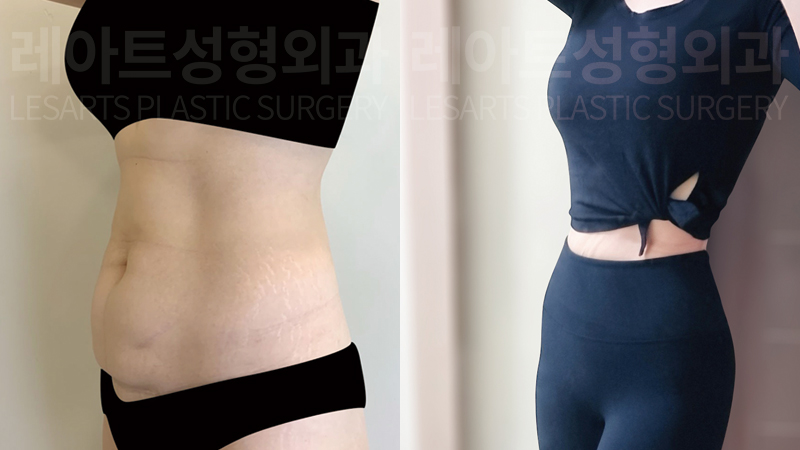
[Side View Comparison: Before vs. 5 Months After S-Type Tummy Tuck]
In photos taken by the patient herself after surgery,
you can also see the refined lower belly and changed waistline.
In particular, before surgery, she was so self-conscious about her lower belly
that she wore shapewear
to hide her abdominal line.
After the tummy tuck, she expressed satisfaction with her changed abdominal line,
sharing that she can now comfortably wear revealing outfits
or fitted clothes much more easily than before.
Quite a few people look into a tummy tuck
because of lower abdominal skin sagging remaining after childbirth,
irregularities around an existing C-section scar,
or an abdomen that protrudes unevenly forward
due to diastasis recti.
However, for a tummy tuck,
it is difficult to decide on the surgical method
simply by checking body weight or abdominal fat volume alone.
Skeletal structure, skin type, belly button shape and position,
the extent of decreased skin elasticity, the condition of the rectus muscles,
and fat distribution must all be checked together.
For this patient as well, rather than simply removing lower belly skin,
we planned everything together to suit her current abdominal shape—
repairing upper and lower abdominal diastasis recti, removing the existing C-section scar,
performing flank and lower belly liposuction,
and even adding a small amount of fat grafting
above the belly button.
Therefore, if you are considering a tummy tuck for postpartum lower belly sagging,
rather than guessing the surgical method or incision scar location on your own,
we recommend getting your current abdominal condition diagnosed first
and deciding whether to proceed with surgery after hearing a thorough explanation
of the suitable surgical scope, expected changes,
and recovery process.
[ View More Lesarts Tummy Tuck Cases ]
Mini Tummy Tuck FAQ
Q1. If only my lower abdominal skin sags after childbirth, can I get a mini tummy tuck?
If the extent of skin sagging is mainly in the lower abdomen,
a mini tummy tuck can be considered.
However, other factors such as upper abdominal diastasis recti or belly button position
must also be checked together
to determine the actual surgical scope.
Q2. Can a C-section scar also be removed during a mini tummy tuck?
If the existing C-section scar is included within the area of skin excised during surgery,
it can be removed together. Instead, a new incision scar
for the tummy tuck will remain.
Q3. Does a floating-umbilicus mini tummy tuck also change the belly button position?
The floating-umbilicus method corrects the surrounding skin and abdominal wall
while preserving the existing belly button,
and the belly button position may shift slightly depending on the surgical plan.
The possible range of movement varies depending on the current belly button position, excess skin,
and abdominal condition.
Q4. Can a mini tummy tuck and liposuction be done together?
If fat remains on the flanks, lower belly, or love handles,
abdominal liposuction can be performed together depending on your condition
to refine the waist and lower abdominal line.
Q5. Are there cases where slim people also need a tummy tuck?
Yes, it is possible. A tummy tuck is not a surgery decided
solely by body weight or fat volume.
If there are issues that are difficult to change through weight loss alone—
such as postpartum skin sagging or diastasis recti—
surgery can be considered depending on your current abdominal condition.
#Abdominoplasty
#S-type


Cases finding
similar to my profile
Customer Diagnostics


Select the surgery and
area you are interestedto see real
before andafter changes.


we
make you,
the art
Clinic hours
MON - FRI
10 am – 7pm
SAT
10 am – 4pm
Holiday
SUN, HOLIDAY
Location
Lesarts Moon Clinic Tower 4-5F, 40, Nonhyeon-ro 168-gil,
Gangnam-gu, Seoul, Republic of Korea

Medical institution name Lesarts Plastic Surgery
Address Lesarts Moon Clinic Tower 4-5F, 40, Nonhyeon-ro 168-gil, Gangnam-gu, Seoul, Republic of Korea
Representative Moon sung jun
