




Online Consultation
Please accurately enter the information below.
Quick Cost Consultation
Quick Consultation & Reservation
Cases finding
similar to my profile






Cases finding
similar to my profile
Customer Diagnostics
Loose Belly Skin After Weight Loss: 1 Year 4 Months After Full Tummy Tuck | Lesarts Plastic Surgery, Gangnam, Seoul, Korea
2026-10-08
Tummy Tuck | Sagging Belly After Weight Loss:
Lower Abdominal Skin Changes at 1 Year and 4 Months - Lesarts Plastic Surgery
Sagging Belly After Weight Loss:
1 Year and 4 Months After a Tummy Tuck
Q. I have lost a lot of weight, but my lower abdominal skin still folds
and sags. Should I keep trying to lose weight?
A. Even after substantial reductions in weight and body fat,
if stretched abdominal skin does not contract again,
folding and sagging in the lower abdomen may remain.
In particular, if skin laxity extends from the upper abdomen
or is accompanied by diastasis recti (abdominal muscle separation),
further weight loss alone may not improve the condition.
The extent of a tummy tuck should therefore be determined
after assessing the excess skin and the condition of the abdominal wall.
[ Learn More About Lesarts Tummy Tuck Cases ]
Significant weight gain can affect not only appearance
but also health in various ways,
prompting many people to begin a weight-loss program.
Recently, in addition to dietary changes and regular exercise,
more people have been seeking weight loss through medications
such as Wegovy and Mounjaro,
or surgical methods such as gastrectomy.
Although more weight-loss options are now available,
significant weight loss can bring a different concern.
Even when weight and body fat decrease,
stretched abdominal skin may not contract sufficiently,
leaving the lower abdominal skin folded
or hanging downward.
When sagging skin, rather than the amount of fat, becomes the main concern,
continuing to lose weight alone may not produce
the desired change.
For this reason, some people explore a tummy tuck
to improve the sagging skin left after weight loss.
In this post, we will look at the case of a patient
who visited us to correct abdominal skin sagging
and diastasis recti after weight loss.

[Before Tummy Tuck: Loose Lower Abdominal Skin and Folding After Weight Loss - Lesarts Plastic Surgery]
The patient was in their 20s and was concerned about
sagging skin that remained in the lower abdomen after weight loss.
An examination of the abdomen before surgery showed
that the overall amount of fat was not particularly high.
The issue was that the remaining skin below the belly button hung downward
and formed a pronounced fold.
In fact, the skin laxity was not limited to the lower abdomen;
it began in the upper abdomen.
As loose skin from the upper abdomen descended,
the excess skin gathered in the lower abdomen, making the lower abdominal fold
appear even more pronounced.
When the patient bent forward, in particular, the loose skin
gathered toward the front, making the deep lower abdominal fold
even more apparent.

[Assessment of Abdominal Skin Sagging After Weight Loss and M-type Tummy Tuck Surgical Plan - Lesarts Plastic Surgery]
During the consultation, the patient initially wanted
an S-type mini tummy tuck, which involves a relatively limited incision.
However, the skin sagging was not confined to the lower abdomen;
it extended from the upper abdomen, and the area requiring correction
was therefore not limited to the lower abdomen.
After thoroughly explaining the extent of excess skin and the correction required,
we ultimately decided to proceed with an M-type full tummy tuck.
The surgical plan included:
- M-type full tummy tuck
- Abdominal wall repair
- Belly button correction
- Adhesion release
- Targeted liposuction to refine the abdominal contour
These procedures were planned together.
Rather than simply removing the skin folded over at the bottom,
it was necessary to address the sagging extending from the upper abdomen,
repair the separated abdominal muscles, and adjust
the position and shape of the belly button to suit the new abdominal contour.

[1 Year and 4 Months After Tummy Tuck: Changes in Lower Abdominal Folding and Waistline - Lesarts Plastic Surgery]
These are the follow-up results 1 year and 4 months after the tummy tuck.
Before surgery, skin sagging downward from the upper abdomen
had created a deep fold in the lower abdomen.
After surgery, the excess skin had been removed,
creating a smoother contour along the front of the abdomen
from the upper abdomen to the lower belly.
The belly button, which had descended along with the sagging skin,
was also reconstructed to suit the overall waistline,
changing the appearance of the central abdomen.
Repairing the separated abdominal muscles at the same time
also improved the loose, spread-apart appearance
of the central abdomen seen before surgery.

[1 Year and 4 Months After Tummy Tuck: Changes in Lower Belly Protrusion and Front Abdominal Contour - Lesarts Plastic Surgery]
 [1 Year and 4 Months After Tummy Tuck: Changes in Lower Belly Protrusion and Front Abdominal Contour - Lesarts Plastic Surgery]
A side-view comparison more clearly shows the change in the lower abdomen,
which had previously sagged downward and protruded forward.
By removing the excess loose skin and repairing the abdominal wall,
the protruding lower abdomen was refined, and the contour
from the waist to the lower belly also changed.

[1 Year and 4 Months After Tummy Tuck: Changes in Lower Abdominal Skin Sagging and Folding When Bending Forward - Lesarts Plastic Surgery]
Comparing the forward-bending posture alongside the side view
makes the changes even more apparent.
Before surgery, the excess skin shifted forward with changes in posture,
creating a deep fold in the lower abdomen.
After surgery, with this excess skin removed, even when bending forward,
the abdominal skin no longer forms a pronounced fold,
and the front abdominal contour is maintained.
The patient also expressed satisfaction that the abdominal contour
remained consistent not only while standing,
but also when viewed from the side
and when bending forward.

[1 Year and 4 Months After Tummy Tuck:
Changes in the Lower Abdominal Incision Scar and Belly Button Scar - Lesarts Plastic Surgery]
Along with the abdominal contour, we also assessed the lower abdominal incision scar
and healing around the belly button.
The scars were continuing to settle over time.
In particular, fading was visible from both ends of the tummy tuck scar,
as the scar gradually matured.
Because the color and texture of tummy tuck scars
can continue to change over an extended period,
we explained that regular follow-up would continue and that, if needed,
laser toning for the scars or injections tailored to their condition
could be added to the care plan.
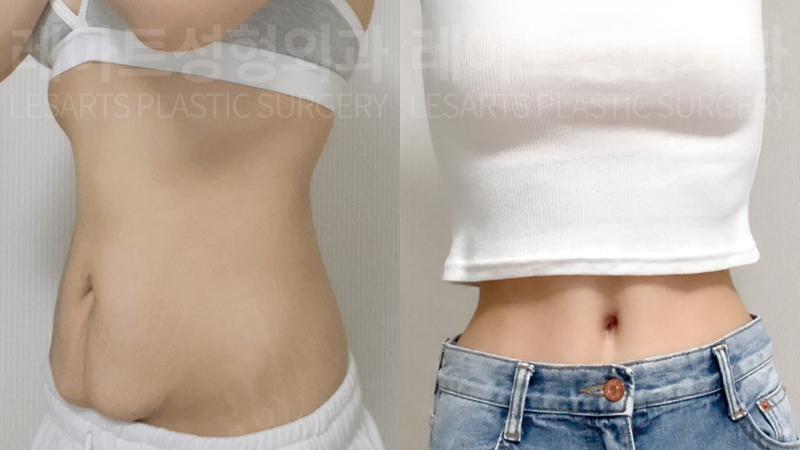
[Patient-Taken Photo Comparison: Before Surgery and 2 Months After]
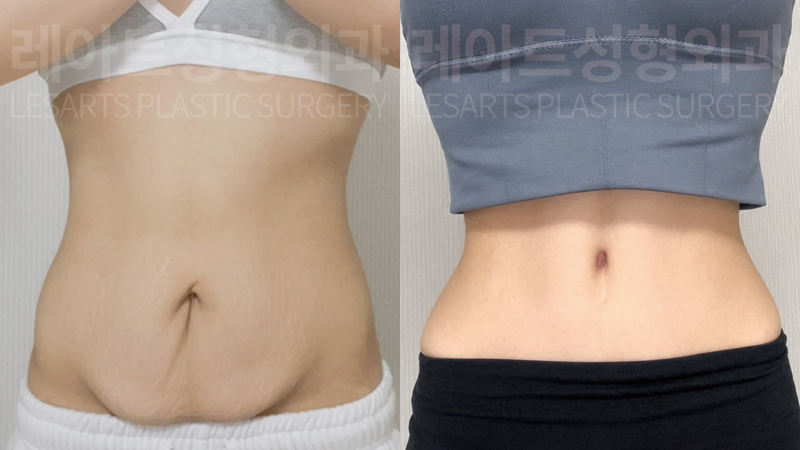
[Patient-Taken Photo Comparison: Before Surgery and 3 Months After]
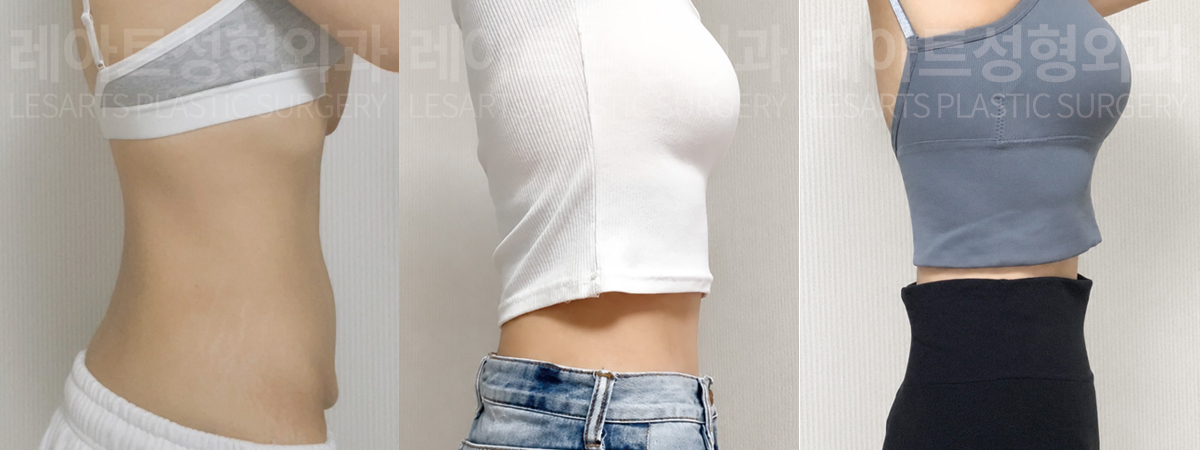
[Patient-Taken Photos Before and 3 Months After Tummy Tuck: Changes in the Front Abdomen and Waistline]
The changes after surgery can also be seen
in the photos provided by the patient.
Before surgery, there was enough loose lower abdominal skin
to hang over the waistband of clothing.
After the tummy tuck removed this excess skin,
the patient reported feeling less self-conscious when wearing fitted workout clothes
or outfits that reveal the waistline.
Ongoing weight and body-shape management, along with scar care,
remain necessary after surgery to help maintain the abdominal contour.
Sagging Skin After Weight Loss: Is a Mini Tummy Tuck Enough?
When the lower abdomen folds after significant weight loss,
some people assume that only the most visibly affected lower abdomen needs correction
and initially explore a mini tummy tuck.
However, the actual extent of surgery depends on
where the skin sagging begins.
In this case, although the lower abdominal fold was the most noticeable feature,
the skin laxity actually extended from the upper abdomen.
An M-type full tummy tuck was therefore needed,
rather than an S-type procedure targeting only the lower abdomen.
If you are concerned about a sagging belly after weight loss,
it is important to look beyond the area where the skin folds most.
The assessment should include excess skin in both the upper and lower abdomen, the presence of diastasis recti,
the position and shape of the belly button, and the distribution of remaining fat.
In particular, if you have lost significant weight through medications
such as Wegovy or Mounjaro, exercise and dietary changes, or bariatric surgery,
but loose skin remains despite the weight loss,
rather than repeatedly pursuing further weight loss,
it is important to distinguish whether the current concern is excess fat
or sagging skin.
After a thorough assessment of your abdomen,
discuss whether a mini or full tummy tuck is needed,
and whether abdominal muscle repair, belly button correction, or liposuction
should be included.
[ View More Lesarts Tummy Tuck Cases ]
Tummy Tuck After Weight Loss FAQ
Q1. Will loose belly skin shrink back after significant weight loss?
Even when weight and body fat decrease, if significantly stretched skin
does not contract sufficiently, lower abdominal skin sagging
or folding may remain.
In these cases, further weight loss alone
may not improve the condition.
Q2. If only my lower belly appears to sag after weight loss,
is a mini tummy tuck enough?
Even when sagging is most noticeable in the lower abdomen,
the skin laxity may extend from the upper abdomen.
Whether a mini or full tummy tuck is more suitable
should be determined after assessing
the actual extent of skin sagging.
Q3. Can diastasis recti also be repaired after weight loss?
If diastasis recti is identified during the tummy tuck process
and requires correction, abdominal wall repair
can be included in the surgical plan.
The extent of repair depends on the condition of the abdomen.
Q4. Can I have a tummy tuck after losing weight with Wegovy or Mounjaro?
Is surgery still an option?
The method of weight loss alone
does not determine whether a tummy tuck is appropriate.
The timing of surgery should be determined by assessing
how stable your weight is, the amount of excess skin,
and the condition of the abdominal wall.
Q5. Do tummy tuck scars disappear after a year?
Scars do not disappear completely.
Over time, their color gradually fades
and their texture settles as they mature.
Depending on their condition, additional scar care,
such as laser toning or injection treatments, may be considered.
#Abdominoplasty
#M-type


Cases finding
similar to my profile
Customer Diagnostics


Select the surgery and
area you are interestedto see real
before andafter changes.


we
make you,
the art
Clinic hours
MON - FRI
10 am – 7pm
SAT
10 am – 4pm
Holiday
SUN, HOLIDAY
Location
Lesarts Moon Clinic Tower 4-5F, 40, Nonhyeon-ro 168-gil,
Gangnam-gu, Seoul, Republic of Korea

Medical institution name Lesarts Plastic Surgery
Address Lesarts Moon Clinic Tower 4-5F, 40, Nonhyeon-ro 168-gil, Gangnam-gu, Seoul, Republic of Korea
Representative Moon sung jun
