




Online Consultation
Please accurately enter the information below.
Quick Cost Consultation
Quick Consultation & Reservation
Cases finding
similar to my profile






Cases finding
similar to my profile
Customer Diagnostics
Could I Have Gynecomastia? How Male Gynecomastia Is Diagnosed | Lesarts Plastic Surgery, Gangnam, Seoul, Korea
2026-10-12
Male Gynecomastia Exam | Nipple & Areola Protrusion and Chest Lumps: How to Check with Ultrasound
Could I Have Gynecomastia? How to Check with Nipple Protrusion and Chest Lumps
Q. Even if my chest isn't very large, if my nipples and areolas protrude
or I can feel a lump, should I get a gynecomastia exam?
A. Gynecomastia does not only appear when the entire chest is heavily developed;
it can also appear as a puffy protrusion only around the nipple and areola, or as
a lump-like tissue texture when touched by hand accompanied by intermittent pain.
In such cases, rather than judging by appearance alone, it is important to check
for glandular tissue development and surrounding fat distribution through a physical exam and ultrasound.
[ Learn More About Lesarts Real Gynecomastia Surgery Cases ]
[ Learn More About Lesarts Gynecomastia Surgery ]
Among those worrying about gynecomastia symptoms,
“My chest isn't that big,
but only the nipple area looks like it sticks out, so I want to get examined first.”
some people say.
Of course, many people are concerned about the size of their entire chest,
but some visit the clinic because only the areola is puffed up and stands out,
or because they feel a lump-like tissue texture
when touching it by hand.
When there is nipple/areola protrusion or a chest lump like this,
you can check whether actual glandular tissue is developed inside the chest
through an ultrasound exam.
Rather than judging whether you have gynecomastia on your own just by looking at your appearance,
it is best to check the cause of your symptoms first.
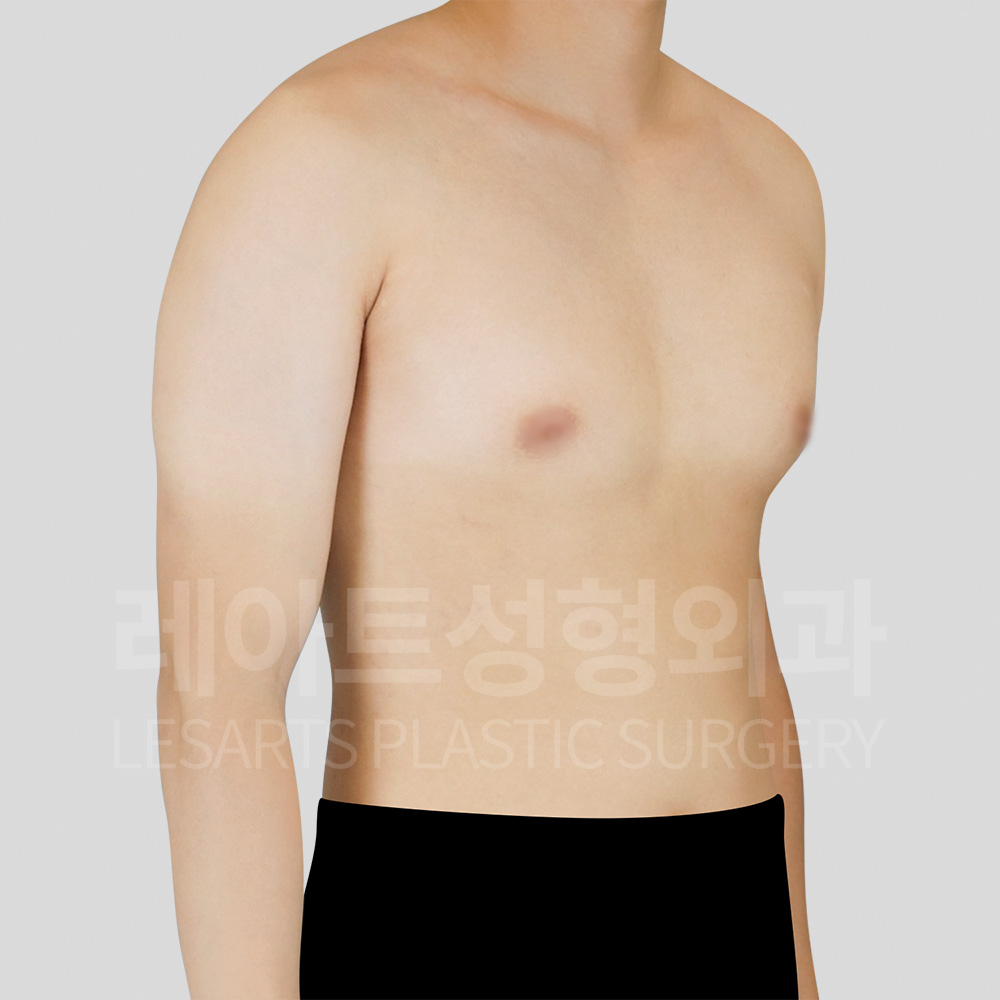
[Before Gynecomastia Surgery: Protrusion Around the Nipple & Areola and Chest Thickness - Lesarts Plastic Surgery]
The patient we are introducing this time
visited us with concerns not only about his chest shape, but also about a lump
and intermittent pain.
[Patient Information & Gynecomastia Ultrasound Results]
Age: 20s
Height / Weight: 171 cm / 63.1 kg
BMI: 21.6
Gynecomastia Diagnosis: Mixed True Gynecomastia, Simon Grade 2A
Skin Elasticity: Good
The patient had an average build
and had been consistently managing his weight
with both weight training and cardio exercise.
However, even after repeating high-intensity chest workouts,
there was no particular change in the size or shape
of his forward-protruding chest.
[True Gynecomastia Surgery Plan: Glandular Tissue Removal and Chest Liposuction - Lesarts Plastic Surgery]
As a result of the ultrasound exam,
it was confirmed that excessively developed glandular tissue was affecting his chest size
and the puffy shape around his areola.
Externally as well, compared to his overall slim build,
the volume in the chest area felt relatively large.
In particular, because the area around the nipple and areola rose forward puffily,
it was assessed as corresponding to 2A in the external Simon classification.
However, glandular tissue was not the only factor
affecting the chest protrusion.
Because subcutaneous fat was also distributed to some extent
in the area extending from the side chest to the lower chest,
we planned the surgery to combine glandular excision, chest liposuction,
and tissue rearrangement to prevent indentation.
Through this, we aimed to reduce the overall volume of the chest
and the protrusion around the swollen areola
and refine the ribcage line.

[2 Weeks After Gynecomastia Surgery: Changes in Central Chest Protrusion and Lower Chest Volume - Lesarts Plastic Surgery]
This is how he looks during the early recovery period,
about 2 weeks after gynecomastia surgery.
It is a point where a lot of swelling still remains
and internal tissue firmness can also appear.
Even so, compared to before surgery,
you can see that the overall chest size and the shape around the areola
have changed.
In particular, before surgery, rounded volume remained in the area
extending from the lower chest to the upper abdomen, making the chest boundary stand out.
After surgery, as that volume decreased,
you can see that the line flowing from the lower chest to the upper abdomen
has been smoothed out gently.

[2 Weeks After Male Gynecomastia Surgery: Changes in Chest Protrusion and T-Shirt Fit - Lesarts Plastic Surgery]
Not only when bare-chested,
but also when wearing a T-shirt, the change is evident.
Before surgery, the puffy volume at the front of the chest and protrusion around the areola
showed directly through a thin T-shirt.
After surgery, as both the front chest volume and protrusion around the areola decreased,
his top now drapes much flatter than before.

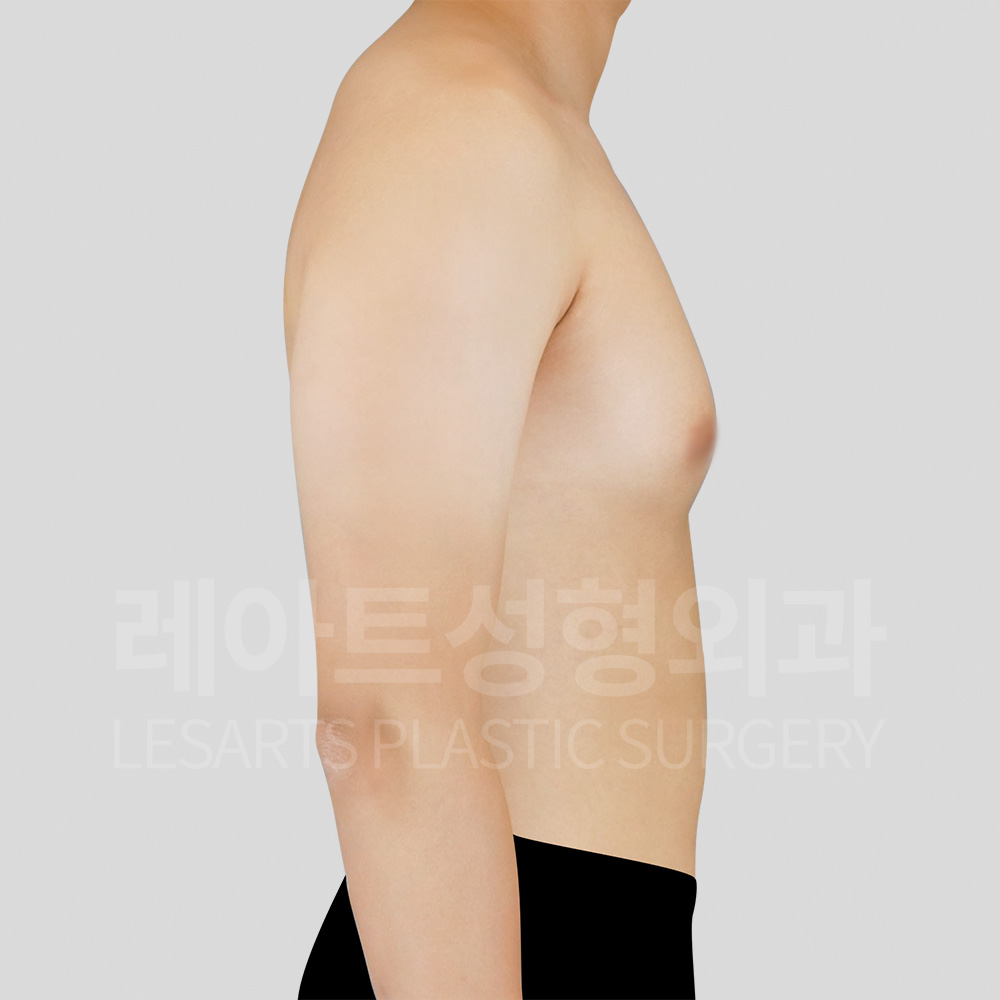
[2 Weeks After Gynecomastia Surgery: Changes in Central Chest Protrusion and Lower Chest Volume - Lesarts Plastic Surgery]

[2 Weeks After Male Gynecomastia Surgery: Changes in Chest Protrusion and T-Shirt Fit - Lesarts Plastic Surgery]
When compared from the side,
the change in chest thickness is revealed even more clearly.
Before surgery, as the area around the nipple and areola stuck out forward,
the central part of the chest showed a puffy shape.
After refining the glandular tissue and surrounding fat,
the chest volume that had been raised forward decreased,
and the outer contour flowing from the chest to the upper abdomen
was also smoothed out flatter than before.
Before surgery, the patient was not only bothered by
the chest shape itself,
but also experienced discomfort due to the lump felt when touched
and intermittent pain.
After surgery, as the discomfort from these accompanying symptoms also decreased,
he expressed satisfaction with the results even though it was still an early recovery period.
When people hear "gynecomastia," it is easy to think only of
“a condition where a man's chest looks large.”
However, in reality, only the area around the areola may stand out,
a lump may be felt inside the chest, and throbbing or
sharp pain may also accompany it.
In particular, if protrusion around the nipple and areola remains
even with consistent exercise and weight management,
rather than simply thinking of it as a chest muscle or fat issue,
it is necessary to check whether actual glandular tissue is developed.
Examining the current condition through external chest shape and palpation,
and checking the distribution of glandular tissue and surrounding fat with an ultrasound exam
helps determine the cause of current symptoms and the necessary treatment scope.
Rather than thinking of gynecomastia as a cosmetic flaw that must be hidden at all costs,
please remember that it is a condition where you can identify the cause of your symptoms
and consider treatment when needed.
If you are constantly bothered by nipple/areola protrusion, a chest lump, or pain,
rather than jumping to conclusions from photos or self-diagnosis alone,
we recommend checking your current condition first through a medical exam and ultrasound.
[ Learn More About Lesarts Real Gynecomastia Surgery Cases ]
[ Learn More About Lesarts Gynecomastia Surgery ]
Male Gynecomastia Exam FAQ
Q1. Even if my chest isn't large, can it be gynecomastia if only my nipples protrude?
Yes, it is possible. If glandular tissue beneath the areola develops,
even if the entire chest does not look large,
only the area around the nipple and areola may protrude puffily.
Rather than assuming based on appearance alone, it is best to confirm through a medical exam.
Q2. If I feel a lump in my chest, is it definitely gynecomastia?
Gynecomastia cannot be confirmed solely by tissue felt in the chest.
A process of checking the condition of that tissue and distinguishing the cause
through palpation and ultrasound is necessary.
Q3. Can gynecomastia also cause chest pain?
In some cases, tenderness, throbbing,
or sharp sensations in the chest area may appear together.
If pain persists or is felt along with a lump,
a medical exam is needed to confirm the exact cause.
Q4. If my chest doesn't shrink with exercise, should I get a gynecomastia exam?
If protrusion around the nipple and areola or
chest thickness persists despite exercise or weight loss,
you can check whether glandular tissue is developed.
An ultrasound exam helps examine the distribution
of glandular tissue and surrounding fat.
Q5. For gynecomastia surgery, is only the glandular tissue removed?
If subcutaneous fat is also distributed in the side chest or lower chest
in addition to glandular tissue,
liposuction can be combined.
Additional steps such as tissue rearrangement are also
determined based on your current chest condition and surgical scope.
#Male body contouring
#Gynecomastia
#Grade2-A #true gynecomastia


Cases finding
similar to my profile
Customer Diagnostics


Select the surgery and
area you are interestedto see real
before andafter changes.


we
make you,
the art
Clinic hours
MON - FRI
10 am – 7pm
SAT
10 am – 4pm
Holiday
SUN, HOLIDAY
Location
Lesarts Moon Clinic Tower 4-5F, 40, Nonhyeon-ro 168-gil,
Gangnam-gu, Seoul, Republic of Korea

Medical institution name Lesarts Plastic Surgery
Address Lesarts Moon Clinic Tower 4-5F, 40, Nonhyeon-ro 168-gil, Gangnam-gu, Seoul, Republic of Korea
Representative Moon sung jun
