




Online Consultation
Please accurately enter the information below.
Quick Cost Consultation
Quick Consultation & Reservation
Cases finding
similar to my profile






Cases finding
similar to my profile
Customer Diagnostics
Can You Keep Taking Hair Loss Medication After Gynecomastia Surgery? 2-Week Chest Changes | Lesarts Plastic Surgery, Gangnam, Seoul, Korea
2026-10-14
Gynecomastia Surgery | Taking Hair Loss Medication? 2-Week Before and After Changes in Chest Protrusion & T-Shirt Fit
Q. I am taking hair loss medication—is it okay to continue taking it after gynecomastia surgery?
A. Depending on the individual, some hair loss medications can be associated
with glandular tissue development, increased chest size,
lumps, or pain.
Therefore, if chest protrusion or a lump
appears while taking hair loss medication, it is necessary to review
your current medications together,
and even after gynecomastia surgery, it is important to periodically monitor
any changes in chest size or shape.
[ Learn More About Lesarts Male Gynecomastia Surgery Cases ]
These days, quite a few men in their 20s and 30s
take medication consistently to prevent hair loss.
However, did you know that hair loss prevention medication
and gynecomastia can be related?
Although it varies individually, some hair loss medications
can affect glandular tissue development,
sometimes causing symptoms such as increased chest size,
lumps, or chest pain.
Therefore, if your chest has started protruding more than before after taking hair loss medication
or if a lump has become palpable beneath the areola,
it is necessary to look at the medications you are currently taking as well.
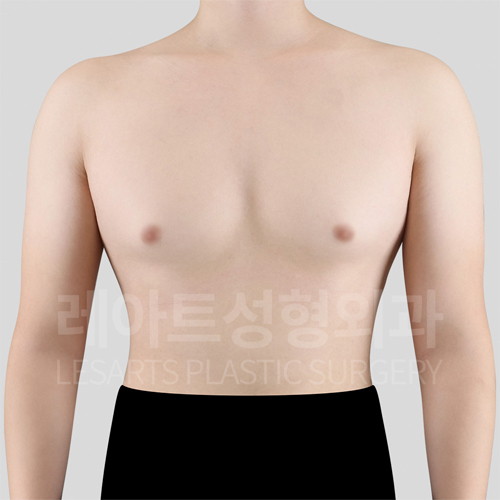
[Before Gynecomastia Surgery: Raised Protruding Chest
Due to Glandular Tissue Development - Lesarts Plastic Surgery]
This patient was a case where gynecomastia symptoms
first appeared in his teens
and continued into his early 20s.
[Patient Information]
Age: Early 20s
Onset of Gynecomastia: Teens
Height: 175 cm
Weight: 69.4 kg
BMI: 22.7
Gynecomastia Diagnosis: Mixed True Gynecomastia, Simon grade 2A
Skin Elasticity: Mild skin laxity
Notes: Taking hair loss medication for about 4–5 years
Although he had consistently maintained exercise and weight management,
his chest protrusion did not change significantly.
Recently, he felt his chest had grown slightly larger than before,
and shared that he had been taking hair loss medication since becoming an adult.
In particular, a firm lump was palpable beneath both areolas
and his nipple and areola protruded forward in a pointed shape,
causing discomfort in his daily life as well.

[Simon Grade 2A: Gynecomastia Surgical Plan Considering Glandular Tissue and Chest Fat - Lesarts Plastic Surgery]
Before surgery, rather than checking external appearance alone,
we performed both palpation and ultrasound
to examine the cause of chest protrusion.
[Diagnosis & Examination Findings]
1. External Findings
- Enlarged chest
- Protrusion of the nipple/areola area
- Simon grade 2A
2. Palpation
- Firm, mobile lump confirmed
beneath both areolas
3. Ultrasound Examination
- Fibrous glandular tissue widely developed
behind both areolas
- Surrounding fat tissue confirmed
Examination results showed that behind the nipple and areola,
actual glandular tissue was widely developed,
and fat tissue was also distributed around it.
Accordingly, we established a surgical plan combining glandular tissue
removal and side chest liposuction to reduce overall chest protrusion.
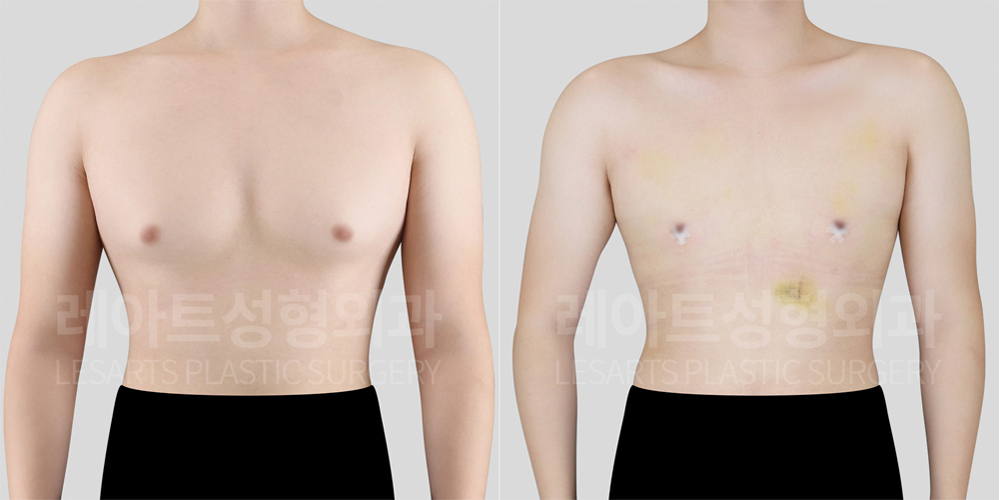
[2 Weeks Before and After Male Gynecomastia Surgery:
Changes in Nipple/Areola Protrusion and Chest Line - Lesarts Plastic Surgery]
Here is how he looks before gynecomastia surgery and about 2 weeks after.
Before surgery, relatively dark shading formed
at the lower part of the chest due to chest volume.
After surgery, as this shading decreased,
you can see that the chest protrusion and bulkiness
observed from the front have also been smoothed out.
However, 2 weeks is still an early recovery period.
Because swelling and bruising remain,
rather than judging the final chest line from his current appearance alone,
it is necessary to continue monitoring the recovery process afterward.
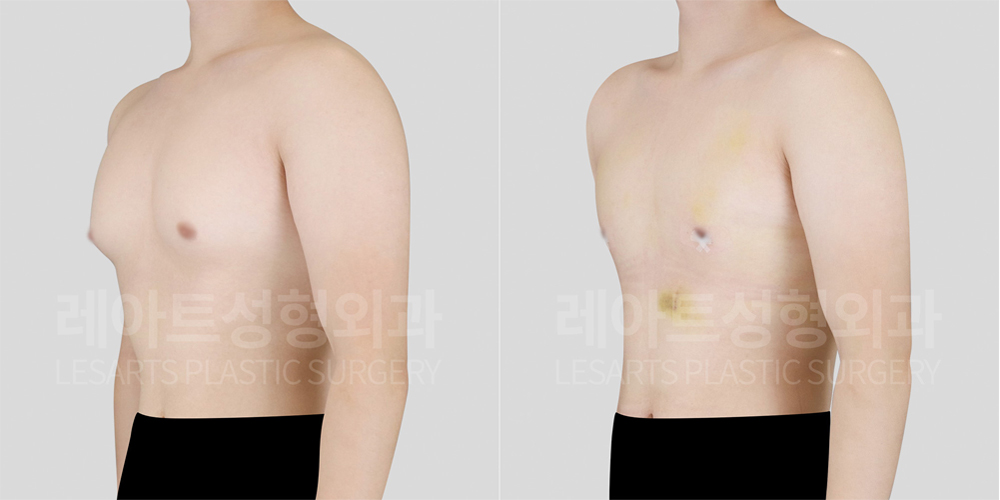
[2 Weeks Before and After Gynecomastia Surgery:
Outer Chest Volume and Overall Contour Changes - Lesarts Plastic Surgery]
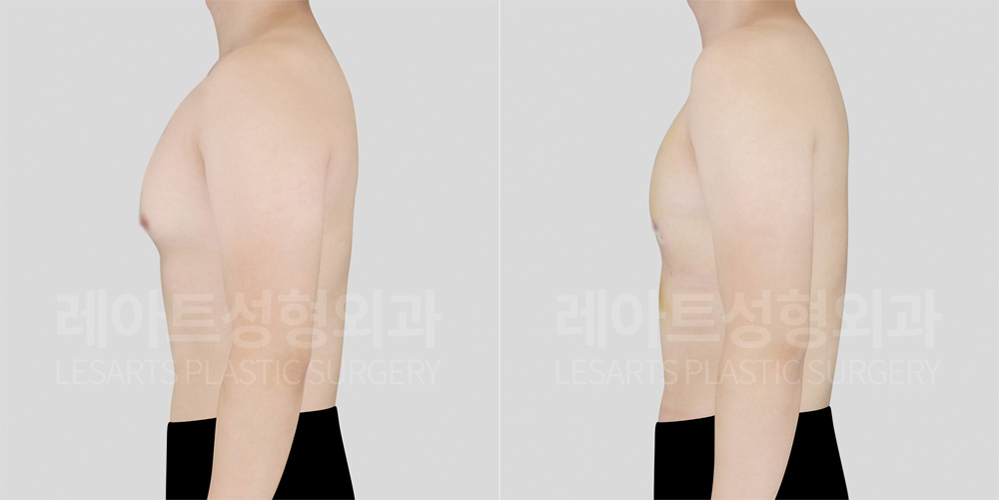
[Side View 2 Weeks After Male Gynecomastia Surgery:
Nipple/Areola Protrusion and Lower Chest Line Changes]
From the 45-degree and side views,
the improvement where protrusion in the nipple and areola area—
which appeared highest on the chest before surgery—has lowered is even clearer.
As the forward-protruding volume centered around the areola decreased,
the shape of his upper chest—which had been hidden—is revealed,
and you can see that the overall chest contour has been refined
into a noticeably different shape.
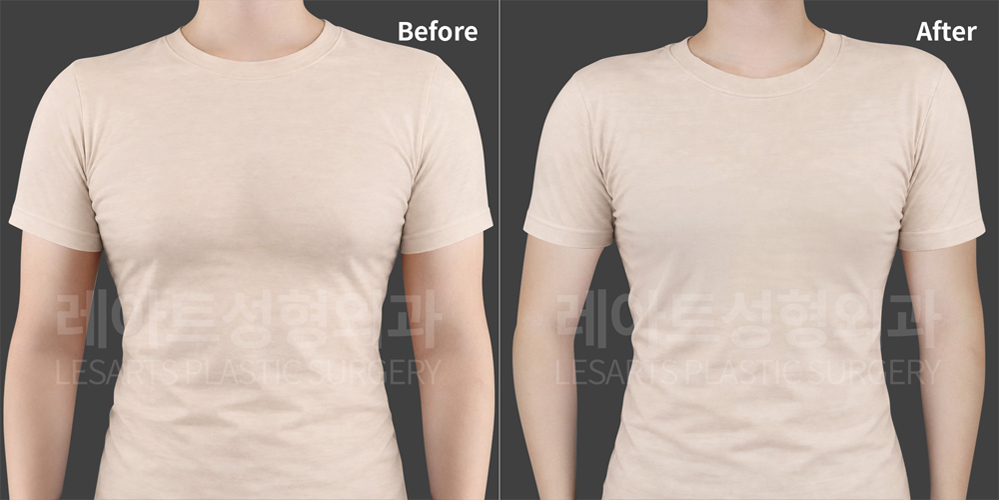
[2 Weeks After Male Gynecomastia Surgery:
T-Shirt Fit Improved by Reduced Chest Protrusion - Lesarts Plastic Surgery]
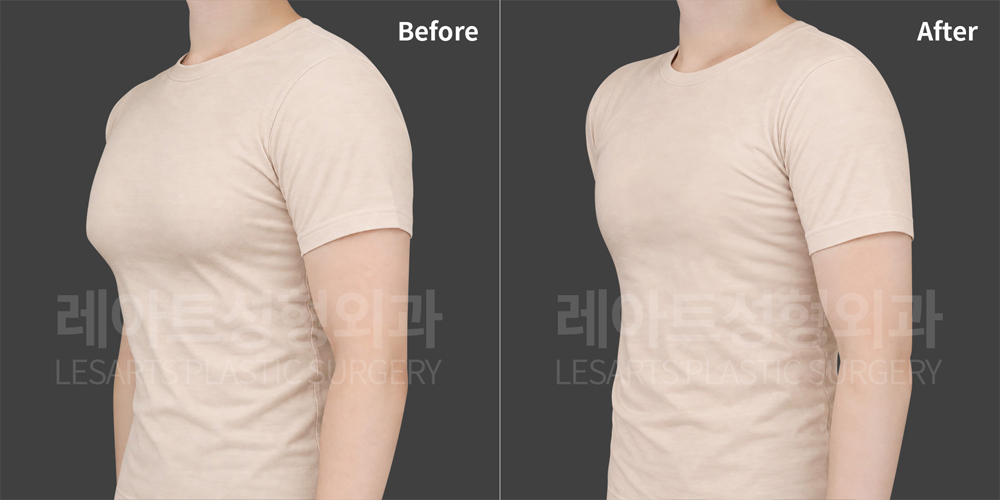
[Gynecomastia That Remained Despite Exercise & Weight Management:
T-Shirt Chest Line Changes 2 Weeks After Surgery - Lesarts Plastic Surgery]
Even when wearing a T-shirt,
a clear difference appeared in how much chest protrusion shows through clothing.
As the chest volume that had remained unchanged
despite consistent exercise and weight management was smoothed out,
you can see a clear improvement in his upper body silhouette
when wearing a T-shirt.
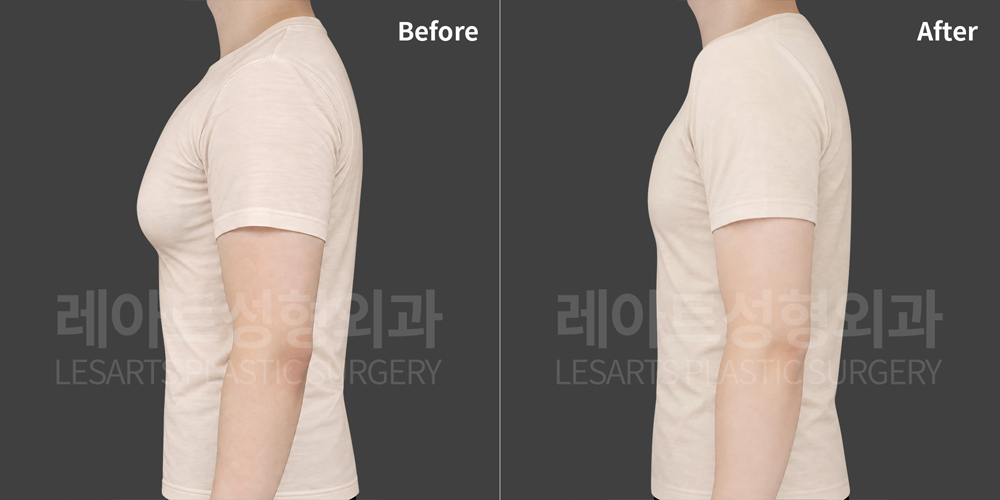
[Male Gynecomastia Accompanied by Areola Protrusion:
Side View Changes in a T-Shirt 2 Weeks After Surgery - Lesarts Plastic Surgery]
The patient had been feeling a lot of stress
in daily life due to gynecomastia.
Even though it is still an early recovery period just 2 weeks after surgery,
he expressed satisfaction with his changed upper body silhouette
when wearing a T-shirt and said he is looking
forward to the rest of the recovery process.
However, because this patient was continuously
taking hair loss medication,
we also explained that it is necessary to periodically check
whether chest size or shape changes again after surgery.
If gynecomastia is suspected
while taking hair loss medication:
Taking hair loss medication
does not cause gynecomastia in all men.
However, if changes that were not present before—
such as chest protrusion, a lump beneath the areola,
or chest pain—occur while taking the medication,
rather than simply assuming it is due to weight gain,
it is necessary to check your current chest condition.
Especially if protrusion centered around the nipple and areola remains
even with continued exercise or weight loss,
rather than checking only the external shape,
it is important to examine through palpation and ultrasound
whether actual glandular tissue is developed behind the areola
and how much surrounding fat tissue is present.
In addition, if you are taking hair loss medication,
even after undergoing gynecomastia surgery,
it is necessary to periodically check for changes in chest size and shape
and monitor your progress.
Gynecomastia Surgery FAQ
Q1. Does everyone who takes hair
loss medication develop gynecomastia?
No. There are individual differences,
and with some hair loss medications, changes such as glandular tissue development,
increased chest size, lumps, or pain can occur.
If these symptoms appear after taking the medication,
it is best to check both your current chest condition and the medication you are taking
together.
Q2. If chest protrusion remains even with exercise,
could it be gynecomastia?
If protrusion or a lump centered around the nipple and areola persists
despite exercise or weight management, you can check whether
glandular tissue is developed.
Rather than judging by external appearance alone,
performing both a physical exam and ultrasound together is helpful.
Q3. What is checked during a gynecomastia ultrasound examination?
You can check how developed the glandular tissue is behind the areola
and the distribution of surrounding fat tissue.
Based on this, we determine which treatment is needed
between glandular tissue removal and liposuction.
Q4. Is the chest shape complete 2 weeks after gynecomastia surgery?
No. Two weeks after surgery is an early recovery period
when swelling and bruising may still remain. As recovery progresses afterward,
the chest contour and tissue condition can continue to change.
Q5. If I am taking hair loss medication,
do I still need checkups after gynecomastia surgery?
Considering the possible link between the medication and chest changes,
it is good to periodically check whether chest size or shape changes
even after surgery.
Whether to continue taking the medication
should be discussed with the prescribing medical staff
rather than stopping or changing it on your own.
#Male body contouring
#Gynecomastia
#Grade2-A #true gynecomastia


Cases finding
similar to my profile
Customer Diagnostics


Select the surgery and
area you are interestedto see real
before andafter changes.


we
make you,
the art
Clinic hours
MON - FRI
10 am – 7pm
SAT
10 am – 4pm
Holiday
SUN, HOLIDAY
Location
Lesarts Moon Clinic Tower 4-5F, 40, Nonhyeon-ro 168-gil,
Gangnam-gu, Seoul, Republic of Korea

Medical institution name Lesarts Plastic Surgery
Address Lesarts Moon Clinic Tower 4-5F, 40, Nonhyeon-ro 168-gil, Gangnam-gu, Seoul, Republic of Korea
Representative Moon sung jun
