




Online Consultation
Please accurately enter the information below.
Quick Cost Consultation
Quick Consultation & Reservation
Cases finding
similar to my profile






Cases finding
similar to my profile
Customer Diagnostics
Is Tummy Tuck Surgery Safe in Your 60s? 2.5-Month Recovery Results | Lesarts Plastic Surgery, Gangnam, Seoul, Korea
2026-10-20
Is a Tummy Tuck Safe for a Mom in Her 60s? 2.5-Month Post-Op Progress
Q. Can someone in their 60s also undergo a tummy tuck?
A. Rather than deciding surgical eligibility based on age alone,
it is important to thoroughly check your current health status,
underlying conditions, and medications.
In this case as well, after confirming that the patient in her 60s
had no particular health issues other than mild high blood pressure,
we provided pre-op medication guidance and conducted real-time monitoring during surgery
to perform an M-Type full tummy tuck.
[ Learn More About Lesarts Tummy Tuck Cases ]
A tummy tuck is a surgery with a wider age range than many people think.
From patients in their 20s to those in their 60s and older,
many come for consultations due to remaining skin sagging after severe obesity,
pregnancy and childbirth, or weight changes.
Recently, there has also been an increase in patients visiting the clinic
due to remaining skin sagging or wrinkles after losing a significant amount of weight
through weight-loss injections
such as Wegovy or Mounjaro.
In this post, we will look at the 2.5-month post-op progress
of a patient in her 60s who decided to undergo a tummy tuck
because abdominal sagging and wrinkles had become more prominent
long after childbirth.
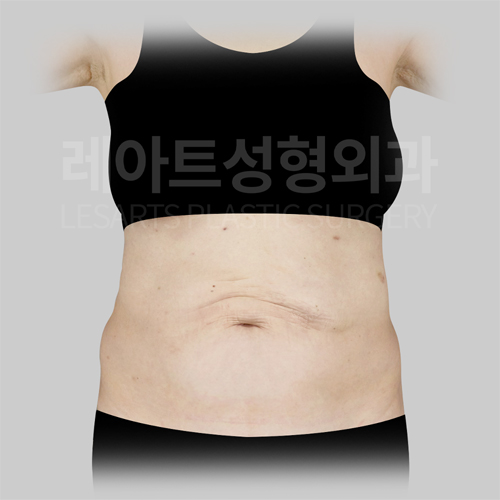
[Before Tummy Tuck: Wrinkles Around the Belly Button and Lower Abdominal Skin Sagging]
Before surgery, skin elasticity had decreased from the upper abdomen to the lower abdomen,
and as the skin above the belly button sagged downward,
even the shape of her belly button was pressed and distorted.
The abdominal wall was also pushed forward,
causing the entire abdomen to protrude bulkily.
Adhesion tissue was also confirmed in the area
where she had previously received fat-dissolving/extraction injections.
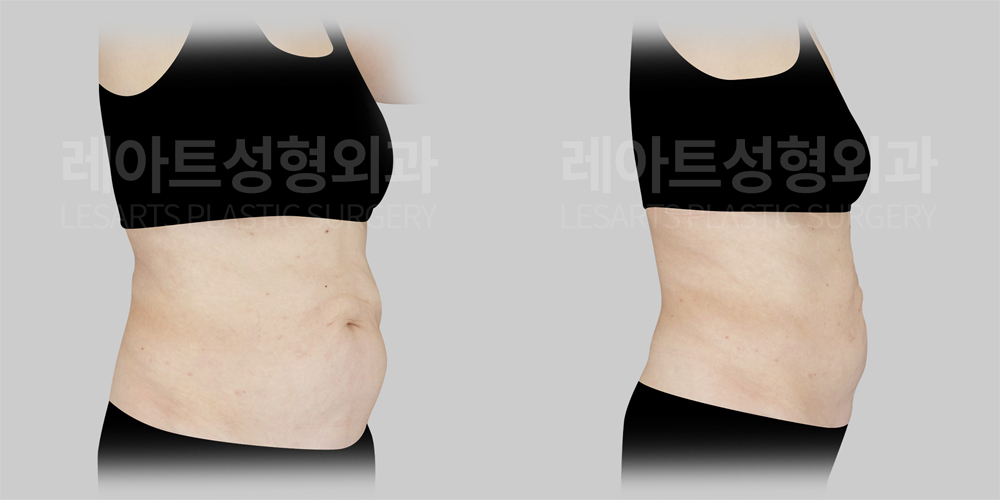
[Before Tummy Tuck: Skin Wrinkles Covering the Belly Button and Lower Abdominal Protrusion]
Summarizing the features confirmed in the pre-op examination,
- Decreased skin elasticity extending from the upper abdomen to the lower abdomen
- Changes in belly button shape due to skin sagging above the belly button
- Abdominal protrusion appearing as the abdominal wall pushed forward
- Adhesion tissue caused by previous fat-extraction injections
were all present together.
Therefore, rather than addressing only part of the lower abdomen,
we determined that an M-Type full tummy tuck lifting the skin of both the upper and lower abdomen
was necessary.
In addition, we aimed to refine the overall abdominal contour
by repairing the separated rectus muscles and performing umbilicoplasty
and abdominal liposuction together.
However, since the patient was in her 60s,
a process of closely examining her pre-op health status
was necessary.
We confirmed that she had no other underlying conditions or
particular health issues other than mild high blood pressure,
and we prepared to perform the surgery safely through pre-op medication guidance
and real-time monitoring during the surgical procedure.
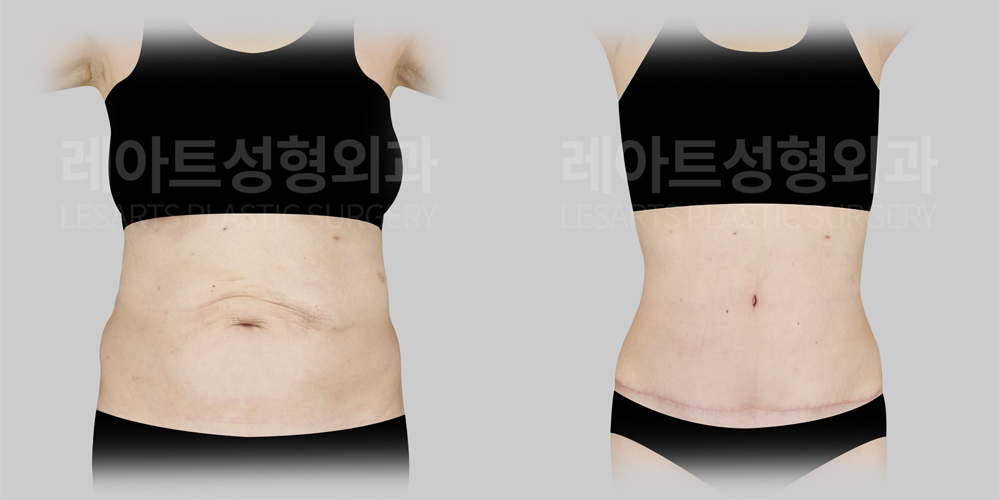
[2.5 Months After Tummy Tuck: Changes in Wrinkles Around the Belly Button and Lower Abdominal Incision Scar]
Before the tummy tuck,
stretched skin from the upper abdomen overlapped
above the belly button, creating several deep wrinkles,
and her belly button also showed a horizontally pressed shape.
After surgery, as these skin wrinkles were smoothed out,
the upper abdominal line flows firmly and you can see that her belly button
has settled into a vertical shape.
The uneven and bulky curves around the belly button, flanks, and lower abdomen
seen from the front also decreased.
The central abdomen, which used to look spread wide horizontally,
also changed into a shape gathered inward through rectus muscle repair.
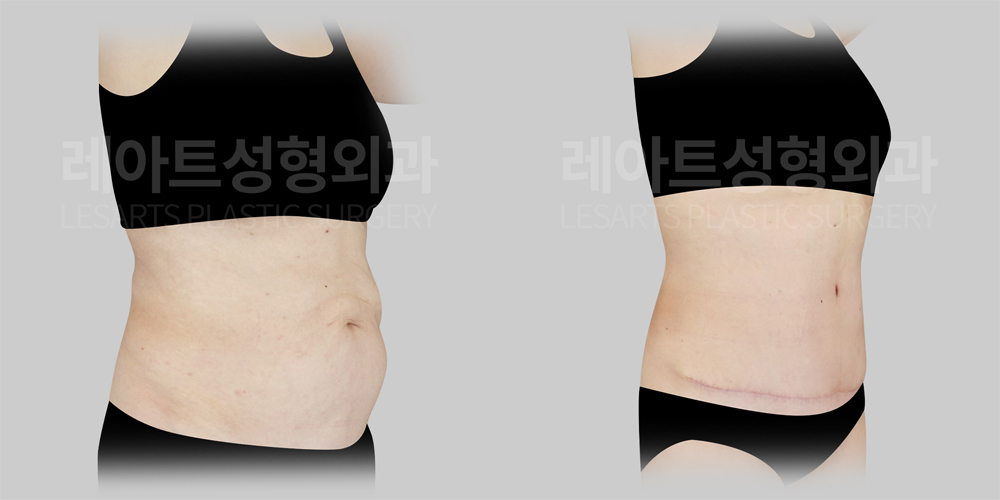
[2.5 Months After Tummy Tuck: Changes in Lower Belly Protrusion and Abdominal Line]
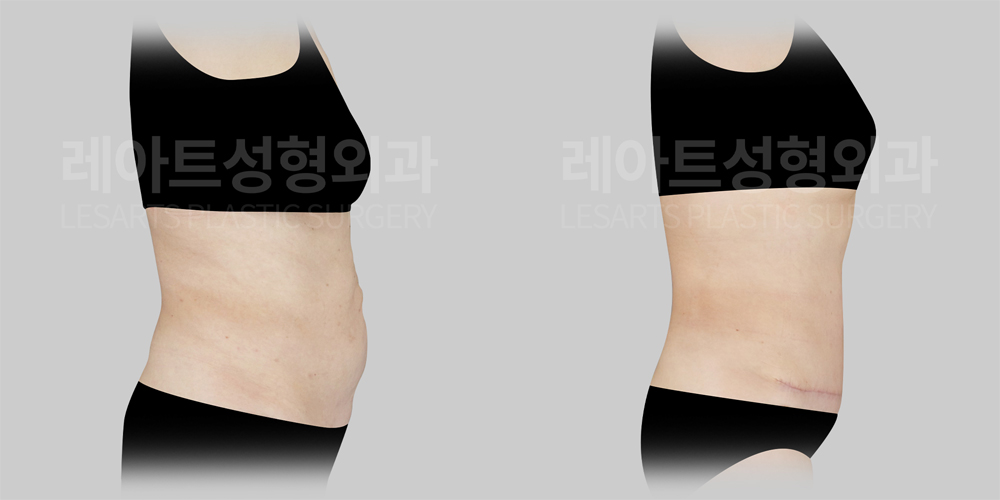
[2.5 Months After Tummy Tuck: Changes in Lower Abdominal Protrusion and Side Abdominal Line]
From the side view,
you can see even more clearly that the front abdomen—which used to be bumpy due to
adhesion tissue along with the forward-protruding abdominal wall—has been smoothed out.
The bulkiness of the lower belly that used to bulge out
above the underwear waistband also decreased.
An important aspect to look at in this case was the patient's age.
Whereas before surgery the abdomen felt heavy due to
stretched skin and wrinkles,
after surgery, as skin sagging decreased and the line was refined,
her overall body shape also changed to a noticeably different impression.
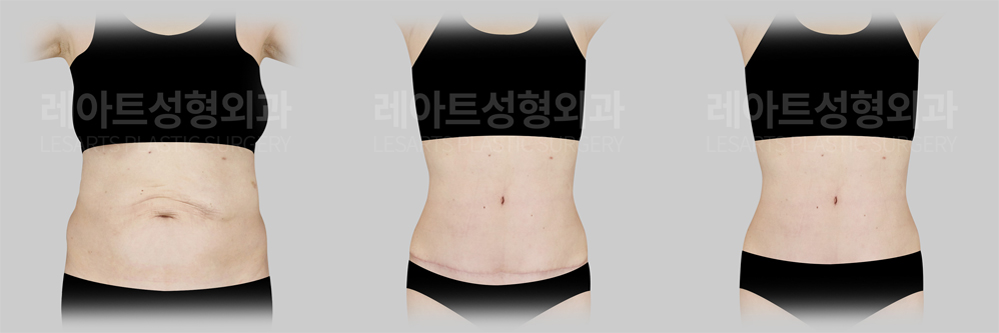
[2.5 Months After Tummy Tuck: Lower Abdominal Horizontal Incision Scar and Recovery Status]
This is currently an early recovery period about 2.5 months
after her tummy tuck.
During this period, redness can appear relatively distinct
along the horizontal incision scar on the lower abdomen.
Scars go through a process of gradually stabilizing and fading
in color over time.
We guided her that she can continue her recovery process afterward
through using Cica-Care scar sheets, moisturizing,
and periodic scar laser treatments.
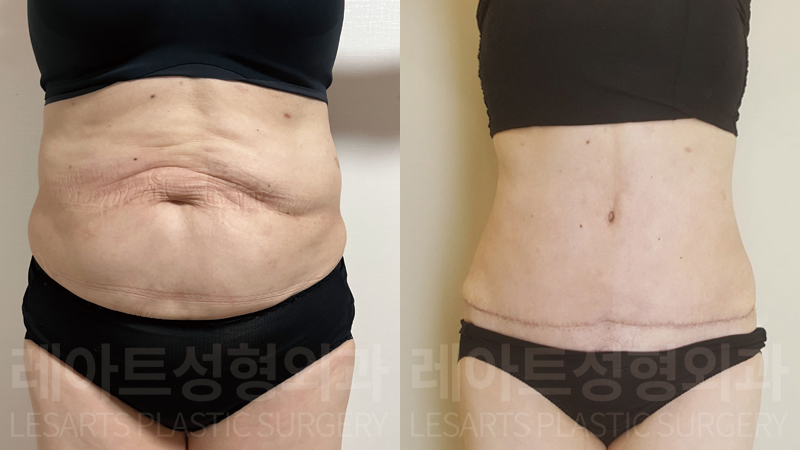
[Comparison of Patient-Taken Photos Before and 1.5 Months After Tummy Tuck]
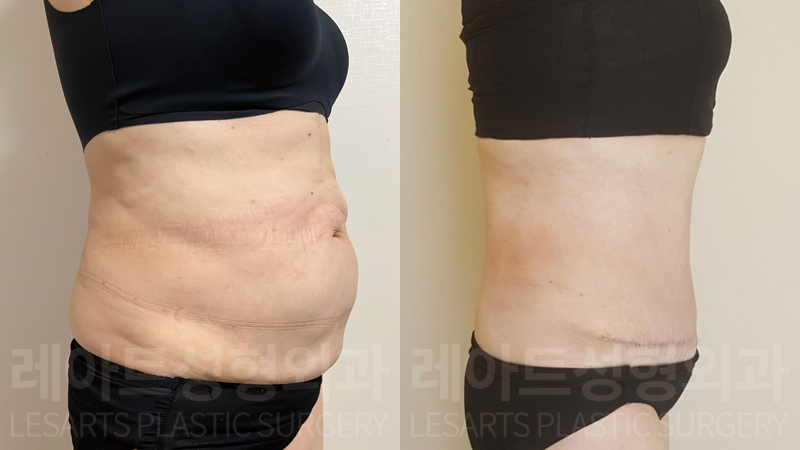
[Comparison of Patient-Taken Photos Before and 1.5 Months After Tummy Tuck]
Even in the photos taken directly by the patient,
you can see the changes in the deep wrinkles around the belly button
and lower abdominal skin sagging that were present before surgery.
However, since the patient-taken photos are from 1.5 months after surgery,
it is necessary to view the progress keeping in mind
that swelling and scars are still in the process of stabilizing.
Recently, an increasing number of patients are coming for tummy tuck consultations
for various reasons regardless of
age or gender.
Sometimes adult children accompany their mothers to consultations,
and conversely, parents sometimes visit with their children.
Because a tummy tuck is a surgery that leaves a relatively long incision scar,
other worries can arise during the decision-making process.
Especially when a patient is older,
rather than simply judging by “Is it possible or impossible because I'm in my 60s?”,
it is necessary to check not only the current abdominal condition, extent of skin sagging,
and condition of the abdominal wall and rectus muscles,
but also underlying conditions and overall health status.
Therefore, if you are considering a tummy tuck,
it is important to thoroughly diagnose your current condition and review
the management plan extending from the surgical process through recovery.
[ Learn More About Lesarts Tummy Tuck Cases ]
Tummy Tuck in Your 60s FAQ
Q1. Can someone in their 60s also get a tummy tuck?
Surgical eligibility is not decided by age alone.
After checking underlying conditions, medications, and overall health status,
surgical eligibility and method must be determined.
Q2. Can long-standing postpartum abdominal skin sagging also be corrected with a tummy tuck?
Even when skin elasticity has decreased significantly long after childbirth,
a tummy tuck can be considered
after checking the current extent of sagging and abdominal wall condition.
Q3. Why are a tummy tuck and rectus muscle repair performed together?
When the rectus muscles are separated and the abdominal wall pushes forward, abdominal protrusion may remain
even if only the skin is pulled. Depending on the rectus muscle condition,
abdominal wall repair can be considered together.
Q4. Does a tummy tuck scar fade a lot after 2.5 months?
Two and a half months is still an early recovery period when the scar can look red.
Color and thickness can continue to change afterward, and depending on progress,
scar sheets or laser care can be considered.
Q5. Is a tummy tuck possible even if I have high blood pressure?
Overall health status—such as the degree of high blood pressure, how well it is controlled, and medications—
must be checked first.
An individual evaluation process through pre-op consultation
and necessary tests is required.
#Abdominoplasty
#M-type


Cases finding
similar to my profile
Customer Diagnostics


Select the surgery and
area you are interestedto see real
before andafter changes.


we
make you,
the art
Clinic hours
MON - FRI
10 am – 7pm
SAT
10 am – 4pm
Holiday
SUN, HOLIDAY
Location
Lesarts Moon Clinic Tower 4-5F, 40, Nonhyeon-ro 168-gil,
Gangnam-gu, Seoul, Republic of Korea

Medical institution name Lesarts Plastic Surgery
Address Lesarts Moon Clinic Tower 4-5F, 40, Nonhyeon-ro 168-gil, Gangnam-gu, Seoul, Republic of Korea
Representative Moon sung jun
