




Online Consultation
Please accurately enter the information below.
Quick Cost Consultation
Quick Consultation & Reservation
Cases finding
similar to my profile






Cases finding
similar to my profile
Customer Diagnostics
Gynecomastia Surgery Recovery: What to Know Before Returning to Exercise | Lesarts Plastic Surgery, Gangnam, Seoul, Korea
2026-10-23
Recovery Period After Gynecomastia Surgery: Precautions to Know Before Returning to Exercise
Q. When can I start exercising again after gynecomastia surgery?
A. Gynecomastia surgery requires time for not only the visible incision site,
but also the internal tissue where glandular tissue was removed to heal.
Because each exercise uses the chest and arms to a different degree
and has different movement intensity,
rather than starting at the exact same time for everyone,
it is important to adjust the type and intensity of exercise
according to your current recovery status.
[ Learn More About Lesarts Male Gynecomastia Surgery Cases ]
If you are someone who exercises regularly,
when deciding on gynecomastia surgery, you will likely be just as curious about
the post-op recovery period, movement restrictions,
and when you can resume exercising as you are about the change in chest shape.
Because gynecomastia surgery is a procedure that physically removes
developed glandular tissue,
recovery is not completely finished just because the visible incision on the skin
has healed.
The internal tissue of the chest
also needs time to stabilize.
In particular, depending on the type of exercise,
the way the chest and arms are used
and the intensity of movement differ,
so the timing of returning to exercise also needs to be
evaluated separately according to your current recovery status.
[ Learn More About Returning to Exercise and Recovery After Gynecomastia Surgery ]

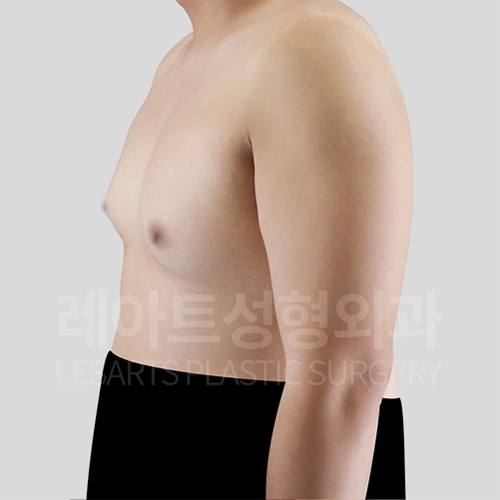
[Before Gynecomastia Surgery: Nipple/Areola Protrusion and Bilateral Glandular Tissue Development]
This patient was in his 30s
and had noticed gynecomastia symptoms since his teens.
After becoming an adult, as discomfort from his protruding chest continued,
he decided to undergo gynecomastia surgery.
He had been consistently doing marathon running and weight management,
and had even experienced losing about 10 kg.
However, regardless of his weight changes,
he shared that there was no noticeable change
in the size or shape of his chest.
[Gynecomastia Surgery Patient Information]
- Age: 30s
- Height: 178 cm
- Weight: 94.9 kg
- BMI: 30.0
- Main Symptoms: Bilateral chest protrusion and nipple/areola protrusion
- Gynecomastia Diagnosis: True Gynecomastia, Simon grade 2B
- Skin Condition: Mild skin laxity
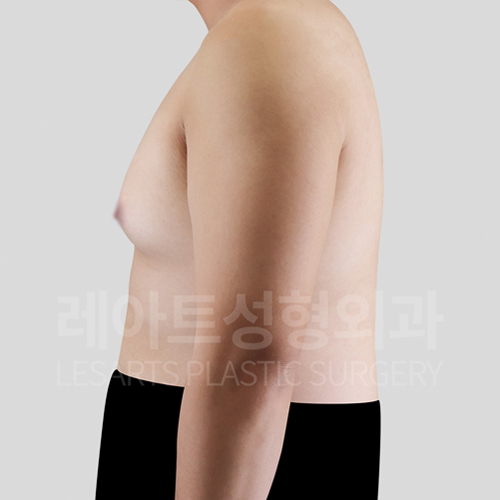
[Gynecomastia Surgical Plan Considering Glandular Tissue Development and Chest Volume]
Looking at his chest condition before surgery,
the area around the nipple and areola stood out forward,
and rounded volume continued down to the lower chest,
making the entire chest protrude forward.
Upon palpation, a firm lump
was felt beneath both areolas.
Ultrasound examination confirmed that the tissue
was fibrous glandular tissue
widely developed behind both areolas.
Chest sagging was also confirmed,
so morphologically it was assessed as corresponding to
Simon grade 2B.
Moreover, glandular tissue was not the only factor
contributing to chest protrusion.
Subcutaneous fat in the lower and side chest
was also making the overall chest volume look larger.
Therefore, while removing the glandular tissue—
the main cause of increased chest size—
we planned to also suction the surrounding fat
to reduce chest size and protruding contours and create a chest line
that flows along the ribcage.
After removing glandular tissue,
the possibility of indentation around the nipple and areola
or adhesion forming must also be considered.
Accordingly, tissue rearrangement beneath the nipple and areola
and anti-adhesion treatment were also performed together.
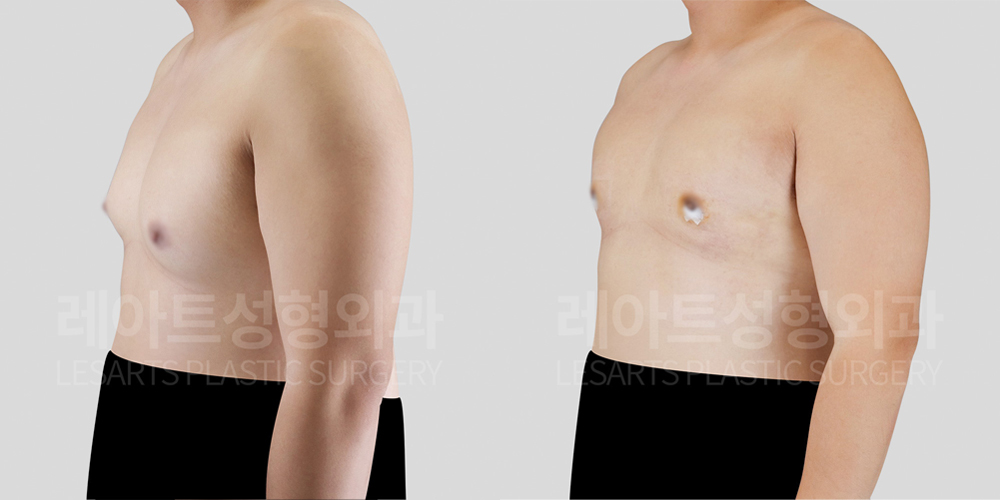
[16 Days After Gynecomastia Surgery: Reduced Chest Protrusion and Chest Line Changes - Lesarts Plastic Surgery]
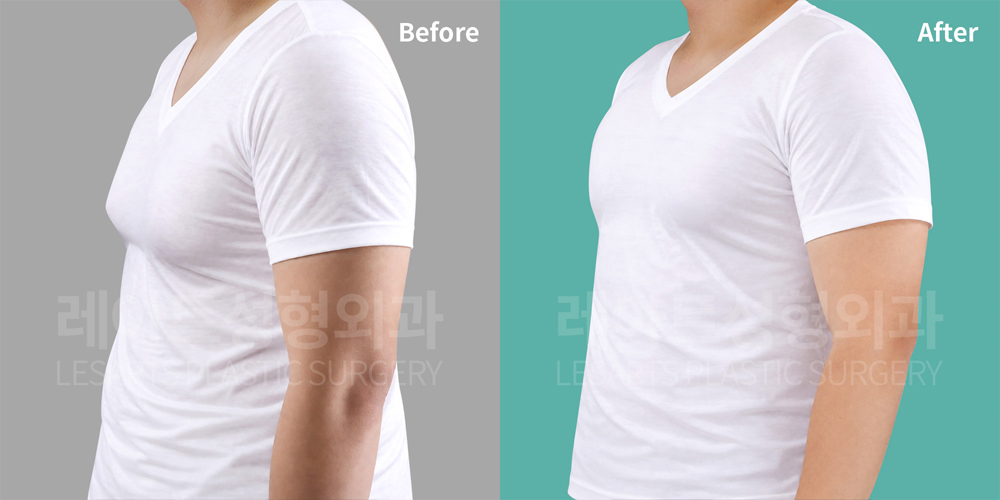
[16 Days After Gynecomastia Surgery: Chest Protrusion and Clothing Fit Changes Under a T-Shirt - Lesarts Plastic Surgery]
Here is how he looks about 2 weeks after gynecomastia surgery.
By removing the glandular tissue and performing chest liposuction together,
the forward-standing chest volume decreased,
and you can see that the rounded contour extending to the lower chest
has also been gently smoothed out.
Before surgery, as volume continued from around the nipple and areola to the lower chest,
chest curves and shadowing stood out even through a T-shirt.
After surgery, as the volume in this area decreased,
you can see that the chest line when wearing a T-shirt
has noticeably changed compared to before.
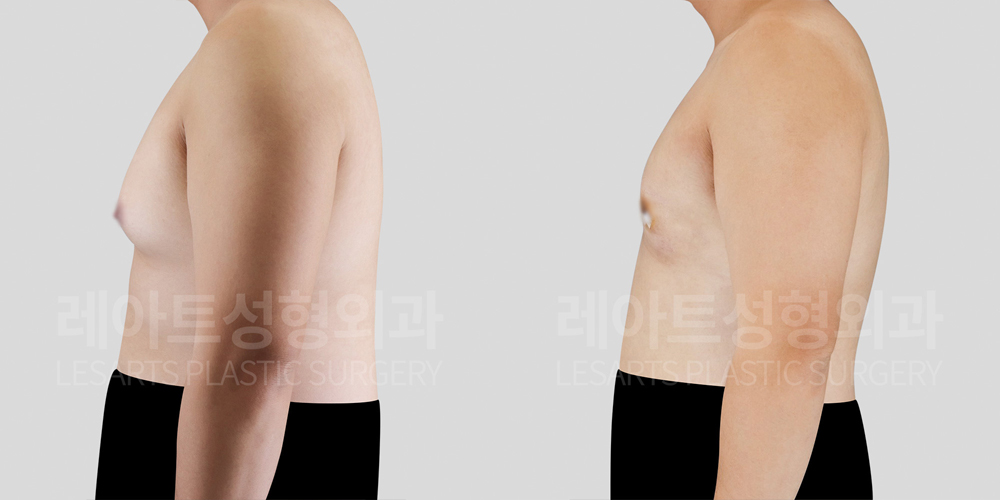
[2 Weeks After Gynecomastia Surgery: Changes in Forward-Protruding Chest - Lesarts Plastic Surgery]
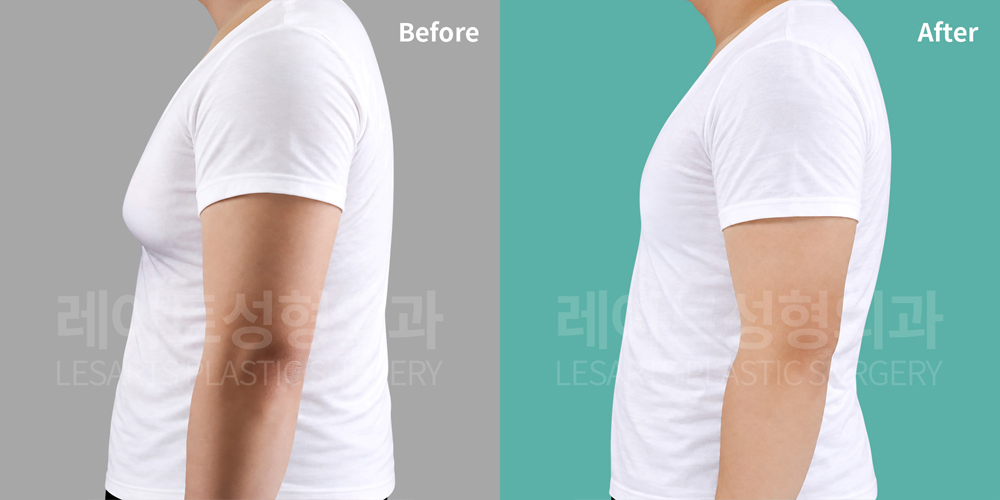
[Chest Protrusion That Stood Out Under a T-Shirt: T-Shirt Fit Changes 2 Weeks After Gynecomastia Surgery - Lesarts Plastic Surgery]
Comparing from the side,
the reduction in volume of the chest
that used to protrude forward before surgery is even clearer.
You can also see that the line flowing from the lower chest to the upper abdomen
connects more gently than before.
Even though the patient had continued marathon running and weight management,
his chest protrusion had not easily changed.
After surgery, as chest volume decreased,
he expressed satisfaction that the part that bothered him
whenever he wore thin T-shirts was reduced.
This is currently an early recovery stage about 2 weeks after surgery.
Therefore, swelling and tissue firmness may still remain,
and over time, these will gradually subside,
allowing the chest skin and contour to slowly settle into place.
During this period, it is important to wear a compression garment
according to the method instructed by the medical staff,
and to take care not to apply excessive stimulation to the surgical area.
For exercise as well, rather than immediately starting at your previous intensity
simply because the visible wound has healed,
it is better to resume while adjusting the type and intensity of exercise
considering the current recovery status
of the internal tissue.
If you continue consistent daily body management along with surgical site care,
it can be helpful for monitoring your recovery progress afterward.
[ Learn More About Lesarts Male Gynecomastia Surgery Cases ]
Recovery Period & Returning to Exercise After Gynecomastia Surgery FAQ
Q1. Can I exercise right away once the wound heals after gynecomastia surgery?
Even if the visible incision site has healed,
the internal area where glandular tissue was removed
may still be recovering.
Therefore, rather than judging whether you can exercise by looking only at the external wound,
it is important to check the current internal tissue condition together.
Q2. Can all exercises be started at the same time after gynecomastia surgery?
Because each exercise uses the chest and arms to a different degree
and has different movement intensity,
it is difficult to apply the same standard to all.
It is best to resume gradually
considering both the type of exercise and your recovery status.
Q3. Is the chest shape complete 2 weeks after gynecomastia surgery?
No. Around 2 weeks is an early recovery period when swelling and
tissue firmness may still remain.
As recovery progresses afterward, the chest skin
and contour can continue to change.
Q4. Why do I need to wear a compression garment after gynecomastia surgery?
It is worn to help the recovery process as tissues stabilize after surgery.
Because the degree of compression and wearing method can vary depending on surgical scope and skin condition,
it is important to wear it according to the instructions given.
Q5. Can gynecomastia remain even if I exercise consistently?
If the cause of gynecomastia is developed glandular tissue, weight loss
or exercise alone will not eliminate the gland itself.
If chest protrusion persists despite exercise and weight management,
you can check the distribution of glandular tissue and
surrounding fat through palpation and ultrasound.
#Male body contouring
#Gynecomastia
#Grade2-B #true gynecomastia


Cases finding
similar to my profile
Customer Diagnostics


Select the surgery and
area you are interestedto see real
before andafter changes.


we
make you,
the art
Clinic hours
MON - FRI
10 am – 7pm
SAT
10 am – 4pm
Holiday
SUN, HOLIDAY
Location
Lesarts Moon Clinic Tower 4-5F, 40, Nonhyeon-ro 168-gil,
Gangnam-gu, Seoul, Republic of Korea

Medical institution name Lesarts Plastic Surgery
Address Lesarts Moon Clinic Tower 4-5F, 40, Nonhyeon-ro 168-gil, Gangnam-gu, Seoul, Republic of Korea
Representative Moon sung jun
