




Online Consultation
Please accurately enter the information below.
Quick Cost Consultation
Quick Consultation & Reservation
Cases finding
similar to my profile






Cases finding
similar to my profile
Customer Diagnostics
Thigh Liposuction for Saddlebags and Inner Thigh Fat: Improving Leg Proportions | Lesarts Plastic Surgery, Gangnam, Seoul, Korea
2026-10-26
Leg Line Looking Short Due to Saddlebags: How to Bring Out Proportions with Thigh Liposuction
Q. If I don't weigh much, but saddlebags make
my legs look short and thick, can thigh liposuction change my proportions?
A. If fat is concentrated in the upper thigh—especially the inner thighs and saddlebags—
the thickness difference between the upper and lower parts increases, making the legs look short and bulky.
In this case, rather than simply removing a large amount of fat, it is important to check
where the fat is concentrated and the degree of front thigh muscle development together,
reducing upper volume while balancing the line
flowing downward.
[ Learn More About Lesarts Thigh Liposuction Cases ]
“You’re already slim enough—why are you trying to lose weight?”
Even if you look slim to others,
there is usually at least one area that has bothered you
for a long time.
In particular, saddlebags on the outer thighs
or excess fat concentrated on the inner thighs can affect
how clothes fit regardless of your overall weight.
For this reason, many try losing weight,
but losing weight does not necessarily reduce fat in those specific problem areas
as much as you want.
In the thighs, fat distribution and thickness differ by area—front, inner, and outer—
and the overall leg line also varies depending on muscle development.
Especially when fat is concentrated in the upper inner thighs and saddlebags,
the thickness difference with the lower leg increases, making the legs look thick and heavy.
Also, when the horizontal width of the upper thigh widens,
it can even make the legs look shorter in proportion.
In this post, we will look at the surgical plan and 2-week post-op changes
of a patient in her 30s who visited us with these thigh line concerns.
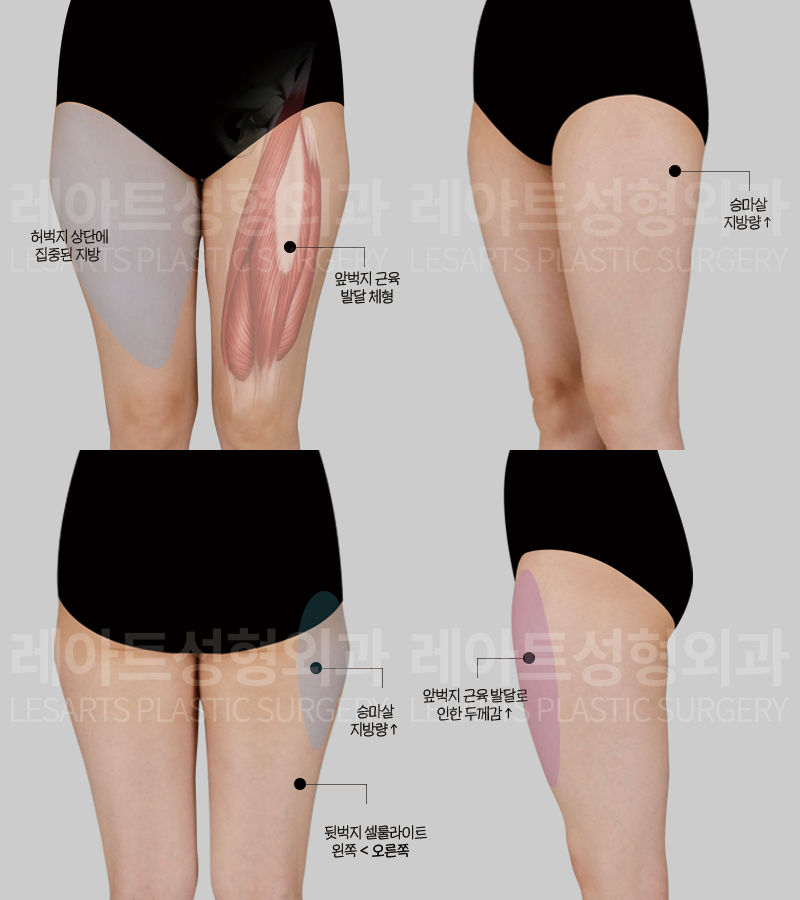
[Before Thigh Liposuction: Surgical Plan Considering Fat Distribution and Muscle - Lesarts Plastic Surgery]
The patient maintained a standard weight
at 168 cm, 58.6 kg, and a BMI of 20.8.
However, she had a body type with a large width difference between the upper and lower thighs.
In particular, fat was concentrated around her inner thighs and saddlebags,
making her overall leg proportions and line look less balanced.
Therefore, we planned the surgery to reduce the thickness of her inner thighs and saddlebags
while balancing the line flowing
from the upper thigh to the lower thigh.
However, the volume in her front thighs was not caused by fat alone.
Because her front thigh muscles were also well-developed,
removing too much fat could actually
make the muscle line stand out more.
Therefore, it was important to adjust the depth of the fat layer
so that the entire thigh connects dimensionally
without exposing the muscle contours.
She also had mild cellulite on the back of her thighs,
which was slightly more noticeable on the right side than the left.
We explained in advance that while reducing thigh volume can make cellulite less noticeable than before,
liposuction does not remove the fibrous tissue beneath the skin,
so some cellulite may still remain after surgery.
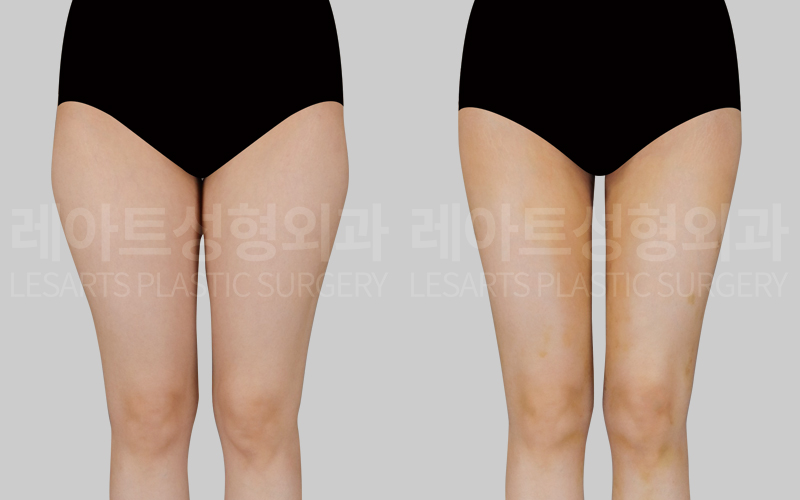
[2 Weeks Before and After Thigh Liposuction: Inner Thigh and Saddlebag Line Changes]
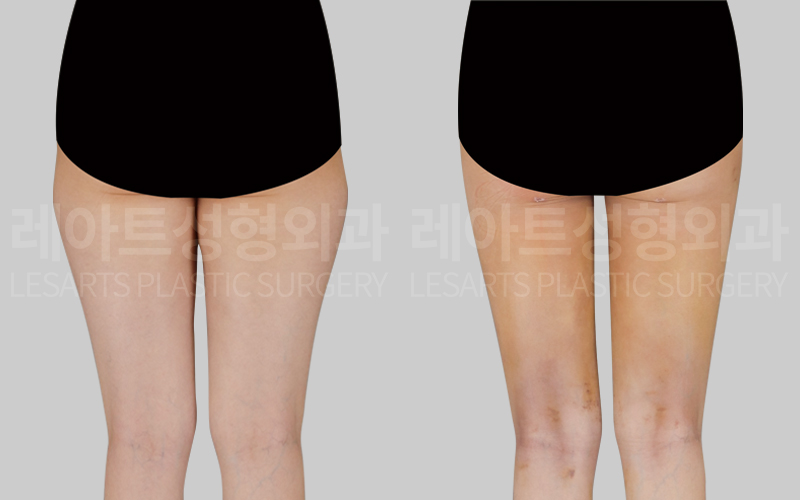
[2 Weeks Before and After Thigh Liposuction: Back-of-Thigh Thickness and Outer Line Changes]
Here is how she looks before thigh liposuction
and about 2 weeks after surgery.
As the thickness of her inner thighs—which bothered the patient the most—decreased,
a gap formed between both thighs,
and you can see that the inner line also flows in a nearly straight shape.
As the saddlebags on the outer thighs were also contoured,
the starting point of the legs—which looked low before surgery—has noticeably shifted higher.
Although it is still 2 weeks post-op with significant swelling,
you can already see the early improvement where the horizontal width at the top narrowed
as excess fat on the inner and outer thighs decreased.
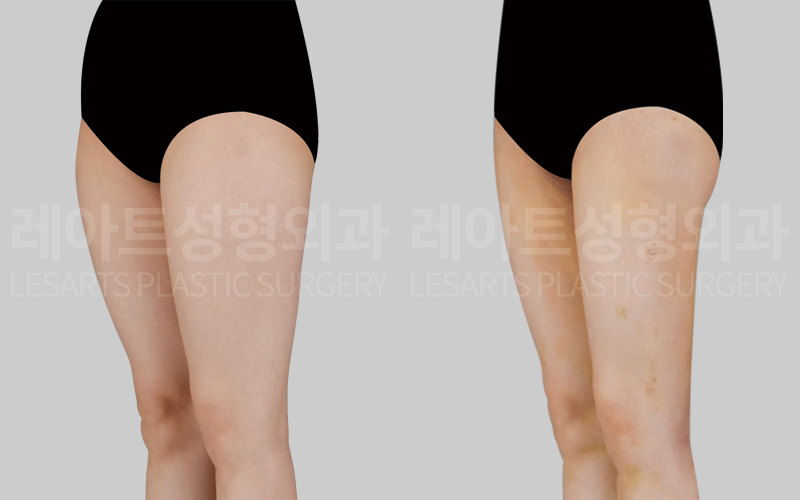
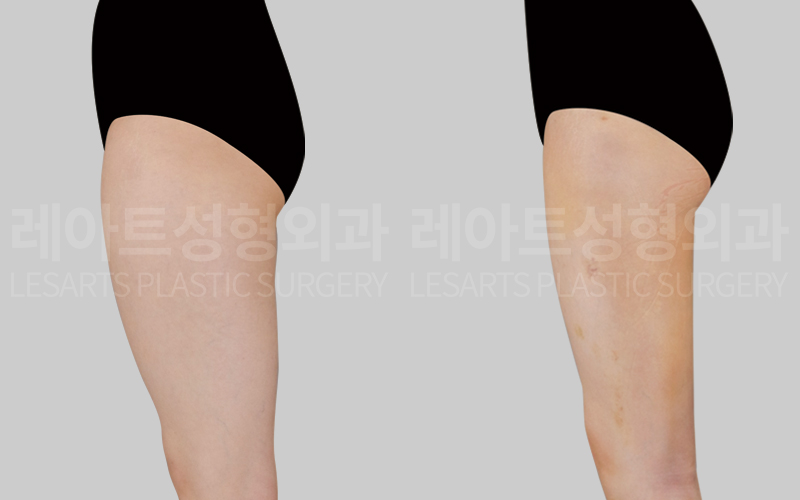
[Saddlebag Liposuction: Outer Thigh Protrusion and Leg Line Changes]
From the side view, the reduction in overall thigh circumference
and the refined outer line are clearly visible.
Before surgery, the thickness of the upper thigh extending from the saddlebags to the buttocks
covered the hip line, making her legs look thick and short.
After the volume in the upper thigh decreased,
the outer line flows straightly,
revealing the previously hidden hip line.
As a result, as the thickness at the top decreased,
her overall leg proportions also changed.
[Thigh Liposuction: Front Thigh Volume and Leg Proportion Changes]
For the front thighs, as planned before surgery,
we reduced volume within a range where muscles would not stand out excessively.
In the case of front thighs, focusing solely on reducing fat
could have emphasized the shape of the developed muscles,
so we adjusted the depth of the fat layer and suction volume
while considering the line connecting to the entire thigh.
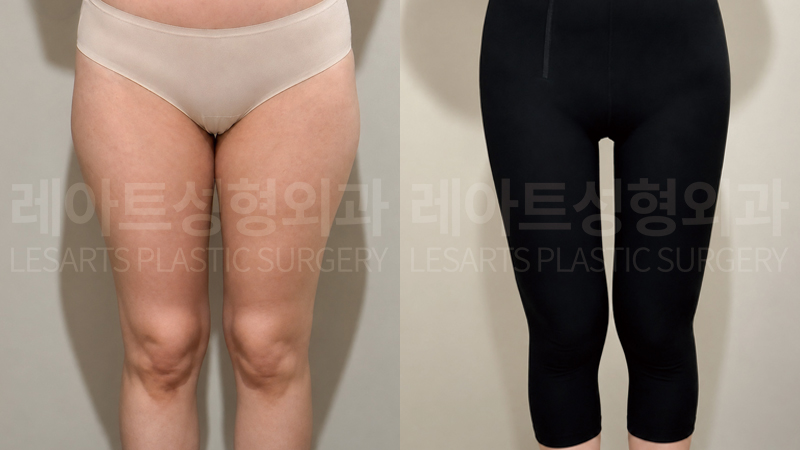
[Selfie Comparison: Before and Same Day After Thigh Liposuction]
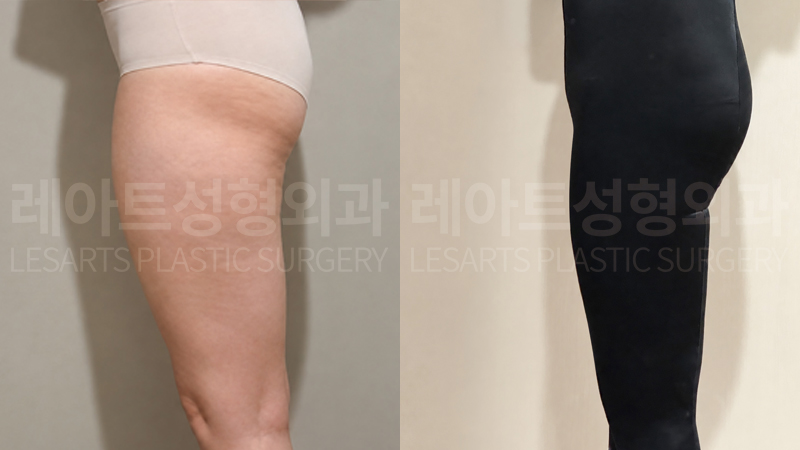
[Selfie Comparison: Before and Same Day After Thigh Liposuction]
Even in the photos taken directly by the patient,
you can see the difference in the inner thighs and
saddlebag area compared to before surgery.
However, since these photos were taken on the day of surgery as an early look,
it should be kept in mind that swelling and tissue changes
can occur afterward.
The patient also expressed satisfaction with the changes in her saddlebags and inner thigh line
after thigh liposuction,
and shared that as her overall leg proportions improved,
she gained more confidence.
Even if you do not weigh much overall like this patient,
if fat is concentrated in specific areas,
you may consider liposuction because your leg proportions look lacking
or clothes don't fit the way you want.
However, in thigh liposuction,
blindly removing a large amount of fat is not what matters most.
It is important to design the line by considering the fat volume in areas that determine overall proportions,
the fat volume in surrounding connected areas, and even the shape of the muscles.
Especially in areas with developed muscles like the front thighs,
you must anticipate how the muscles will show when fat is reduced.
Therefore, it is important to accurately check your current fat distribution and muscle shape
before planning the surgical scope and suction volume suited to your individual body type.
[ Learn More About Lesarts Thigh Liposuction Cases ]
Thigh Liposuction FAQ
Q1. Can having prominent saddlebags make my legs look shorter?
When fat is concentrated in the saddlebags and upper thighs,
the thickness difference between the upper and lower parts increases,
which can make the starting point of the legs look lower.
Reducing volume in that area can also improve overall proportions.
Q2. Can inner thigh liposuction create a thigh gap?
If there is sufficient fat distributed in the inner thighs, reducing fat volume
can create an improvement in the space between the thighs.
However, the possible range varies depending on muscle and bone structure.
Q3. Is liposuction still possible even if my front thigh muscles are well-developed?
It may be possible, but the shape of the muscles must be considered together.
Because removing too much fat can make developed muscles stand out more,
it is important to adjust suction volume and depth.
Q4. Does thigh liposuction also get rid of cellulite?
While reducing fat volume can make cellulite less noticeable,
liposuction does not remove the fibrous tissue beneath the skin that causes cellulite,
so some may remain.
Q5. Is 2 weeks after thigh liposuction the final result?
No. Two weeks after surgery is an early recovery period when significant swelling may still remain.
As swelling subsides and tissues stabilize afterward, the leg line can continue to change.
#Liposuction
#Thigh
#Thigh Gap #Lateral thigh #Front thigh #BMIbelow30(thigh)


Cases finding
similar to my profile
Customer Diagnostics


Select the surgery and
area you are interestedto see real
before andafter changes.


we
make you,
the art
Clinic hours
MON - FRI
10 am – 7pm
SAT
10 am – 4pm
Holiday
SUN, HOLIDAY
Location
Lesarts Moon Clinic Tower 4-5F, 40, Nonhyeon-ro 168-gil,
Gangnam-gu, Seoul, Republic of Korea

Medical institution name Lesarts Plastic Surgery
Address Lesarts Moon Clinic Tower 4-5F, 40, Nonhyeon-ro 168-gil, Gangnam-gu, Seoul, Republic of Korea
Representative Moon sung jun
