




Online Consultation
Please accurately enter the information below.
Quick Cost Consultation
Quick Consultation & Reservation
Cases finding
similar to my profile






Cases finding
similar to my profile
Customer Diagnostics
M-Type Full Tummy Tuck: 11-Month Changes in Lower Belly Sagging and Skin Folds | Lesarts Plastic Surgery, Gangnam, Seoul, Korea
2026-11-06
Tummy Tuck in Your 40s: How Much Did Lower Belly Skin Sagging and Folding Improve?
Q. If my lower belly won't go down even with exercise and skin folding remains, can I consider a tummy tuck?
A. When abdominal protrusion is caused not only by subcutaneous fat,
but also by stretched skin and laxity of the abdominal wall,
it can be difficult to achieve the desired changes through exercise alone.
If skin sagging extends from the upper abdomen to the lower abdomen
and the abdominal wall is also pushed forward,
we can check the overall extent of skin sagging and the condition of the rectus abdominis muscles
to consider a tummy tuck together with rectus muscle repair.
[ Learn More About Lesarts Tummy Tuck Cases ]
In this post, we will look at an M-Type full tummy tuck case of a female patient in her 40s
who still had lower belly skin sagging and folding after a C-section delivery.

[Before Tummy Tuck: Fine Wrinkles Around the Belly Button and Lower Abdominal Skin Sagging - Lesarts Plastic Surgery]
Looking at her abdomen before surgery,
there were fine wrinkles above the belly button,
and below the belly button, the skin stretched downward,
forming horizontal folding creases.
A bulging line along her flanks was also noticeable.
Although the patient had maintained her weight without major fluctuations
since her C-section delivery,
she was concerned that her lower belly wouldn't go down even with exercise
and her waistline wasn't shaping
the way she wanted.

[Before Tummy Tuck: Surgical Plan Considering Skin Sagging and C-Section Scar - Lesarts Plastic Surgery]
From the side view, curving and protrusion of the front abdomen were also visible.
Not only subcutaneous fat and skin laxity,
but also the abdominal wall pushing forward
made the abdomen look bulky.
Accordingly, we planned the surgery as follows.
1. M-Type Full Tummy Tuck
To improve the skin sagging that started from the upper abdomen,
we planned an M-Type full tummy tuck.
2. Rectus Abdominis Muscle Repair, Triple Lock
To correct the forward-protruding abdominal wall
and create a firmer, slimmer waistline,
we planned rectus muscle repair using the Triple Lock method.
3. Umbilicoplasty (Belly Button Reshaping)
In the process of pulling stretched skin downward from the upper abdomen
and removing it,
the existing belly button shifts as well.
To match the newly refined abdominal contour,
we planned to reconstruct the belly button as well.
4. Abdominal Liposuction
Although the overall amount of abdominal fat was not large,
we decided to perform liposuction on key areas
needed to improve the overall contour.

[11 Months After M-Type Tummy Tuck: Changes in Fine Wrinkles Around the Belly Button and Lower Abdominal Skin Sagging - Lesarts Plastic Surgery]
 [11 Months After M-Type Tummy Tuck: Changes in Lower Abdominal Protrusion and Waistline - Lesarts Plastic Surgery]
Here is how she looks 11 months
after her tummy tuck.
As the fine wrinkles above the belly button before surgery
and the horizontal creases formed by folding lower abdominal skin were smoothed out,
you can see that the front abdominal line flows more smoothly than before.
With rectus muscle tightening and abdominal liposuction performed together,
the area where the abdominal wall used to push forward was refined,
and both the abdomen and waistline changed noticeably.

[11 Months After Full Tummy Tuck: Changes in Front Abdominal Protrusion and Lower Abdominal Line - Lesarts Plastic Surgery]
Comparing from the side,
the abdomen that used to protrude unevenly forward before surgery
now looks flatter and more refined after surgery.
Unnecessary subcutaneous fat was also contoured
within the needed range, reducing her waist circumference,
and the curve flowing from the love handles to the upper buttocks
connects more smoothly than before.

[11 Months After Full Tummy Tuck: Changes in Lower Abdominal Skin Folding and Sagging When Bending Forward - Lesarts Plastic Surgery]
When bending forward at the waist,
the difference before and after surgery is even clearer.
Before surgery, when bending forward,
the skin sagged downward
and the abdominal wall also protruded forward as if spilling out,
creating multiple layers of creases in the lower abdomen.
After surgery, as this skin sagging, abdominal wall protrusion,
and overlapping creases decreased, the front abdomen stays firmer
than before even when bending forward.
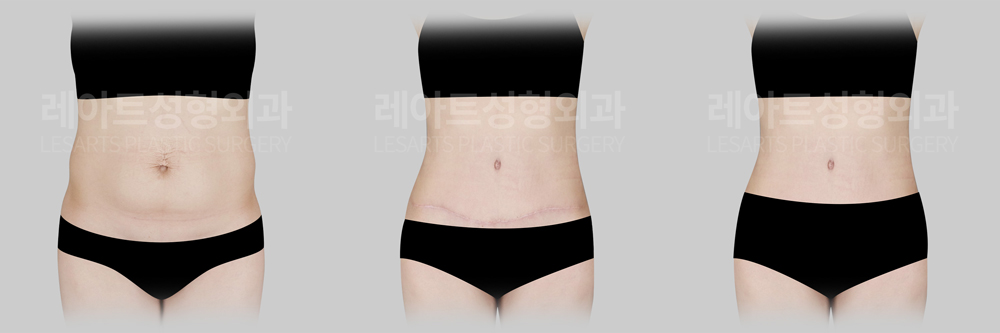
[11 Months After Tummy Tuck: Changes in Lower Abdominal Incision Scar and Belly Button Scar - Lesarts Plastic Surgery]
Now at 11 months after surgery,
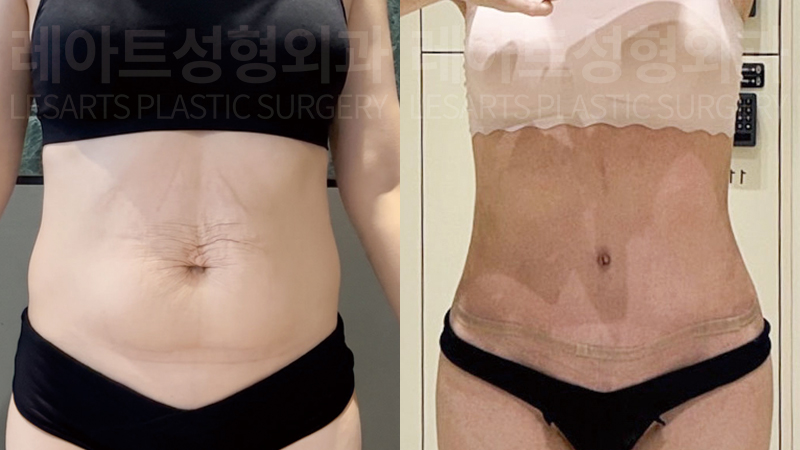
[Comparison of Patient-Taken Photos Before and 2 Months After Tummy Tuck]
#Abdominoplasty
#M-type


Cases finding
similar to my profile
Customer Diagnostics


Select the surgery and
area you are interestedto see real
before andafter changes.


we
make you,
the art
Clinic hours
MON - FRI
10 am – 7pm
SAT
10 am – 4pm
Holiday
SUN, HOLIDAY
Location
Lesarts Moon Clinic Tower 4-5F, 40, Nonhyeon-ro 168-gil,
Gangnam-gu, Seoul, Republic of Korea

Medical institution name Lesarts Plastic Surgery
Address Lesarts Moon Clinic Tower 4-5F, 40, Nonhyeon-ro 168-gil, Gangnam-gu, Seoul, Republic of Korea
Representative Moon sung jun
