




Online Consultation
Please accurately enter the information below.
Quick Cost Consultation
Quick Consultation & Reservation
Cases finding
similar to my profile






Cases finding
similar to my profile
Customer Diagnostics
Thigh Liposuction for Upper Thigh Fullness: 1.5-Month Results | Lesarts Plastic Surgery, Gangnam, Seoul, Korea
2026-11-09
Upper Thigh Thickness: How Much Can It Be Reduced with Liposuction?
Q. If I don't weigh much overall, but only my upper thighs look thick, can liposuction slim them down?
A. If fat is concentrated in the upper thigh area, such as the inner thighs and saddlebags,
you can expect a reduction in upper thigh circumference through liposuction.
However, because other factors besides fat—such as front thigh muscles, bone structure, and knee protrusion—also have an impact,
rather than blindly removing as much fat as possible from every area,
it is important to distinguish between fat to leave behind and fat to reduce.
[ Learn More About Lesarts Thigh Liposuction Cases ]
Among those considering thigh liposuction,
even if they are not overweight overall,
many feel stressed because their upper thighs look thick
or excess fat stands out.
For this reason, many expect that removing excess fat from the areas that bother them with liposuction
will transform their legs into a slim, smooth line overall.
However, in actual consultations, thickness or protrusion can appear
even in areas that do not have a large amount of fat.
That is because the shape of the thighs is influenced not only by fat,
but also by the degree of muscle development, skeletal characteristics,
and skin condition.
Therefore, in thigh liposuction,
it is important to distinguish between areas where fat should be reduced and areas where it should be preserved,
and to plan the surgery to match overall body proportions.
In this post, we will look at this through an actual case
of a female patient in her 30s.
[Patient Information]
Age: 30s
Height: 158 cm
Weight: 50.5 kg
BMI: 20.2
Body Fat Percentage: 34.7%
※ Even with similar physical conditions,
liposuction results may vary individually depending on
fat distribution and muscle development.
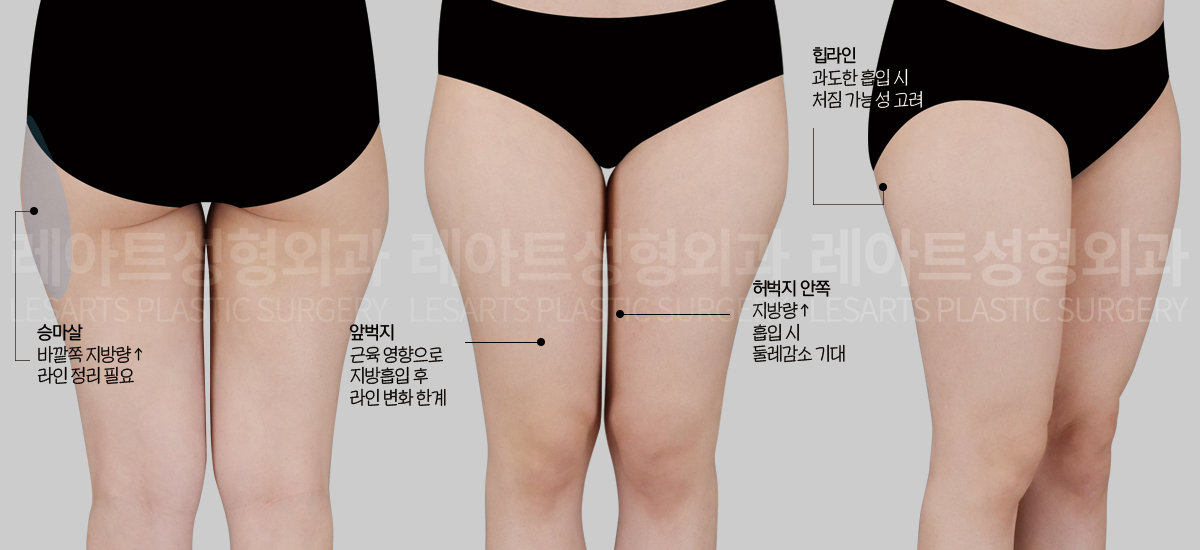
[Before Thigh Liposuction: Surgical Plan Focusing on Saddlebags and Hip Line - Lesarts Plastic Surgery]
The patient had previously undergone
arm and armpit liposuction at Lesarts,
and satisfied with her previous results, she visited us again
this time to improve her thigh line.
Although she was within the standard weight range,
fat was concentrated in her upper thighs,
and she wanted to improve the bulky appearance of her overall body shape.
Examination showed that there was sufficient removable fat
in her inner thighs and outer saddlebags.
Therefore, reducing fat in those areas
was expected to create a noticeable reduction
in her upper thigh circumference.
[Why We Didn't Remove All Inner Thigh Fat]
The patient wanted to remove
as much inner thigh fat as possible.
However, excessive suction of inner thigh fat
could have made her legs look bowed in an O-shape.
Therefore, to create a nearly straight inner line
without making her bone structure stand out,
we explained the plan to leave some fat in certain areas.
The thickness of her front thighs was also not caused by fat alone.
Because muscle mass also played a role,
there was a limit to reducing front thigh thickness with liposuction alone,
and we explained before surgery that some protrusion
at the front of the knees could also remain.
Reducing buttock size without emphasizing sagging:
The patient also wanted to reduce the size of her buttocks.
Because the buttocks also have a fair amount of muscle mass,
there was a limit to how much size could be reduced through liposuction alone.
In addition, removing too much fat
could have made existing sagging relatively more noticeable.
Accordingly, we planned to preserve some fat at the lower part of the buttocks
and contour the outer volume to create a line
that flows naturally into the thighs.
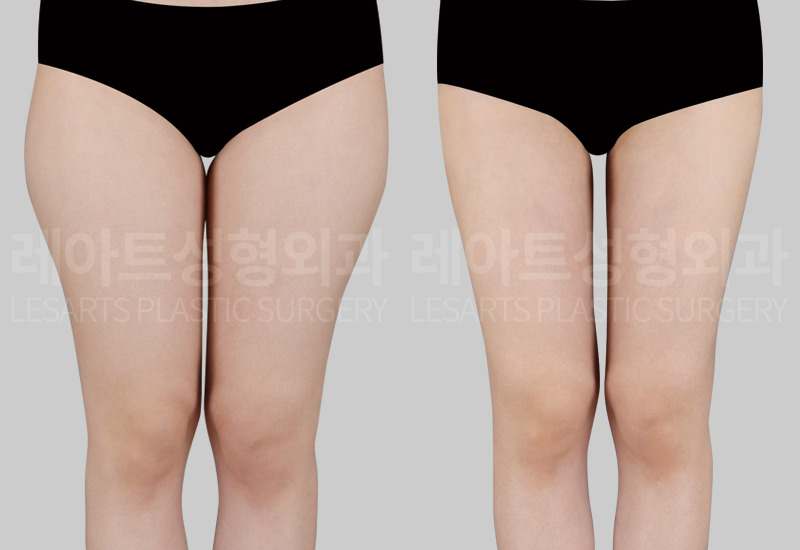
Front View Comparison Before and 1.5 Months After Thigh Liposuction - Lesarts Plastic Surgery
Here is how she looks about 1.5 months
after thigh and hip line liposuction.
From the front view,
as the volume in the upper thighs decreased,
the overall leg line has become slimmer than before.
The horizontal width of the legs has also narrowed,
reducing the previously bulky impression.
In particular, the inner thighs—which bothered the patient the most—
became slimmer, creating a straighter line than before,
and with a gap between both thighs, her legs overall
look longer and lighter.
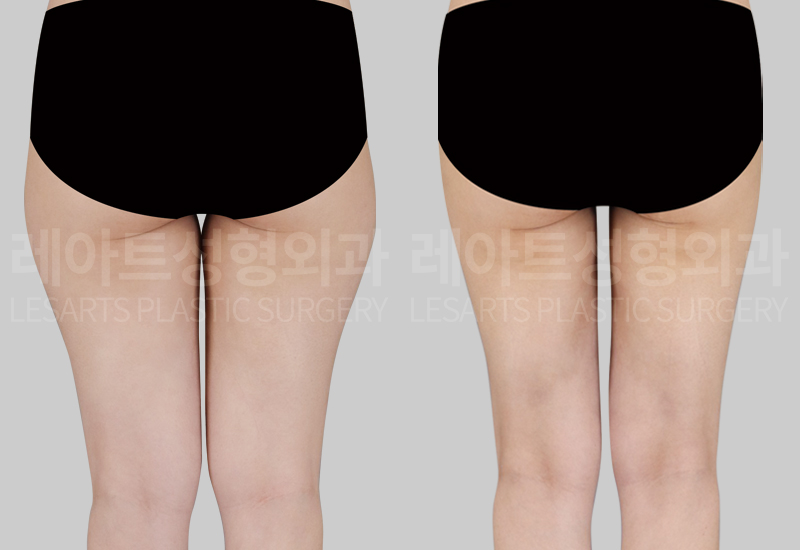
[1.5 Months After Thigh Liposuction: Saddlebag and Buttock Line Changes - Lesarts Plastic Surgery]
From the rear view as well, as the volume in the upper thighs decreased,
the overall width of the legs has narrowed.
For the buttocks, rather than blindly reducing size,
we left some fat in the lower area
and contoured the outer volume
so that the thighs and hip line connect naturally.
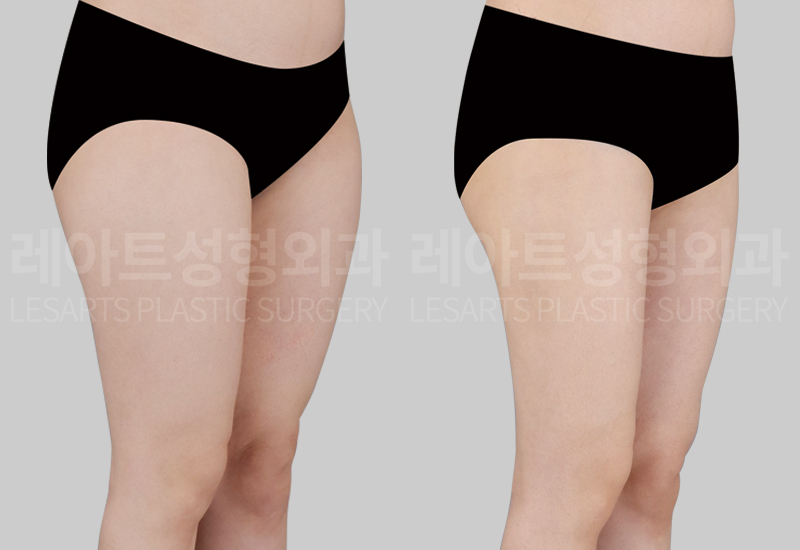
[1.5 Months After Thigh Liposuction: Front Thigh Thickness and Side Line Changes - Lesarts Plastic Surgery]
Comparing from the side,
you can clearly see the changes in the rounded, protruding curve
and thickness of the front thigh.
Before surgery, front thigh protrusion
emphasized the front-to-back width of the thighs,
but after liposuction, the side-flowing line
has become more naturally refined than before.
However, because muscle also influenced the front thighs,
rather than aggressively removing fat,
it was important to adjust the fat volume based on overall leg proportions
so that the muscle line would not stand out excessively.
Even after surgery, some protrusion due to muscle remains,
but as the overall thigh curve decreased,
the side line also shows a noticeable improvement.
[Thigh Liposuction: Distinguishing Fat to Leave Behind Matters More Than Removing a Lot]
The thickness and contour of the thighs
are influenced not only by fat, but also by muscle, bone structure,
and other factors.
Therefore, removing as much inner thigh fat as possible
or blindly making the buttocks smaller
is not always appropriate.
Excessively reducing inner thigh fat
can make skeletal features stand out more,
and removing too much buttock fat
can make sagging more noticeable.
Furthermore, in areas strongly influenced by muscle like the front thighs,
there is a limit to the change liposuction alone can create.
Ultimately, it is important to accurately check your current muscle, bone structure, and fat distribution
and build a surgical plan that divides areas to reduce and areas to preserve.
If you are considering thigh liposuction for similar concerns,
we recommend consulting about the realistic changes you can expect for your current body type
and the appropriate surgical scope before deciding.
#Liposuction
#Thigh #Etc
#BMIbelow30(thigh) #Hip


Cases finding
similar to my profile
Customer Diagnostics


Select the surgery and
area you are interestedto see real
before andafter changes.


we
make you,
the art
Clinic hours
MON - FRI
10 am – 7pm
SAT
10 am – 4pm
Holiday
SUN, HOLIDAY
Location
Lesarts Moon Clinic Tower 4-5F, 40, Nonhyeon-ro 168-gil,
Gangnam-gu, Seoul, Republic of Korea

Medical institution name Lesarts Plastic Surgery
Address Lesarts Moon Clinic Tower 4-5F, 40, Nonhyeon-ro 168-gil, Gangnam-gu, Seoul, Republic of Korea
Representative Moon sung jun
