




Online Consultation
Please accurately enter the information below.
Quick Cost Consultation
Quick Consultation & Reservation
Cases finding
similar to my profile






Cases finding
similar to my profile
Customer Diagnostics
Gynecomastia Surgery for a Protruding Male Chest: 2-Week Early Results | Lesarts Plastic Surgery, Gangnam, Seoul, Korea
2026-11-11
Concerns of Men with Large Chests: What Changes Appear Just 2 Weeks After Gynecomastia Surgery?
Q. If chest and areola protrusion does not decrease
even with exercise and weight loss, should I consider gynecomastia surgery?
A. If the chest protrusion is not simply due to fat accumulation,
but is true gynecomastia caused by the development of glandular tissue,
it can be difficult to change through exercise or weight control alone.
After checking the glandular tissue and surrounding fat distribution through palpation and ultrasound,
glandular excision and liposuction in the necessary areas can be planned together.
[ Learn More About Lesarts Male Gynecomastia Surgery Cases ]
When a man's chest enlarges
and the area around the areola protrudes forward,
many first wonder whether it can be resolved
with exercise or weight loss.
However, male chest protrusion
can be divided into pseudogynecomastia, caused by fat accumulation,
and true gynecomastia, which occurs
due to overgrowth of glandular tissue.
If fat accumulation is the main cause,
some improvement can be expected with weight loss and exercise,
but when glandular tissue is developed, it may not improve sufficiently
through exercise or weight control alone.
In this post, we will look at the pre-op condition
and 2-week early post-op progress
of a male patient in his 30s whose chest protrusion remained
despite continuing exercise and weight management.
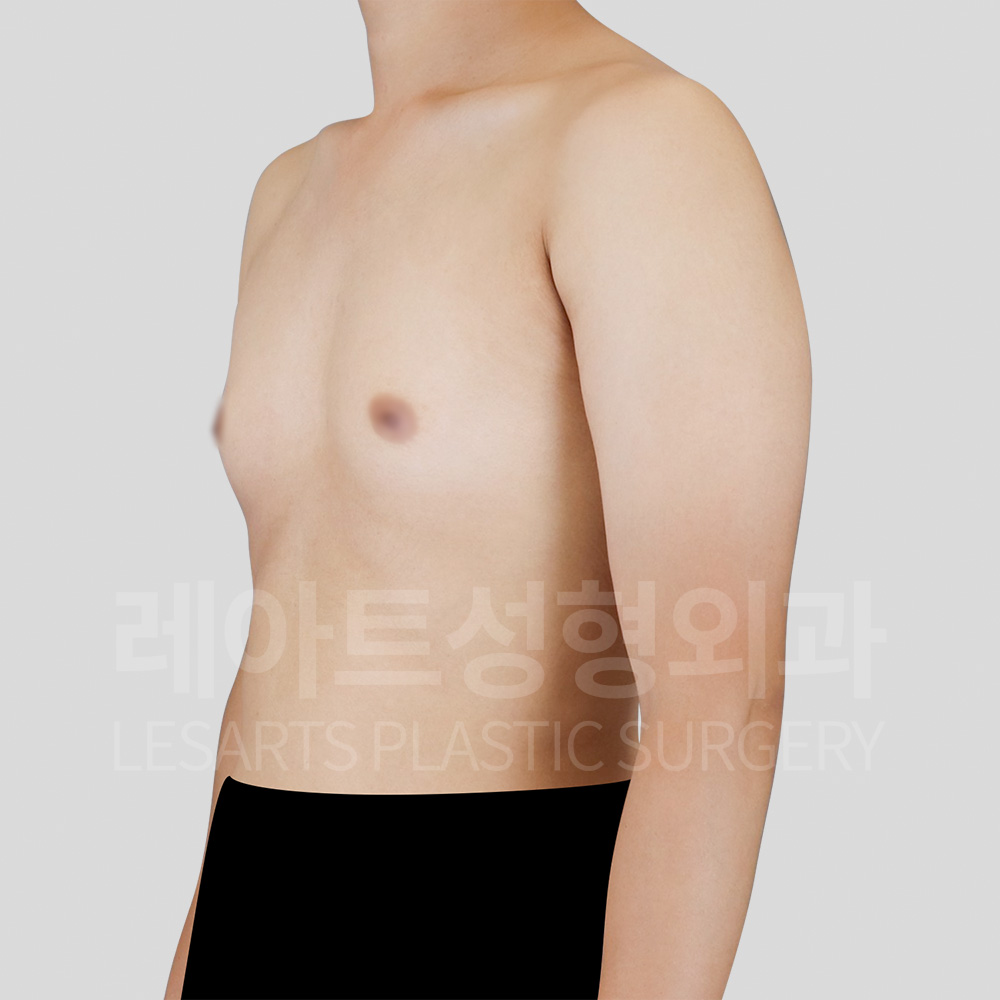
[Before Gynecomastia Surgery: Protrusion Around the Areola and Bilateral Glandular Tissue Development - Lesarts Plastic Surgery]
As the patient entered his 30s,
his chest enlarged and the areola also puffed up,
causing him to notice forward-protruding gynecomastia symptoms.
Although he regularly ran and hiked
to manage his weight,
there was no noticeable change in his chest protrusion,
so he visited the clinic for an accurate diagnosis and surgical correction.
[Gynecomastia Surgery Patient Information]
Age: 30s
Height / Weight: 179 cm / 73.9 kg
BMI: 23.1
Main Symptoms: Bilateral chest protrusion and protrusion around the areola
Gynecomastia Diagnosis: True Gynecomastia, Simon Grade 2A
Skin Condition: Mild skin laxity
[Male Gynecomastia Surgery: Glandular Excision and Chest Liposuction Surgical Plan]
Looking at his chest before surgery,
the area around the nipple and areola stood out forward,
and a convex contour continued
from the center of the chest to the lower part.
During palpation, a firm, lump-like tissue
was felt beneath both areolas.
Ultrasound examination confirmed that this area
was developed fibrous glandular tissue.
Although there was mild loss of skin elasticity,
there was no significant chest sagging,
so he was diagnosed with true gynecomastia, Simon Grade 2A.
For surgery, we first planned glandular excision
to remove the developed glandular tissue.
However, rather than stopping at removing only the gland,
we decided to also remove subcutaneous fat
in the area extending from the side chest to the lower chest
to refine the overall chest line.
In addition, considering the possibility that the area around the nipple and areola
could become indented or adhere after removing the glandular tissue,
we also performed tissue rearrangement and anti-adhesion treatment.
 [2 Weeks After Gynecomastia Surgery: Reduced Nipple/Areola Protrusion and Chest Line Changes - Lesarts Plastic Surgery]
This is the early progress about 2 weeks after gynecomastia surgery.
Through glandular tissue removal and chest liposuction,
the forward protrusion around the nipple and areola decreased,
and the convex contour extending to the lower chest was also smoothed out compared to before.
In particular, before surgery, the volume around the areola was emphasized,
making the center of the chest appear to protrude forward.
After surgery, as that area decreased,
you can see a chest line that flows naturally
along the ribcage.

[2 Weeks After Gynecomastia Surgery: Changes in Chest Protrusion and Clothing Fit Under a T-Shirt - Lesarts Plastic Surgery]
Even when wearing a T-shirt,
the change in protrusion at the center of the chest is clearly visible.
Before surgery, the volume around the nipple and areola
stood out through clothing, making the chest feel larger,
whereas after surgery, as that volume decreased,
the front chest contour visible through a T-shirt changed noticeably.

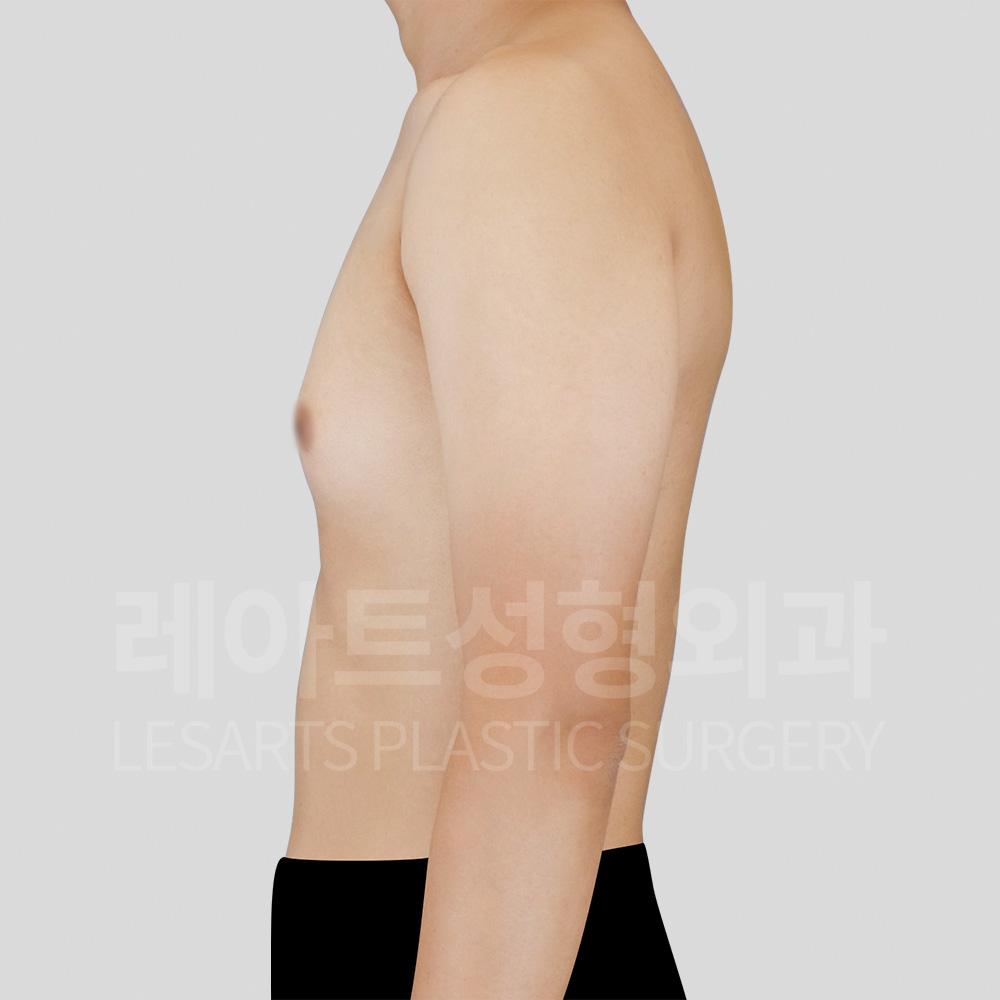
[Side View Comparison Before and 2 Weeks After Male Gynecomastia Surgery: Front Chest Protrusion and Chest Thickness Changes]
Comparing from the side view,
the change in chest thickness—which used to protrude forward
around the areola—is even clearer.
After surgery, protrusion in the center of the chest decreased,
and the convex contour extending toward the lower chest
was also smoothed out.

[2 Weeks After Gynecomastia Surgery: Changes in Chest Protrusion and Clothing Fit Under a T-Shirt]
After gynecomastia surgery, the patient
expressed particular satisfaction with how his chest
stands out much less when wearing clothes.
As the volume around the nipple and areola decreased,
he shared that his worry about how clothes fit was reduced,
and he can now wear a variety of outfits
much more comfortably than before.
This patient had been experiencing discomfort
due to chest protrusion since his 30s.
Even though he managed his weight through running and hiking,
there was no major change in the shape of his chest.
That was because it was true gynecomastia,
where actual glandular tissue was confirmed on ultrasound.
While there is no fixed right time or season for gynecomastia surgery,
if chest protrusion does not decrease despite exercise and weight control
and discomfort continues in daily life,
it is important to accurately examine your current chest condition
and establish a treatment plan.
In particular, if the cause of protrusion is developed glandular tissue,
it can be difficult to resolve through exercise or weight loss alone.
Through palpation and ultrasound,
it is necessary to check for glandular tissue development and surrounding fat distribution
and decide on the surgical method that is right for you.
Gynecomastia Surgery FAQ
Q1. If my chest doesn't shrink even with exercise, is it gynecomastia?
You cannot conclude it is gynecomastia solely because there is no change with exercise.
It is important to check through palpation and ultrasound
whether glandular tissue is developed or if fat is the main cause.
Q2. What is true gynecomastia?
It is a condition where glandular tissue beneath the nipple and areola develops,
causing the center of the chest to protrude forward. Depending on how much fat is also distributed,
the surgical scope may vary.
Q3. Can side chest and lower chest liposuction also be done during gynecomastia surgery?
If subcutaneous fat in the side chest or lower chest
affects the overall chest contour, liposuction in the necessary areas
can be performed together with glandular excision.
Q4. Why is tissue rearrangement performed after glandular removal?
It can be performed to reduce the possibility of indentation or adhesion where the glandular tissue was removed,
and to adjust the remaining tissue so that the chest surface and contour
connect more naturally.
Q5. Is 2 weeks after gynecomastia surgery the final result?
Two weeks is still an early recovery period.
Since swelling and tissue changes may still remain,
it is necessary to continue monitoring
how the chest line settles over time.
#Male body contouring
#Gynecomastia
#Grade2-A #true gynecomastia


Cases finding
similar to my profile
Customer Diagnostics


Select the surgery and
area you are interestedto see real
before andafter changes.


we
make you,
the art
Clinic hours
MON - FRI
10 am – 7pm
SAT
10 am – 4pm
Holiday
SUN, HOLIDAY
Location
Lesarts Moon Clinic Tower 4-5F, 40, Nonhyeon-ro 168-gil,
Gangnam-gu, Seoul, Republic of Korea

Medical institution name Lesarts Plastic Surgery
Address Lesarts Moon Clinic Tower 4-5F, 40, Nonhyeon-ro 168-gil, Gangnam-gu, Seoul, Republic of Korea
Representative Moon sung jun
