




Online Consultation
Please accurately enter the information below.
Quick Cost Consultation
Quick Consultation & Reservation
Cases finding
similar to my profile






Cases finding
similar to my profile
Customer Diagnostics
Tummy Tuck After Weight Loss in Your 50s: 1 Year 9 Months Later | Lesarts Plastic Surgery, Gangnam, Seoul, Korea
2026-11-12
Tummy Tuck in Your 50s: Improving Sagging Lower Belly Skin That Remained Even After Dieting
Q. If lower abdominal skin sagging and
creases above the belly button remain despite consistent dieting and exercise, can I consider a tummy tuck?
A. When skin elasticity decreases after childbirth or significant weight changes,
causing loose skin in both the upper and lower abdomen along with diastasis recti or abdominal wall protrusion,
it can be difficult to sufficiently change the abdominal shape through exercise and weight loss alone.
In such cases, after checking the extent of skin sagging, the rectus abdominis muscles, and fat distribution,
a full tummy tuck, rectus muscle repair, and liposuction in necessary areas can be considered.
[ Learn More About Lesarts Tummy Tuck Cases ]
In this post, we will look at an M-Type full tummy tuck case
of a female patient in her 50s who experienced three natural childbirths.
The patient had been concerned for a long time about abdominal sagging and overall loss of elasticity after childbirth,
and she was experiencing discomfort and stress
in her daily life as well.
Even though she dieted and exercised consistently, the downward sagging of her lower abdominal skin
did not change, so her primary surgical goal
was to remove the sagging belly skin.

[Before Tummy Tuck: Sagging Lower Abdominal Skin and Creases Above the Belly Button Remaining After Dieting]
Looking at her abdomen before surgery,
the skin below the belly button was stretched,
forming wrinkles and folds in the lower abdomen.
Above the belly button as well, the skin folded, leaving deep creases.
The patient's abdominal shape had changed due to decreased skin elasticity
across both the upper and lower abdomen,
and subcutaneous fat in the flanks and love handles, along with a forward-protruding
abdominal wall, was also affecting her overall abdominal contour.

[Pre-Op Diagnosis and Surgical Plan for Tummy Tuck - Lesarts Plastic Surgery]
At the time of consultation, the patient wanted most of all
to improve the skin sagging that appeared concentrated in the lower abdomen.
However, examination showed that without correcting the skin laxity above the belly button and diastasis recti
together, the overall surgical effect could be limited,
so we explained that an M-Type full tummy tuck
would be more suitable than addressing only the lower abdomen.
We also planned liposuction on the flanks and love handles
to refine the waistline and prevent any uneven step-off
between the tummy tuck area and the surrounding areas.
[Tummy Tuck Surgical Plan]
- Upper & lower abdominal skin laxity, lower abdominal wrinkles and skin folds, creases above the belly button: M-Type Full Tummy Tuck
- Diastasis recti, abdominal wall protrusion: Rectus Abdominis Muscle Repair
- Belly button changes following skin excision: Umbilicoplasty (Belly Button Reshaping)
- Volume in the front abdomen, flanks, and love handles: Abdominal Liposuction

[1 Year and 9 Months After Tummy Tuck: Changes in Lower Abdominal Skin Sagging and Incision Scar - Lesarts Plastic Surgery]

[1 Year and 9 Months After Tummy Tuck: Changes in Lower Belly Protrusion and Waistline - Lesarts Plastic Surgery]
Here is how she looks 1 year and 9 months after her tummy tuck.
Even in the long-term follow-up, the maintenance and recovery of her overall abdominal contour,
as well as the scar condition, have progressed well.
As the sagging skin below the belly button before surgery was removed,
the deep wrinkles and folded belly skin were smoothed out,
and the entire abdominal line flows more smoothly than before.
The lower belly, which used to protrude forward, has become flatter than before,
and as the bulging fat in the flanks and love handles was also reduced,
her waist curve is more clearly defined.
During the process of pulling and removing the stretched skin,
the shape and position of the belly button were also recreated and placed to match the new abdominal contour.

[1 Year and 9 Months After Tummy Tuck: Changes in Lower Belly Protrusion and Lower Abdominal Skin Sagging - Lesarts Plastic Surgery]
Comparing from the side view, the changes in abdominal elasticity
and volume are even clearer.
Before surgery, the volume of the lower abdomen and love handles stood out
due to loose, sagging skin and subcutaneous fat.
After surgery, as this bulkiness decreased, the lower abdomen was smoothed out,
and the curve from the waist to the back also appears softer.

[1 Year and 9 Months After Tummy Tuck: Lower Abdominal Incision Scar Recovery - Lesarts Plastic Surgery]
The incision scar left on the lower abdomen after a tummy tuck
goes through a recovery process where its overall color
gradually fades over time.
Even now, 1 year and 9 months later,
we are continuing ongoing follow-up and care,
focusing on areas where some hyperpigmentation remains.
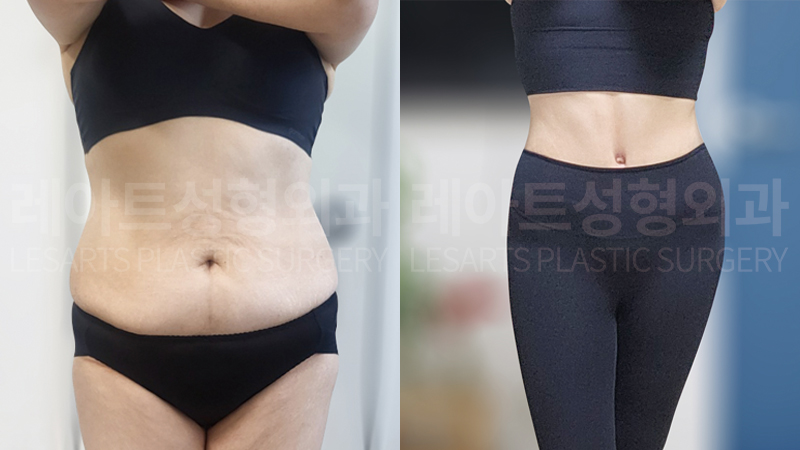
[Front Selfie Comparison: Before and 6 Months After Tummy Tuck]

[Front Selfie Comparison: Before and 6 Months After Tummy Tuck]
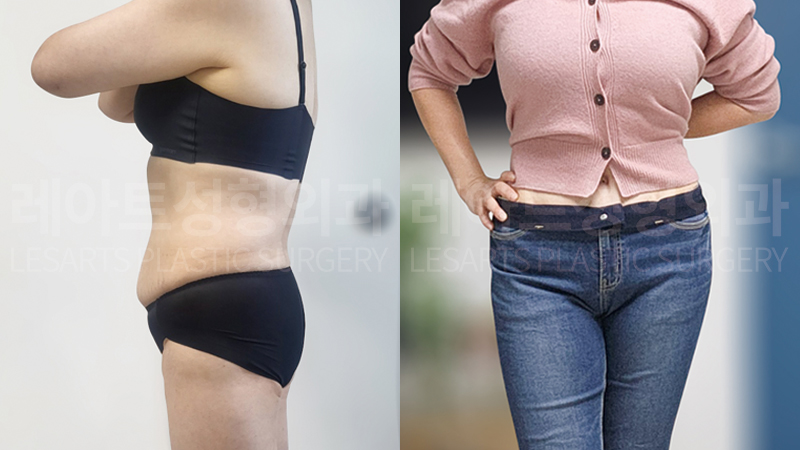
[Front Selfie Comparison: Before and 6 Months After Tummy Tuck]
Even in the photos shared directly by the patient,
we could see her satisfaction with her changed abdominal contour.
Before surgery, her lower abdominal skin folded over the waistband of her underwear and sagged downward,
causing discomfort and stress whenever she got dressed.
After the tummy tuck, she shared that she feels much less self-conscious than before
when wearing form-fitting everyday clothes, leggings, or crop tops.
In particular, she expressed satisfaction that the sagging lower abdominal skin—which hadn't changed despite dieting and exercise—was smoothed out,
and that her waistline improved as well.
Even after childbirth or weight loss,
stretched skin can remain as it is.
In particular, even if only lower abdominal sagging stands out,
if upper abdominal skin laxity, diastasis recti, or abdominal wall protrusion are also present,
it is necessary to evaluate the overall abdominal condition rather than correcting only the lower abdomen partially.
In this case as well,
upper & lower abdominal skin sagging + diastasis recti + abdominal wall protrusion + flank & love handle fat
were each evaluated, and we planned an M-Type full tummy tuck, rectus muscle repair,
umbilicoplasty, and abdominal liposuction together.
If you are considering a tummy tuck,
it is important to comprehensively check your current abdominal skin and fat distribution,
whether you have diastasis recti, and your desired direction of improvement
before deciding on the appropriate surgical method.
[ Learn More About Lesarts Tummy Tuck Cases ]
Tummy Tuck FAQ
Q1. Can sagging lower belly skin remain even if I diet?
When the skin has stretched significantly due to childbirth or major weight changes,
skin sagging and wrinkles can remain even after losing weight.
The correction method is decided after checking your current skin elasticity and the extent of sagging.
Q2. Can I get a full tummy tuck even if only my lower abdomen looks saggy?
Even if the lower abdomen is the most noticeable area, if the skin above the belly button is also loose,
a full tummy tuck that corrects both the upper and lower abdomen together can be considered.
Q3. Why are a tummy tuck and rectus muscle repair performed together?
When diastasis recti and abdominal wall protrusion are present,
front abdominal protrusion can remain even if only the skin is removed.
Depending on the condition of the rectus abdominis muscles, the abdominal wall can be repaired together.
Q4. Can a tummy tuck be combined with flank and love handle liposuction?
If flank and love handle fat affects the abdominal and waist contour,
liposuction can be performed within the necessary range to reduce any step-off with surrounding areas.
Q5. Is scar care still needed even 1 year after a tummy tuck?
Scars can change in color and texture over a long period.
If some hyperpigmentation or redness remains,
scar care can be continued depending on the healing progress.
#Abdominoplasty
#M-type


Cases finding
similar to my profile
Customer Diagnostics


Select the surgery and
area you are interestedto see real
before andafter changes.


we
make you,
the art
Clinic hours
MON - FRI
10 am – 7pm
SAT
10 am – 4pm
Holiday
SUN, HOLIDAY
Location
Lesarts Moon Clinic Tower 4-5F, 40, Nonhyeon-ro 168-gil,
Gangnam-gu, Seoul, Republic of Korea

Medical institution name Lesarts Plastic Surgery
Address Lesarts Moon Clinic Tower 4-5F, 40, Nonhyeon-ro 168-gil, Gangnam-gu, Seoul, Republic of Korea
Representative Moon sung jun
