




Online Consultation
Please accurately enter the information below.
Quick Cost Consultation
Quick Consultation & Reservation
Cases finding
similar to my profile






Cases finding
similar to my profile
Customer Diagnostics
Gynecomastia Surgery for Puffy Nipples: 13-Day Changes in Chest Projection and Clothing Fit | Lesarts Plastic Surgery, Gangnam, Seoul, Korea
2026-11-16
Gynecomastia accompanied by male nipple protrusion: Why diet failed to resolve it
Q. Even after exercising and dieting,
if the area around the nipples and areola remains bulging, could it be gynecomastia?
A. If protrusion around the nipples and areola persists even after losing weight and firm lumps can be felt,
it is necessary to check for the development of glandular tissue.
After assessing the size, distribution, and surrounding fat volume
of the mammary glands through an ultrasound examination,
the scope of gland excision and liposuction can be determined.
[ Learn more about Lesarts Gynecomastia Surgery cases ]
Male gynecomastia appears not only as an overall increase in chest size,
but also in the form of a convex protrusion around the nipples and areola.
In such cases, many people feel self-conscious about their chest line standing out,
not only when wearing thin T-shirts
but also form-fitting golf shirts, athletic wear,
or knitwear that subtly reveals the upper body silhouette.
Even when trying to hide it with thick clothes or jackets,
the stress regarding clothing choices itself does not disappear.
Some even develop a habit of hunching their shoulders
or crossing their arms
to prevent their chest contours from showing.
In this post, we will look at the case of a patient
whose gynecomastia symptoms, which began in his teens,
persisted into his 30s, and whose chest size and areolar protrusion
did not change despite exercise and weight management.
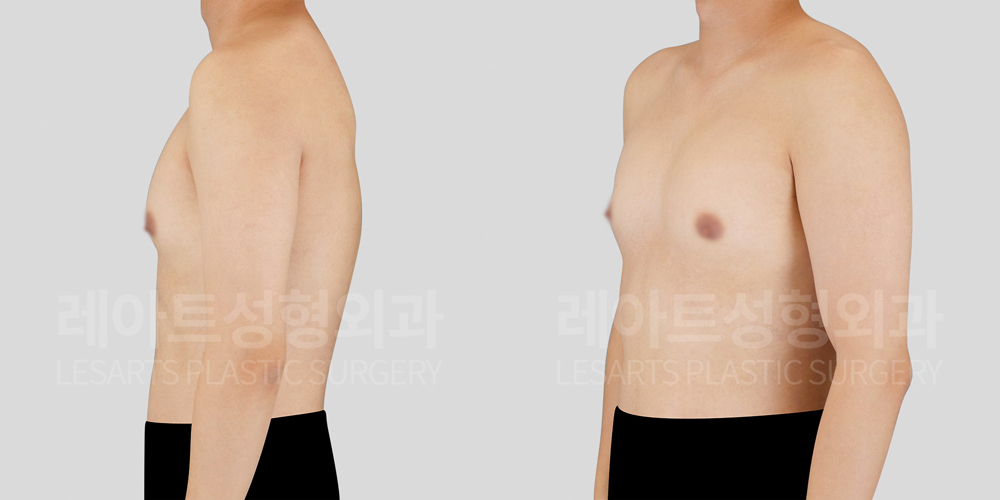
[Before gynecomastia surgery, chest shape prominently
bulging mainly around the nipples and areola]
The patient had experienced gynecomastia symptoms since his teenage years,
but decided to undergo surgical correction only after entering his 30s.
Although he consistently tried exercising and managing his weight,
his chest size and the protruding shape around the areola
remained without significant changes.
[Patient Information and Diagnosis Results]
Age: 30s
Height / Weight: 182 cm / 81.6 kg
Gynecomastia Diagnosis: True gynecomastia, Simon Grade 2A
Glandular Length: 35 mm or more bilaterally
Main Symptoms: Bilateral chest protrusion,
nipple/areola protrusion, palpable firm lumps
[Gynecomastia surgery plan considering both glandular tissue and surrounding chest fat]
Looking at the chest before surgery,
the areas around the nipples and areola were convexly raised,
and volume had formed toward the front of the chest as well.
The external shape corresponded to Simon Grade 2A,
and upon palpation,
firm, lump-like tissue was felt beneath both areolae.
Ultrasound examination confirmed that this tissue
was developed glandular tissue.
Rather than simply removing only the glandular tissue,
it was necessary to also remove adipose tissue distributed
in the lower chest and lateral chest wall
to reduce the overall chest volume
and contour the chest line.
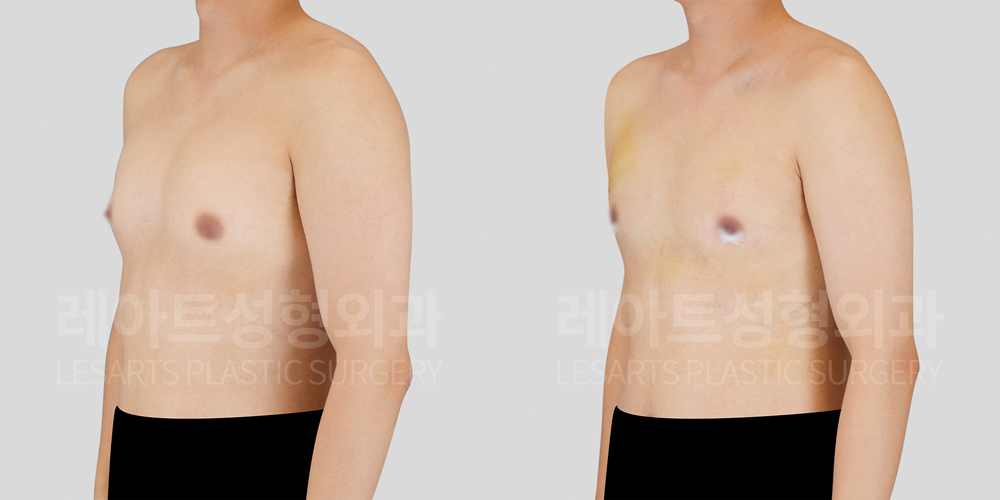
[2 weeks after gynecomastia surgery, reduced nipple
/areola protrusion and flattened chest line - Lesarts Plastic Surgery]
This is how he looked about 2 weeks after gynecomastia surgery.
The surgery was performed via gland excision + liposuction + tissue rearrangement.
Comparing from the oblique view, the most noticeable change is
that the convex protrusion around the nipples and areola decreased,
and the anterior chest contour is refined.
The overall chest size also decreased compared to before surgery.
After removing the glandular tissue and performing surrounding liposuction,
by rearranging the tissue beneath the nipples and areola,
the protrusion in the center of the chest was reduced
and the line leading to the lower chest
was smoothed out more than before.
However, as it has been about 2 weeks since surgery,
this is still the early recovery phase where some swelling may remain.
Even so, with the reduction in chest size and nipple/areola protrusion,
you can see that the overall ribcage line has changed from before.
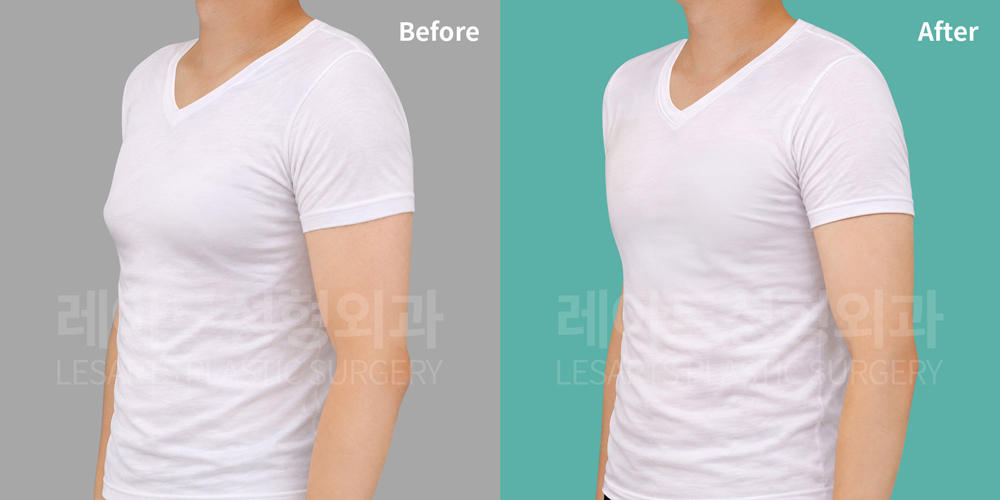
[Before and after male gynecomastia surgery,
changes in chest protrusion visible through a T-shirt - Lesarts Plastic Surgery]
Before surgery, wearing a thin T-shirt caused
the volume in the center of the chest to show right through the clothes,
making the front chest appear even more prominent.
After surgery, as the protrusion around the nipples and areola
and the volume in the center of the chest decreased,
the chest contour appearing through a T-shirt
is much more refined than before.
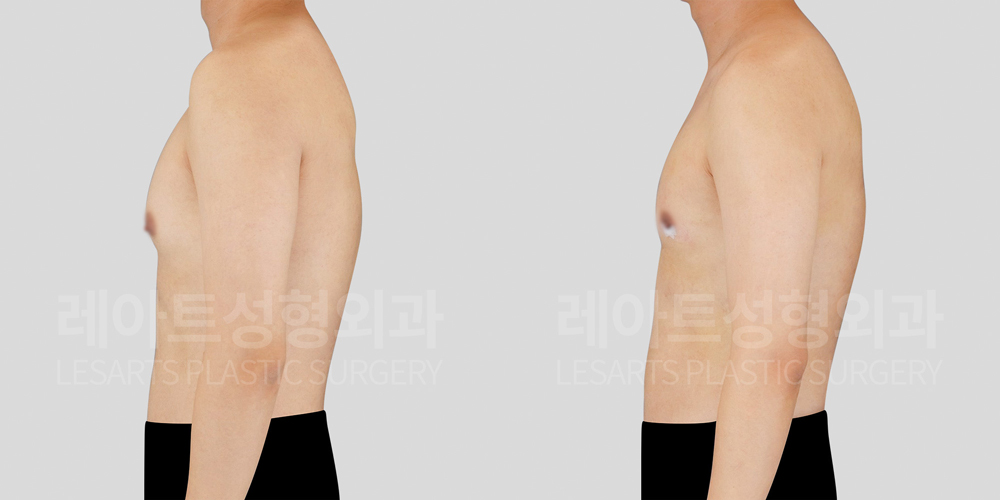
[Side-by-side comparison 13 days after gynecomastia surgery,
reduction in the thickness of the forward-protruding chest - Lesarts Plastic Surgery]
From the side, the volume of the previously convexly protruding
center of the chest has decreased,
and you can see the line from the upper chest to the lower chest
gradually settling into a gentle curve.
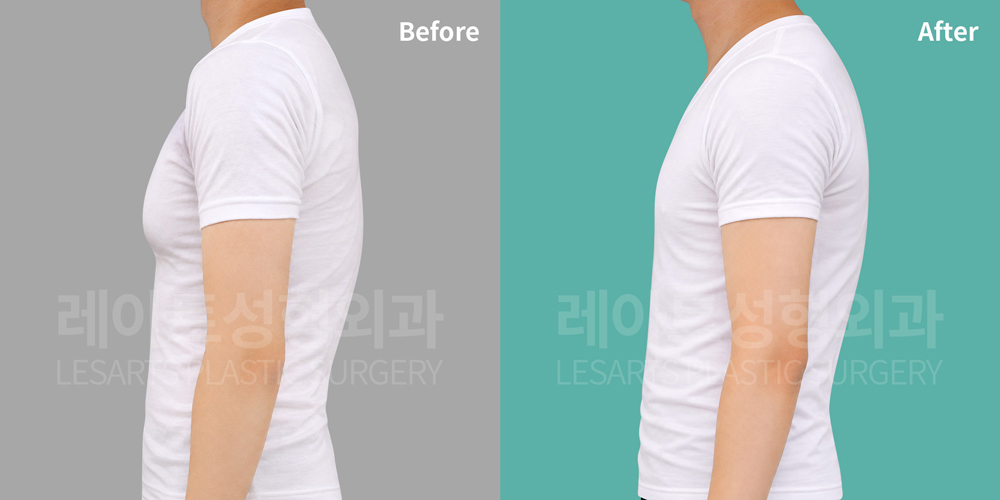
[13 days after gynecomastia surgery, chest protrusion that used to stand out through T-shirts and improved clothing fit - Lesarts Plastic Surgery]
The patient expressed particular satisfaction
that the issue where his chest protruded
forward when wearing thin T-shirts
had diminished.
He also shared that he was pleased
with how his overall upper body silhouette felt firmer
as the convex contours around the nipples and areola were smoothed out.
You can expect a reduction in the burden that chest protrusion places on clothing fit,
not only with T-shirts but also with knitwear or form-fitting athletic wear
that reveals the upper body shape.
Gynecomastia surgery is not simply
a procedure to reduce the overall chest size.
It also requires considering the process of smoothing out
the prominent nipple and areolar areas
and creating a chest line that harmonizes with the overall ribcage.
To achieve this, one must evaluate bone structure,
muscle development, glandular tissue size and distribution,
surrounding fat volume, and skin elasticity together.
If, like this patient, your nipple and areolar protrusion remains unchanged
despite exercise and weight loss,
and firm lumps can be felt,
rather than assuming it is simply a matter of having excess chest fat,
it is important to accurately check
for the development of glandular tissue
through palpation and ultrasound examination.
Depending on the diagnosis results, you can establish a surgical plan
that achieves harmony with the overall ribcage line
by determining the necessary scope, including not only gland excision
but also liposuction of the lower and lateral chest walls and tissue rearrangement.
[ Learn more about Lesarts Gynecomastia Surgery cases ]
Gynecomastia Surgery FAQ
Q1. If my nipples stick out even after dieting, is it gynecomastia?
The fact that nipple and areolar protrusion persists after weight loss
is not enough to confirm a diagnosis of gynecomastia.
It is important to verify whether glandular tissue
is actually developed through palpation and ultrasound examination.
Q2. Is a firm lump under the areola glandular tissue?
In gynecomastia, firm glandular tissue can often be felt beneath the areola.
However, the cause of lumps can vary, so it must be accurately confirmed via ultrasound examination.
Q3. Is side chest liposuction also performed during gynecomastia surgery?
If fat distribution along the lateral chest wall or lower chest affects the overall chest volume and contour,
liposuction of the necessary areas can be performed alongside gland excision.
Q4. Why is tissue rearrangement necessary after gland excision?
After removing the glandular tissue, adjusting the remaining tissue
helps prevent the area beneath the nipples and areola from becoming indented
or developing irregular contours, and is performed to smooth out the overall chest surface.
Q5. Is the final result achieved at 2 weeks post-surgery?
No. Days 13 to 2 are still in the early recovery phase where swelling may remain.
As edema and tissues settle thereafter, the chest line can continue to change.
#Male body contouring
#Gynecomastia
#Grade2-A #true gynecomastia


Cases finding
similar to my profile
Customer Diagnostics


Select the surgery and
area you are interestedto see real
before andafter changes.


we
make you,
the art
Clinic hours
MON - FRI
10 am – 7pm
SAT
10 am – 4pm
Holiday
SUN, HOLIDAY
Location
Lesarts Moon Clinic Tower 4-5F, 40, Nonhyeon-ro 168-gil,
Gangnam-gu, Seoul, Republic of Korea

Medical institution name Lesarts Plastic Surgery
Address Lesarts Moon Clinic Tower 4-5F, 40, Nonhyeon-ro 168-gil, Gangnam-gu, Seoul, Republic of Korea
Representative Moon sung jun
