




Online Consultation
Please accurately enter the information below.
Quick Cost Consultation
Quick Consultation & Reservation
Cases finding
similar to my profile






Cases finding
similar to my profile
Customer Diagnostics
Tummy Tuck Surgery | L-Type Extended Tummy Tuck for Sagging Belly in Your 50s: Changes in Loose Skin and Scars After 2 Months
2026-11-24
Abdominoplasty | Sagging Belly in Her 50s:
Skin Sagging and Scar Changes 2 Months After L-Type Extended Abdominoplasty - Lesarts Plastic Surgery
Q. If the lower abdomen folds in multiple layers with severe skin sagging after childbirth,
what type of abdominoplasty can be considered?
A. When skin sagging is not limited to the lower abdomen but extends widely from the upper abdomen,
and diastasis recti and abdominal fat are present together, a full abdominoplasty
capable of sufficiently refining the sagging area can be considered.
In this case, to improve extensive skin sagging,
we performed L-Type Extended Abdominoplasty together with abdominal wall plication, umbilicoplasty,
and abdominal and mons pubis liposuction.
[ Learn More About Lesarts Abdominoplasty ]
[ View More Lesarts Abdominoplasty Cases ]
Through pregnancy, childbirth, and weight fluctuations,
not only does fat accumulate in the abdomen,
but lower-abdominal skin can also stretch severely and fold,
changing the overall shape of the abdomen itself.
Especially in one's 40s and 50s, as skin elasticity declines,
a stretched lower belly can fold in multiple layers
or form deep creases across the lower abdomen.
Such changes are not only an aesthetic concern—
they can also lead to everyday discomfort
such as sweat trapping between folded skin,
itching, or irritation from friction.
Because dieting alone has limits in improving
skin sagging, abdominoplasty to remove
excess stretched skin
can be considered.
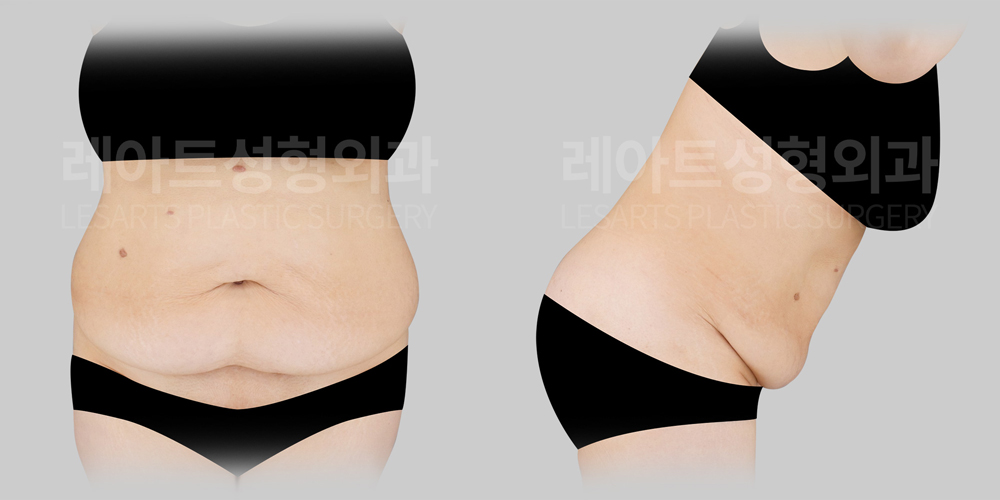
[Before Abdominoplasty: Downward-Sagging Belly and Lower-Abdominal Skin Folded in Multiple Layers]
[Patient Information]
Age: 50s
Height: 158 cm
Weight: 71.2 kg
BMI: 28.5
Childbirth History: 3 children, first via C-section
Surgery: L-Type Extended Abdominoplasty / Abdominal Wall Plication / Umbilicoplasty / Abdominal Liposuction / Mons Pubis Liposuction
The patient was a woman in her 50s who had given birth to three children
and was concerned about severe lower-abdominal skin sagging,
overall abdominal size, and contour.
In particular, deep folding of the lower-abdominal skin
caused sweat to trap in the overlapping areas,
leading to itching and discomfort.
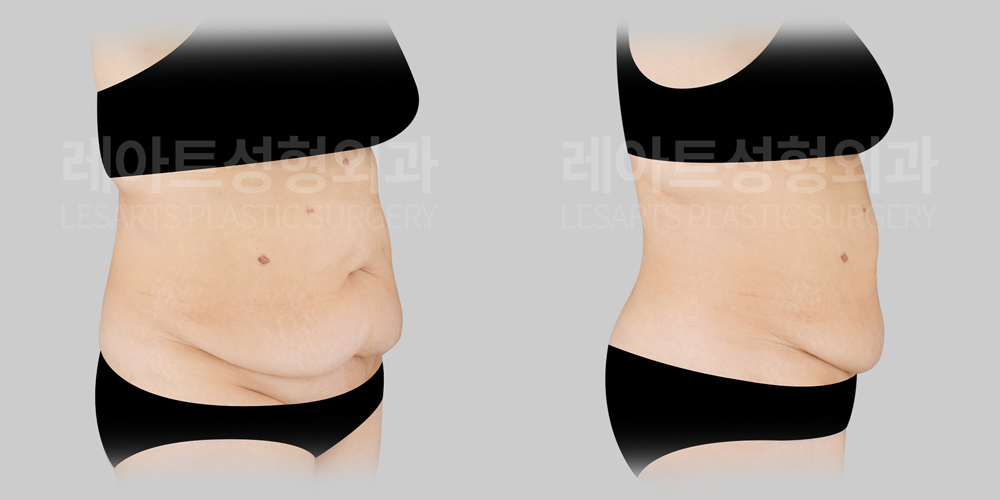
[Abdominoplasty Plan: Surgical Method Accounting for Skin Sagging and Existing Umbilical Scar]
Examining her abdomen before surgery,
her lower abdomen protruded forward,
with deep creases and multiple layers of skin folding.
This was not an issue limited to the lower abdomen alone,
but the result of decreased skin elasticity starting from the upper abdomen
causing the skin to shift downward.
As a result, her navel had also been deformed
into a wide, horizontal, drooping shape.
Stretch marks were also observed on the lower abdomen,
and because diastasis recti caused the abdominal wall to push forward,
abdominal wall plication was also needed.
In addition, because overall abdominal fat volume was substantial,
a surgical plan addressing extensive skin sagging, diastasis recti,
and abdominal fat together was required.
Accordingly, this surgery was performed with
L-Type Extended Abdominoplasty + Abdominal Wall Plication + Umbilicoplasty + Abdominal Liposuction + Mons Pubis Liposuction.
The patient had a keloid-like scar remaining
from a past laparoscopic surgery.
Therefore, we thoroughly explained in advance
that scarring after abdominoplasty could also be relatively prominent
and that ongoing scar care might be needed
following surgery.
Let's examine the changes 2 months after L-Type Extended Abdominoplasty
through the before-and-after photos below.
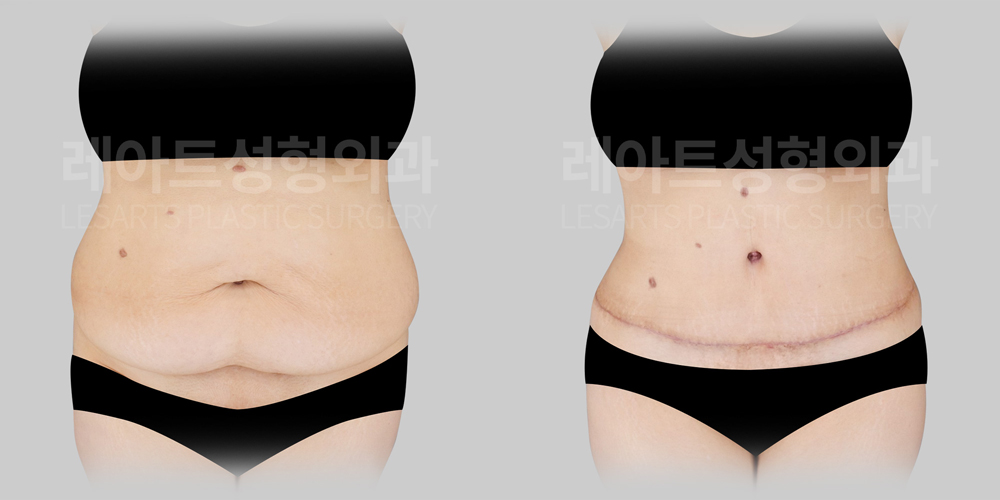
[2 Months After L-Type Extended Abdominoplasty: Changes in Creases Around the Navel and Lower-Abdominal Skin Sagging]
Here is how she looks 2 months after
L-Type Extended Abdominoplasty.
The lower-abdominal skin that had stretched downward below the navel
and folded in multiple layers before surgery has been refined,
and the deeply formed creases also appear
noticeably softened compared with before.
The abdomen that had pushed forward and looked lax
due to diastasis recti has also been tightened together,
and as overall abdominal volume decreased,
her contours look much smoother.
Because skin sagging was severe starting from the upper abdomen,
the extent to which the skin was pulled downward
can also be seen in how the position of her previous
laparoscopic surgery scar has shifted.
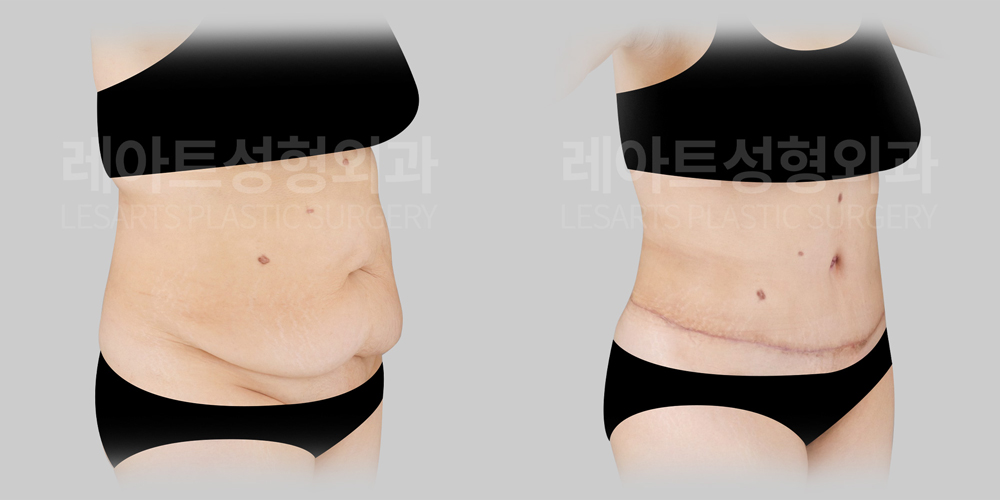
[2 Months After L-Type Extended Abdominoplasty & Abdominal Liposuction: Changes in Lower-Belly Protrusion and Waistline]
From an oblique angle, the reduction in volume of the lower belly
that had protruded forward before surgery is even clearer.
As the skin folded in multiple layers across the lower abdomen was refined,
the contour flowing from the waist to the lower abdomen
connects more smoothly than before.
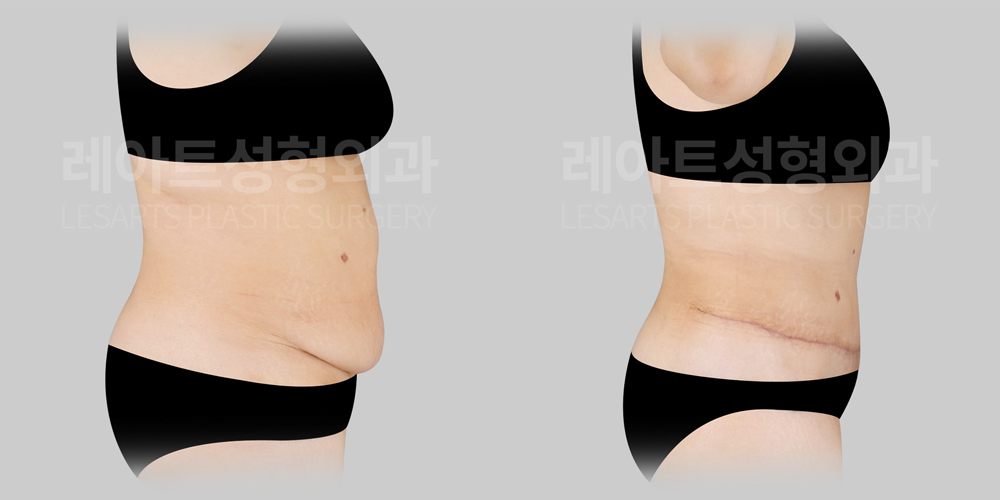
[2 Months After L-Type Extended Abdominoplasty: Changes in Forward-Protruding Lower Belly and Abdominal Contour]
In the side view, the before-and-after changes from abdominoplasty
are even more distinct.
The upper and lower abdomen that had protruded heavily and laxly forward
due to diastasis recti and subcutaneous fat, along with
the skin sagging toward the lower belly, have been refined together,
creating a smoother overall abdominal silhouette than before.
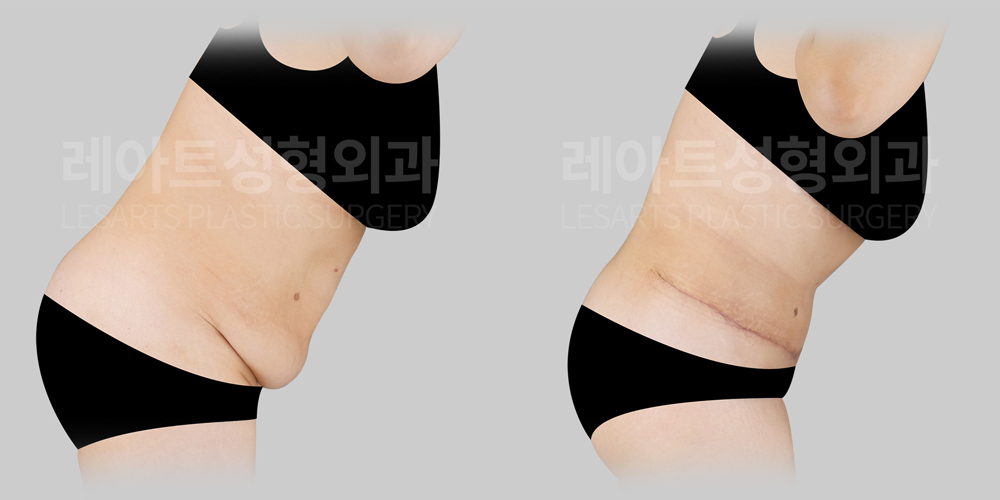
[2 Months After L-Type Extended Abdominoplasty: Changes in Lower-Abdominal Skin Sagging and Creases When Bending Forward]
Before surgery, when bending forward,
stretched lower-abdominal skin shifted downward,
making folding and protrusion stand out even more.
After surgery, even in a bent-forward posture,
the amount of heavy sagging and protrusion has decreased,
leaving the front abdomen noticeably more refined.

[2 Months After L-Type Extended Abdominoplasty: Recovery Progress of Lower-Abdominal Incision Scar and Umbilical Scar]
Because L-Type Extended Abdominoplasty
must refine extensively sagging skin,
the incision line extends widely out toward both sides of the pelvis.
At 2 months after surgery, she is still in
an early recovery phase,
when redness along the incision line is relatively noticeable.
Although there was concern about scar healing
due to her prior history of keloid-like scarring,
so far the scar is not raised
and is showing relatively stable healing progress.
Since only 2 months have passed,
rather than judging the final scar appearance by its current redness alone,
it is important to continue treatment and care
while monitoring long-term recovery.
When skin stretches extensively from the upper to lower abdomen
and the lower belly folds in multiple layers—as in this patient's case—
beyond concerns about abdominal size or contour,
everyday discomfort such as sweat trapping or itching
between skin folds can also occur.
Furthermore, when diastasis recti and fat accumulation are present together,
rather than removing skin alone,
it is important to decide the surgical scope by considering
the condition of the abdominal wall and abdominal fat together.
Because L-Type Extended Abdominoplasty involves a wide incision scope,
the burden of scarring must also be weighed carefully.
After thoroughly evaluating your current extent of skin sagging, abdominal wall condition,
fat volume, and any prior scar history,
consult on the abdominoplasty method best suited to you.
[ Learn More About Lesarts Abdominoplasty ]
L-Type Extended Abdominoplasty FAQ
Q1. When is L-Type Extended Abdominoplasty considered?
It can be considered when more extensive skin excision is needed,
such as when skin sagging extends beyond the lower abdomen
into the upper abdomen and toward both flanks.
The exact scope is decided after evaluating current skin sagging and body shape.
Q2. If diastasis recti is present, is abdominal wall plication performed together?
When diastasis recti causes the abdominal wall to push forward and contribute to abdominal protrusion,
abdominal wall plication can be performed together with abdominoplasty depending on your condition.
Q3. Is umbilicoplasty also performed in extended abdominoplasty?
Because shifting and excising a wide area of abdominal skin
can change the positional relationship between the existing navel and surrounding skin,
umbilicoplasty is performed together when needed.
Q4. How far does an L-Type Extended Abdominoplasty scar extend?
Because it is a surgery that excises a wide area of skin, the lower-abdominal incision line
can extend widely toward both sides of the pelvis.
Actual incision length can vary depending on the extent of skin sagging.
Q5. Is it okay if the scar is still red 2 months after abdominoplasty?
Two months is still an early recovery phase when redness can be noticeable.
Because the scar continues to change as it matures, regular follow-up checks
and appropriate scar care are important.
#Abdominoplasty
#L-type
#Abdominal liposuction(L)


Cases finding
similar to my profile
Customer Diagnostics


Select the surgery and
area you are interestedto see real
before andafter changes.


we
make you,
the art
Clinic hours
MON - FRI
10 am – 7pm
SAT
10 am – 4pm
Holiday
SUN, HOLIDAY
Location
Lesarts Moon Clinic Tower 4-5F, 40, Nonhyeon-ro 168-gil,
Gangnam-gu, Seoul, Republic of Korea

Medical institution name Lesarts Plastic Surgery
Address Lesarts Moon Clinic Tower 4-5F, 40, Nonhyeon-ro 168-gil, Gangnam-gu, Seoul, Republic of Korea
Representative Moon sung jun
