




Online Consultation
Please accurately enter the information below.
Quick Cost Consultation
Quick Consultation & Reservation
Cases finding
similar to my profile






Cases finding
similar to my profile
Customer Diagnostics
How should scars be managed after tummy tuck surgery?
2025-03-18
Tummy tuck surgery removes sagging skin
and firmly corrects the stretched abdominal wall,
allowing for definite body contour improvement.
However, since it involves a long incision,
questions about scar management naturally arise.
Especially in severe sagging cases,
a sufficient lift is required,
which increases the amount of skin to be removed
and the extent of tissue dissection,
making the incision length likely longer.
Therefore, managing the tummy tuck scar
to heal stably and fade is as important
as the lifting effect itself.
Scar management varies depending on each patient’s skin condition
and recovery care methods,
making a long-term, personalized care plan essential.
In other words, when deciding on a tummy tuck surgery,
it is important to consider the incision length and location
according to the degree of sagging,
the patient’s skin type,
and above all, the patient’s concerns and expectations.
Checking the surgical method and post-operative care system
that fully address these factors is necessary.
We will explain in more detail by reviewing
a patient case below.
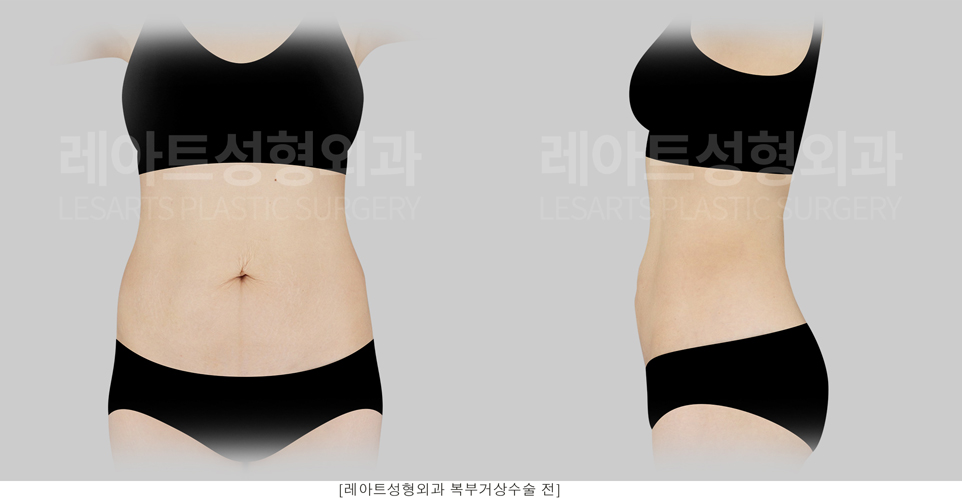
The tummy tuck surgery case we will analyze this time
is a patient in her late 40s who has given birth twice
through natural delivery.
After her last childbirth,
she has consistently managed her increased weight
and has a history of abdominal liposuction
at another clinic.
However, due to repeated weight fluctuations,
the elasticity of her abdominal skin decreased,
resulting in prominent sagging.
Although she maintained diligent care in her daily life,
she mentioned that the sagging skin and diastasis recti
were difficult to resolve with exercise and dieting alone,
leading to greater concerns about her body shape.
Ultimately, she visited our clinic seeking
a fundamental solution.
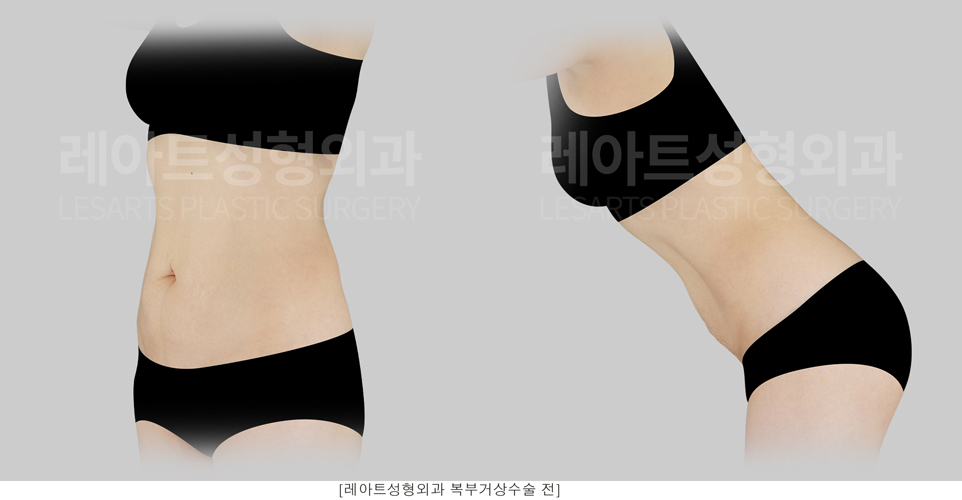
To assess the necessity and effectiveness
of tummy tuck surgery,
we conducted a thorough analysis of the patient’s condition.
Due to repeated weight changes after childbirth,
the overall elasticity of the abdominal skin was significantly reduced,
with noticeable sagging from the upper abdomen down to above the belly button.
Additionally, diastasis recti was also diagnosed.
It was determined that tummy tuck surgery
would be necessary to improve these issues.

The patient was concerned about the length of the scar
and initially preferred the S-type tummy tuck surgery,
which involves the shortest incision.
However, after understanding that this method would make it difficult
to correct the sagging skin above the belly button and the stretched abdominal wall,
she ultimately decided to proceed with the M-type tummy tuck surgery.
Additionally, to enhance the overall contour of the abdomen,
we explained that abdominal liposuction would be performed together.
We will explain the surgical effects in detail
using photos taken before the surgery and
2 and a half months after the tummy tuck surgery.
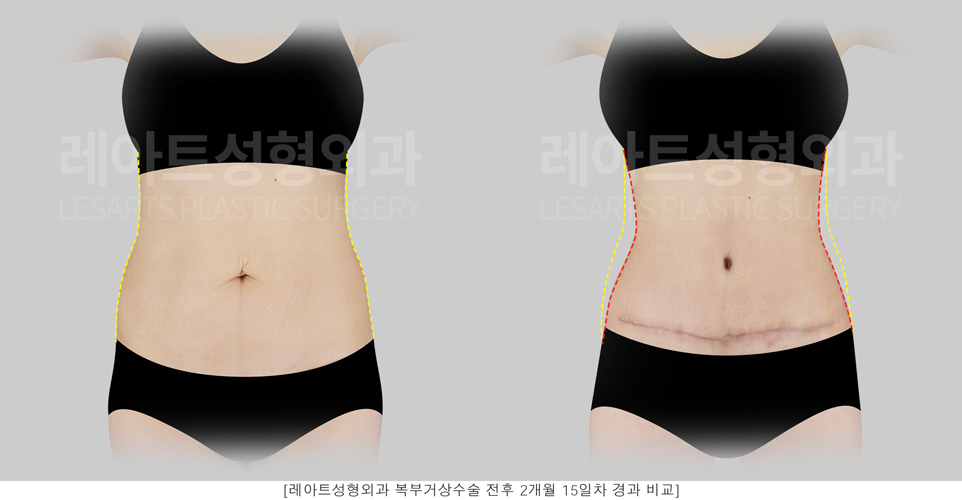
The before-and-after photos taken 2 and a half months
after the tummy tuck surgery show
that the upper abdominal skin, which was sagging and wrinkled
above the belly button before surgery,
has been smoothly lifted,
resulting in a firm and slim abdominal line.
In particular, the skin that was loose and stretched
from above the belly button to below has been neatly tightened,
and the position and shape of the belly button
have also been ideally improved.
This is not just a simple removal of sagging skin;
the diastasis recti was also corrected,
creating a firm line toward the center of the abdomen,
with a well-defined waistline and contoured sides.
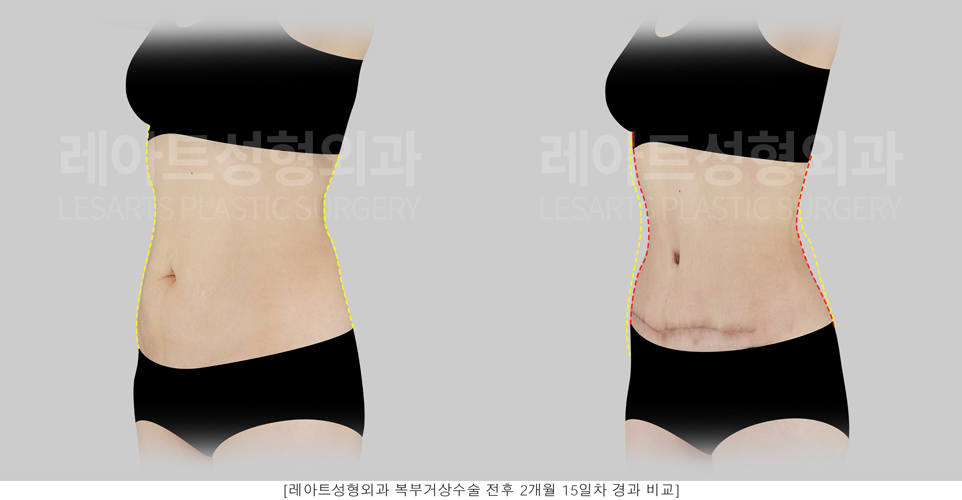
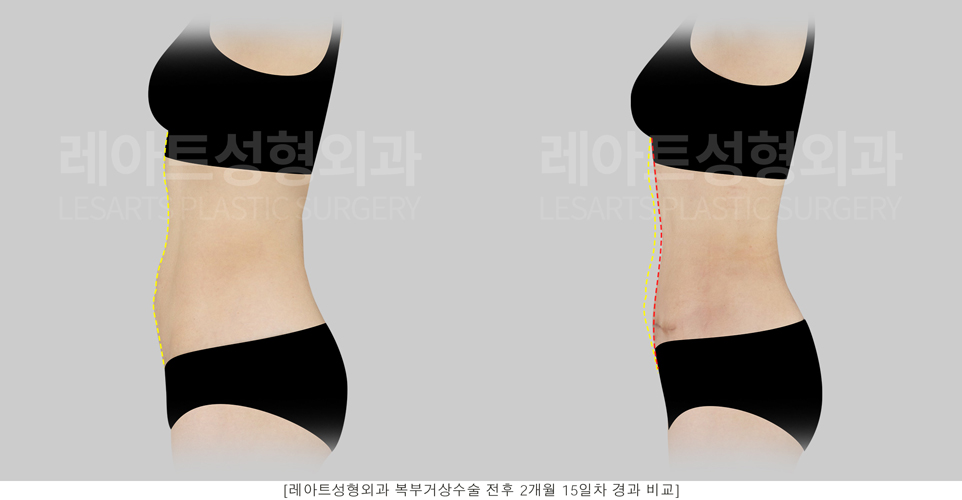
The side view before-and-after photos reveal
various changes that were not clearly visible from the front.
Before surgery, the upper abdomen above the belly button
protruded outward noticeably,
but now the abdominal contour appears well-defined and refined.
The overall appearance of the lower abdomen is slimmer and flatter,
which is strikingly noticeable.
The skin from the belly button down to the lower abdomen,
which was sagging and felt thick around the belly button area,
has been smoothly lifted,
showing a firm and continuous line
from the waist down to the lower abdomen.
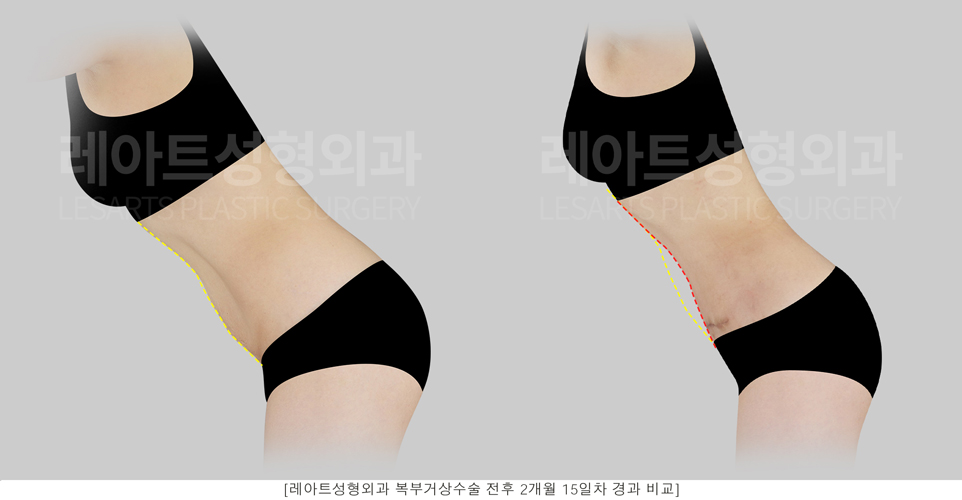
When bending forward before surgery,
the skin lacked elasticity and sagged downward,
causing the entire abdomen to stretch and droop.
After undergoing tummy tuck surgery,
abdominal wall repair, and liposuction,
these issues were tightened and smoothed out,
giving the abdomen a lighter, less heavy appearance.
Also, before surgery,
the sagging skin obscured the waistline,
but after surgery,
the waist appears slimmer and more defined,
creating a youthful image that looks younger than the actual age.
In this patient’s case, there was initially some concern about the length of the incision.
However, through professional consultation, the surgical method was chosen to maximize the effects of skin tightening and abdominal wall repair.
As a result, the patient experienced more satisfying changes.
About two months after surgery, the patient is recovering faster and more stably than expected.
Not only the sagging skin in the upper abdomen but also the diastasis recti has been effectively corrected,
maintaining a smooth and firm body contour.
Especially with the repositioning of the navel,
the overall appearance has become more balanced.
The scar from the incision is also expected to gradually fade through consistent treatment and care.
The patient was advised to continue regular follow-up visits for recovery checks,
undergo toning treatments, and carefully manage the scar with silicone sheets and moisturizing care
to ensure the scar stabilizes quickly.
Since some swelling remains,
it was emphasized once again that long-term management and regular visits are important
to achieve a more natural and slim body line.
#Abdominoplasty
#M-type
#Abdominal liposuction(M)


Cases finding
similar to my profile
Customer Diagnostics


Select the surgery and
area you are interestedto see real
before andafter changes.


we
make you,
the art
Clinic hours
MON - FRI
10 am – 7pm
SAT
10 am – 4pm
Holiday
SUN, HOLIDAY
Location
Lesarts Moon Clinic Tower 4-5F, 40, Nonhyeon-ro 168-gil,
Gangnam-gu, Seoul, Republic of Korea

Medical institution name Lesarts Plastic Surgery
Address Lesarts Moon Clinic Tower 4-5F, 40, Nonhyeon-ro 168-gil, Gangnam-gu, Seoul, Republic of Korea
Representative Moon sung jun
