Many men with gynecomastia
share stories on fitness forums
about how their chest shape and size
don’t improve—
even after consistent workouts and dieting.
Especially in cases where the patient
is not overweight,
but the chest appears full
and the area around the nipple is raised,
this issue often becomes clear quickly
and can’t be resolved through exercise alone.
Still, many hesitate about surgery
due to seasonal concerns—
worried whether summer is the right time
for the procedure.
While a proper diagnosis
must come first,
it’s important to know that seasonality
does not significantly affect the surgical outcome.
Today, we’ll look at a case where
a patient was diagnosed with true gynecomastia,
underwent surgical correction,
and experienced noticeable changes
in confidence and chest contour.
The patient is a man in his early 30s,
working a full-time job,
who had been aware of gynecomastia symptoms
since his teenage years.
Although he maintained a stable weight
through exercise,
the lump under the nipples
remained unchanged—
prompting him to seek a diagnosis.
He was especially bothered by
his chest shape under T-shirts,
with the nipples visibly protruding
and avoided upper-body exposure
in social settings—
which impacted his confidence.
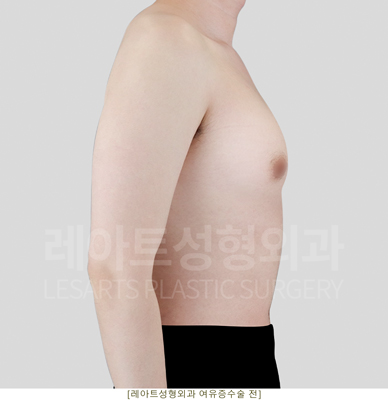
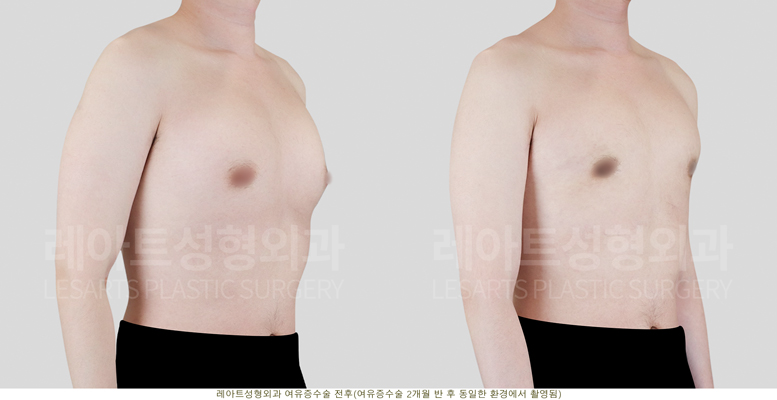
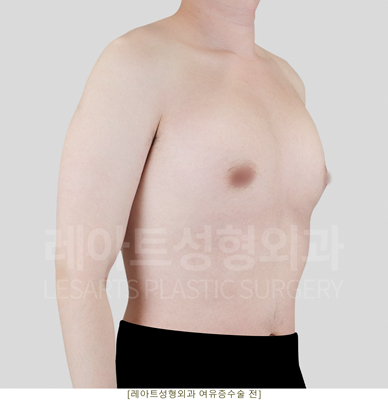
A pre-surgery evaluation showed
clearly enlarged glandular tissue
centered around both nipples.
From the side, the bulging contour
beneath the nipples was especially pronounced.
There was also fat accumulation
in the lower and lateral chest areas,
further exaggerating the protrusion.
He was diagnosed with Simon Grade 2A
true gynecomastia.
His treatment plan included:
1. Glandular Tissue Excision
The overdeveloped glandular tissue
directly contributing to the protrusion
was surgically removed
to flatten the chest profile.
2. Liposuction
To reduce the remaining fat
around the lower chest and flanks,
liposuction was performed—
smoothing the chest contour
and reducing bulk.
3. Adhesion Prevention & Sunken Scar Prevention
Following gland removal,
internal reshaping and support were added
to prevent adhesions or hollowing
around the nipple area.
Let’s now review his results
2 months post-surgery.
The bulging contour
that surrounded his nipples pre-surgery
has been flattened.
His entire upper body now appears
more even and defined.
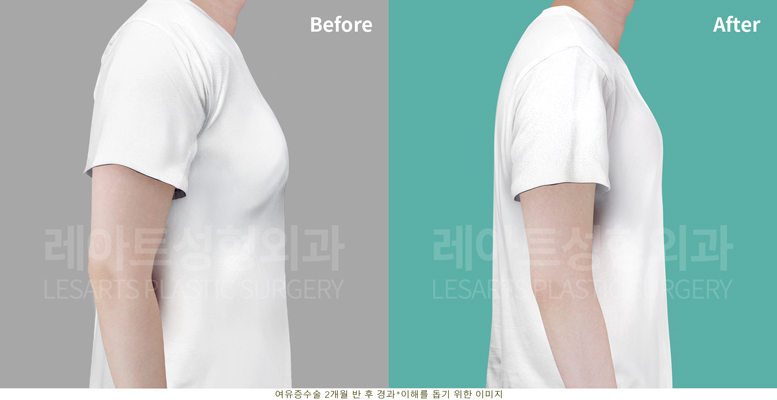
Especially in the side view,
the previously visible lower chest bulge
is gone,
and the chest line looks more masculine.
The sides of the chest
also show improvement,
giving a sculpted appearance
similar to that from weight training.
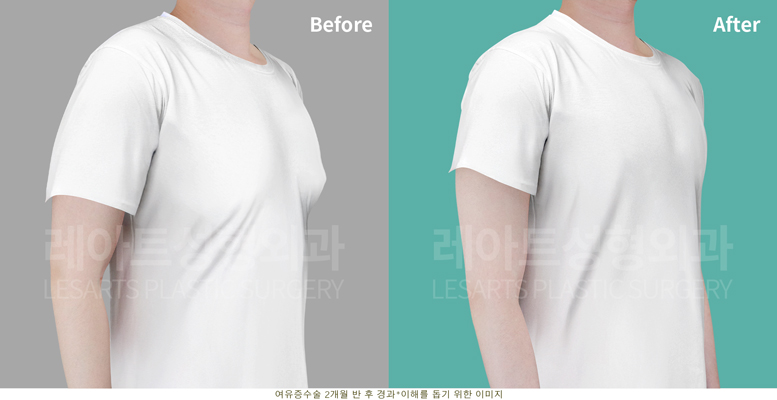
Looking at his T-shirt fit,
the previously visible nipple projection
has been corrected.
Even with just a thin white shirt,
he can now confidently stand straight
without worrying about chest visibility.
Since true gynecomastia involves
glandular tissue growth—
not fat—
weight loss and exercise
are usually not effective.
In this patient’s case,
the enlarged gland
was concentrated under both nipples,
with fat also present in
the lower chest and flanks.
With both gland excision
and liposuction,
his chest was flattened in the center
and the surrounding contours
smoothed out.
The previously protruding nipples
now have a natural, stable shape,
and even in thin summer clothes,
his upper body looks more refined
and balanced—restoring confidence.
For patients who’ve had symptoms
since adolescence,
as in this case,
long-term tissue stabilization
is just as important as the initial outcome.
Currently, both nipple position
and chest symmetry
are recovering well,
but continued care is essential:
If he follows these post-op guidelines,
his results should continue
to improve naturally—
with a well-balanced, confident chest shape.