When male patients visit the clinic
for enlarged chest or nipple protrusion,
many have the typical case of bilateral gynecomastia.
But quite a few also struggle with asymmetrical gynecomastia,
where only one side is more developed or sagging.
If one side of the chest appears more prominent
when wearing clothes and the difference in contour
is clearly visible, it can cause a lot of stress.
Fortunately, with the right diagnosis and surgery,
this can be fully corrected.
This post details the full course
of diagnosis, treatment, and results
of gynecomastia surgery in a case of chest asymmetry.
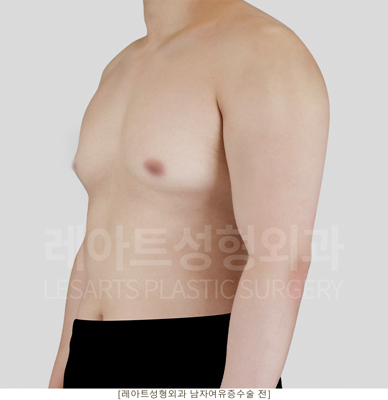
The patient was in his late 30s,
and had noticed chest protrusion since his teens.
Despite consistent workouts and diet,
he experienced no improvement in chest shape.
He became increasingly concerned
as the asymmetry between both sides worsened.
He also felt uncomfortable because
his nipples were prominently visible
even through clothing,
which added to his daily stress.
After realizing this issue couldn't be solved alone,
he visited our clinic for accurate diagnosis and treatment.
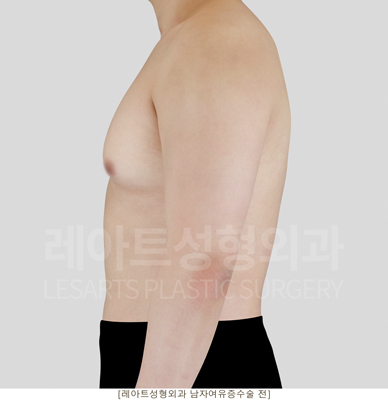
Upon examination,
both sides of the chest were visibly protruding,
with a clear size difference.
The areola and nipple areas were puffy,
and the left side was more prominent
in both size and depth.
Palpation revealed a firm mass beneath the nipple,
and the patient also reported
long-term discomfort due to this lump.
Ultrasound confirmed glandular hypertrophy
on both sides, with the left side
being wider and deeper.
Based on these findings:
-
Right side was diagnosed as Simon Grade 2A
-
Left side as the more developed Simon Grade 2B
→ both true gynecomastia.
We proposed the following surgical plan:
1. Glandular Tissue Removal
Through an areolar incision,
we planned to remove the enlarged gland
to reduce chest size and correct nipple protrusion.
2. Liposuction
To prevent an uneven contour after gland removal,
we included liposuction of the lower and outer chest
for a smoother and flatter shape.
3. Adhesion & Indentation Prevention
To prevent post-op nipple depression or skin adhesion,
we included deep tissue repositioning
for volume maintenance and natural outcome.
4. Medication Review
The patient was taking finasteride for hair loss,
so we informed him about the potential recurrence risk
due to hormonal influences,
and emphasized the need for follow-ups.
Now, let’s review the outcome
2 months after gynecomastia surgery.
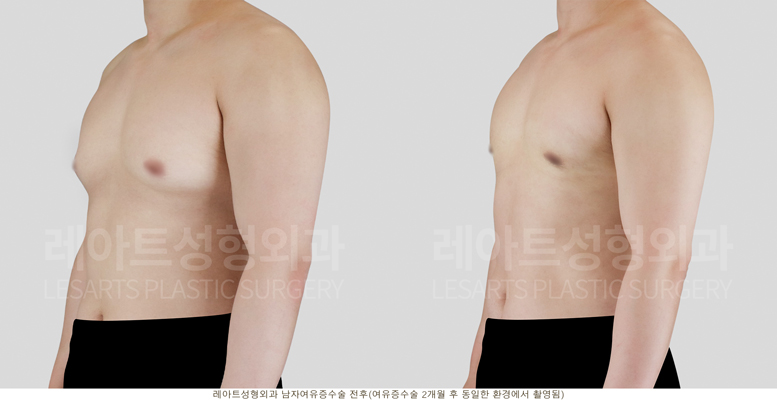
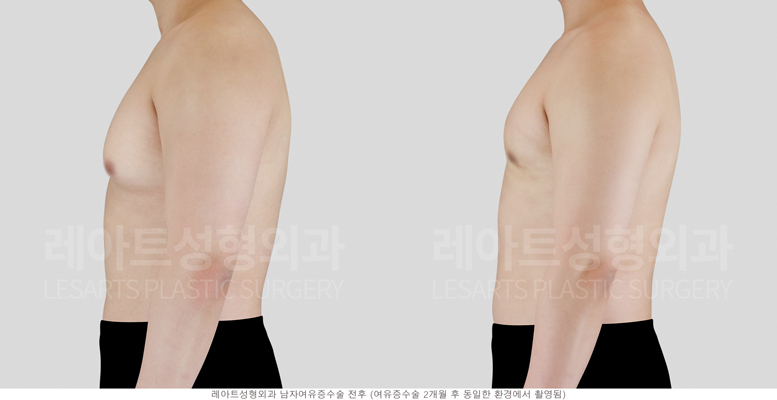
Before surgery,
noticeable chest protrusion was seen,
especially on the left side,
which extended down from the nipple.
At 2 months post-op,
chest protrusion was significantly reduced,
and the volume around the nipples
appeared well-contoured and natural.
The asymmetry between both sides was clearly improved,
and the areas where glandular tissue was removed
remained smooth without indentations,
resulting in a balanced and defined male chest line.

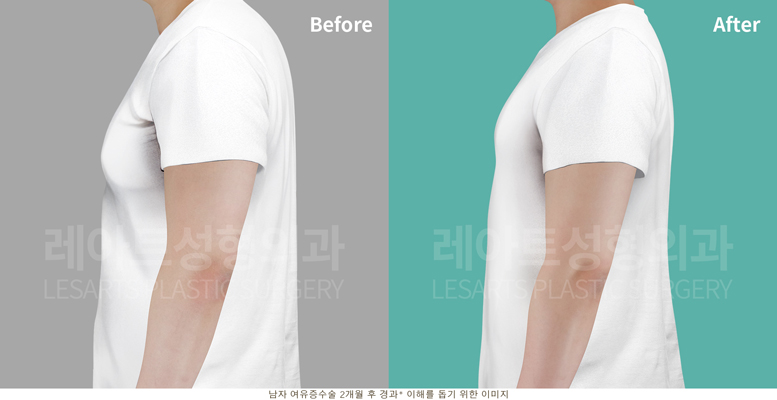
Even in a thin t-shirt,
the post-op improvement is visible.
Before surgery,
the nipple protrusion and chest shape
were obvious through clothing,
with the asymmetry affecting how the shirt fit.
After surgery, the asymmetry was corrected,
volume around the nipples reduced,
and the overall look became clean and stable.
Now, even a single thin shirt fits naturally
and reveals a smooth chest contour.
This patient had a clear difference
in gland size between both sides,
with noticeable visual asymmetry.
By removing both glandular tissue
and excess fat from the lower and outer chest,
we refined the entire chest shape
for symmetry and a smoother finish.
Asymmetry in size and projection
was also corrected through this approach.
At present, both chest sides are stable,
and if the patient continues to maintain
his body with moderate care,
these results will remain natural and well-defined
for the long term.












