ALL MENU

Online Consultation

Online Consultation

kakaoTalk

NaverTalk

INSTAGRAM

YOUTUBE

Cases finding similar to my profile

Cases finding
similar to my profile

Customer Diagnostics

#Abdominoplasty

Case of restoring sagging belly after repeated weight fluctuations with tummy tuck surgery

2025-07-14

Visible changes can happen
in many parts of the body,
but the abdomen tends to show
more noticeable signs like sagging,
wrinkles, and stretch marks
due to its structural nature.
Especially when obesity begins
during childhood and continues into adulthood,
with repeated cycles of weight gain and loss,
loose abdominal skin may fold over itself,
and low skin elasticity often leads
to discomfort and deep wrinkling.
When these issues persist over time,
they often result from structural problems
in the abdominal wall and skin,
making it difficult to correct fully
with just diet and exercise alone.


Case of restoring sagging belly after repeated weight fluctuations with tummy tuck surgery photo 1
 

Today's case features a woman
in her 30s who experienced
childhood and adolescent obesity,
followed by repeated weight fluctuations
as an adult.
She came to Lesarts
with prominent sagging in the abdomen,
especially in the lower region.
Even after significant weight loss,
she continued to experience
excess lower belly skin, deep folds,
a distorted navel, and skin overlapping
over her underwear that never regained elasticity.


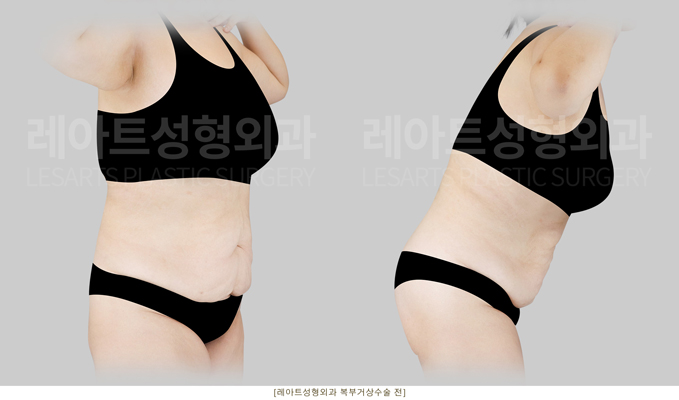
Case of restoring sagging belly after repeated weight fluctuations with tummy tuck surgery photo 2
 

Before surgery, her abdomen showed
a clear loss of elasticity
from the upper belly to the lower.
Sagging from the upper area
had concentrated downward
under the pull of gravity,
causing the belly button to deform
and creating multiple folds
of loose, sagging skin.
This degree of abdominal skin laxity
made her torso appear heavier
and broke her body’s overall balance.
When palpated, her abdominal wall
showed signs of diastasis recti,
where the muscles had separated
and weakened the structural support,
allowing the belly to protrude outward
without proper tightness.
This made it difficult to achieve
a smooth contour along the torso.
The combination of skin sagging,
fat accumulation, and muscle separation
gave her abdominal area
a bulky and uneven appearance.
Given these complex findings,
we determined that a combination
of tummy tuck, abdominal liposuction,
and diastasis recti repair
would be necessary for optimal results.


1. L-Type Abdominoplasty

As the patient was unmarried,
we considered future pregnancy possibilities.
We used dissolvable sutures
to tighten her abdominal muscles
and planned a wide-area lift
using L-type tummy tuck surgery
to address the upper abdominal sagging.
We also redesigned and repositioned
her distorted belly button
to restore symmetry and balance.


2. Abdominal Liposuction

To maximize the overall result,
we performed liposuction
to reduce volume in the abdomen
and enhance the contouring effect
of the tummy tuck procedure.

3. Hip Dip Fat Grafting

Her waist-to-hip transition lacked volume,
making her body appear disconnected.
To improve this,
we grafted fat to the hip dips
to enhance the curve from the waist
to the hips and create
a more balanced, natural lower body line.


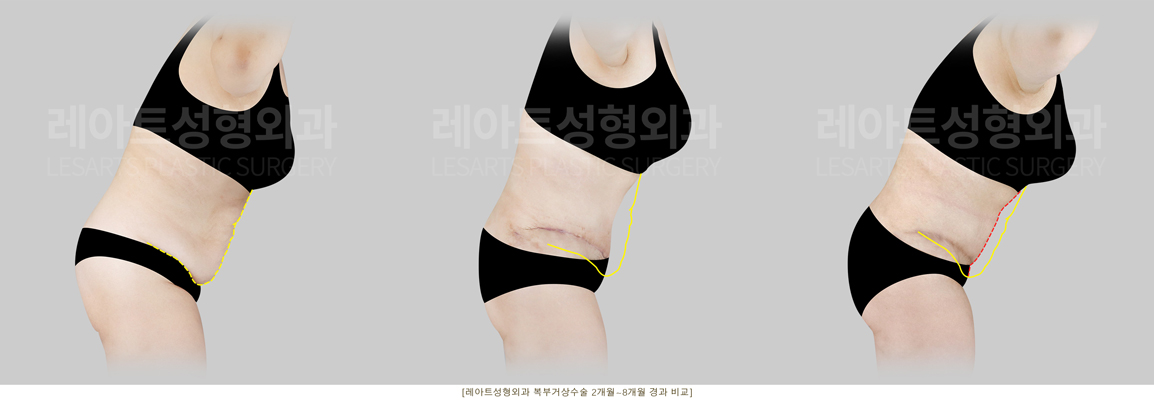
We analyzed her progress
using photos taken
before surgery,
and 2 and 8 months post-op.


Case of restoring sagging belly after repeated weight fluctuations with tummy tuck surgery photo 3
Case of restoring sagging belly after repeated weight fluctuations with tummy tuck surgery photo 4
 

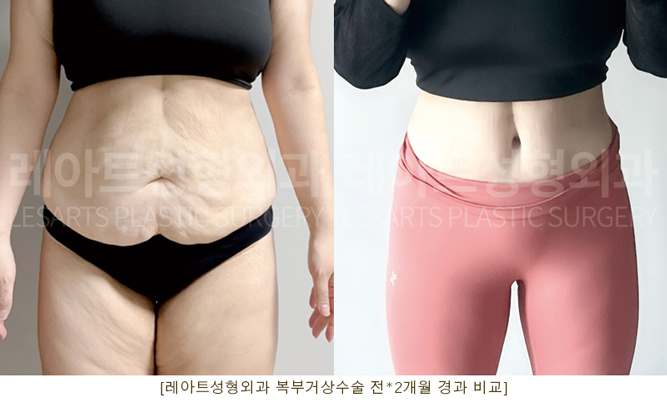
Before surgery,
due to childhood obesity and yo-yo dieting,
she had severely reduced skin elasticity
and sagging concentrated
in the lower belly.
Her skin folded over the underwear,
deep wrinkles formed,
and the abdominal line collapsed
due to muscle loosening.
There was no clear definition
between her waist and pelvis,
making her upper and lower body
look disconnected.
But 2 months after the surgery,
her sagging skin had tightened,
and a firm abdominal shape
was clearly visible.
The repaired abdominal muscles
had recovered structure,
and the outer ribs pulled inward
to create a well-supported midsection.
Her body line was stable enough
to allow comfortable clothing exposure
in daily life.

Case of restoring sagging belly after repeated weight fluctuations with tummy tuck surgery photo 5


As time passed after the surgery,
her posture improved,
and her abdomen remained supported.

Bulging and folding skin
disappeared altogether.

The thick folds of sagging skin
that once wrapped below
were gone,
and the belly was now
firmly supported with no drooping.

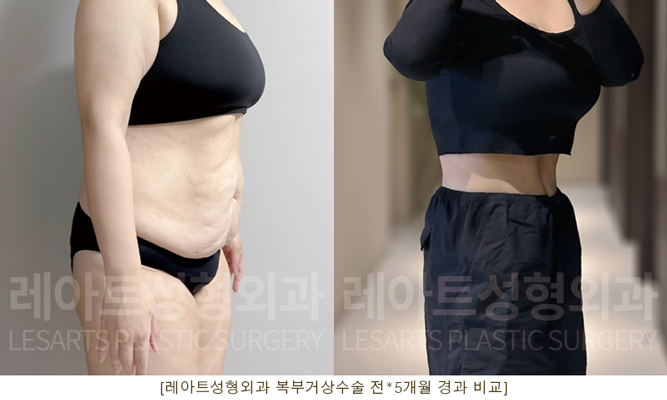
Case of restoring sagging belly after repeated weight fluctuations with tummy tuck surgery photo 6
Case of restoring sagging belly after repeated weight fluctuations with tummy tuck surgery photo 7

From the side,
her lower belly used to protrude,
collapsing her body’s center line
and making her clothes look bulky.

After the surgery,
her waistline pulled inward,
and her abdomen appeared tighter,
giving her both comfort
and renewed confidence in clothing.

The incision line sits
below the underwear,
so there's no concern
about it being visible in daily wear.


Tummy tuck surgery does involve
a long scar, and recovery varies
by individual and skin type.

Scar color may also differ,
so we advised her
to continue with scar ointment,
laser care, moisturization,
and UV protection when exposed.

Fortunately, her scar area healed well,
with no irregularities or complications.
Her skin smoothed evenly
above and below the incision.

With continued follow-up,
proper care, healthy diet,
and moderate exercise,
her results are expected
to become even more refined over time.


#Abdominoplasty 

#L-type 

Previous post

Slimming the Upper Body with Arm and Armpit Fat Removal

Next post

Does arm fat make your upper body look bulky? How much of a difference does arm liposuction really make?