Gynecomastia is often dismissed
as a cosmetic issue,
but in cases of true gynecomastia
involving glandular tissue growth,
many patients experience intermittent chest pain
and a vague sense of pressure.
In addition to visible nipple and areola protrusion,
some may notice lumps, or even discharge,
and these symptoms can become
a source of daily discomfort
that affects more than just appearance.
As a result, clothing choices, posture,
and even social confidence
can be affected.
While gynecomastia may begin
as a physical body contour concern,
it often evolves into psychological discomfort—
and in such cases, accurate diagnosis
and surgical treatment become the most effective solution.
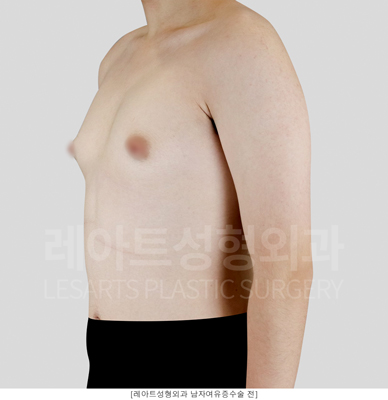
This patient, in his 20s,
had been experiencing symptoms
since his teenage years—
including visible chest protrusion
and occasional pain in the chest area.
During puberty, he assumed
the condition would resolve naturally,
but even into adulthood,
his nipple and areola area remained prominent,
and it was clearly visible through clothes,
causing ongoing discomfort.
After receiving a gynecomastia diagnosis
at another clinic,
he did not undergo surgery at the time,
but returned to seek treatment
due to persistent symptoms.
He visited Lesarts Plastic Surgery
for a second opinion,
including an ultrasound diagnosis
and a plan for surgical correction.
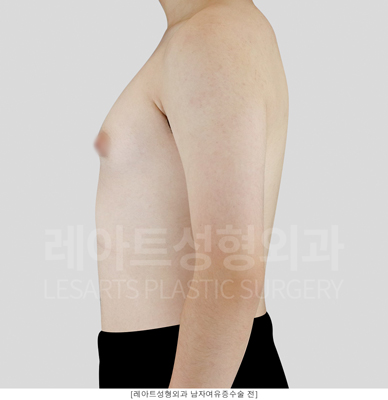
Upon initial examination,
protrusion was clearly visible
in both sides of the chest.
The nipple and areola areas
were especially raised and puffy.
Palpation revealed a firm lump under the nipple,
suggesting glandular hypertrophy.
Ultrasound imaging confirmed
significant glandular tissue overgrowth
beneath both nipples.
Based on these findings,
the patient was diagnosed with true gynecomastia,
Simon Grade 2A.
We recommended surgery to remove
the glandular tissue,
which was the root cause of the symptoms.
1. Glandular Excision
We performed periareolar excision
to remove the overgrown glandular tissue,
which was the main cause of gynecomastia.
2. Liposuction
Fat surrounding the glands
and extending toward the lateral chest
was suctioned to smooth the contour
and reduce overall volume.
3. Adhesion Prevention and Tissue Repositioning
To prevent nipple inversion or uneven adhesion
after gland removal,
we performed tissue repositioning
and anti-adhesion care
for a natural and stable chest shape.
Let’s look at how the patient’s chest appearance
changed 2 months after gynecomastia surgery,
compared to before.
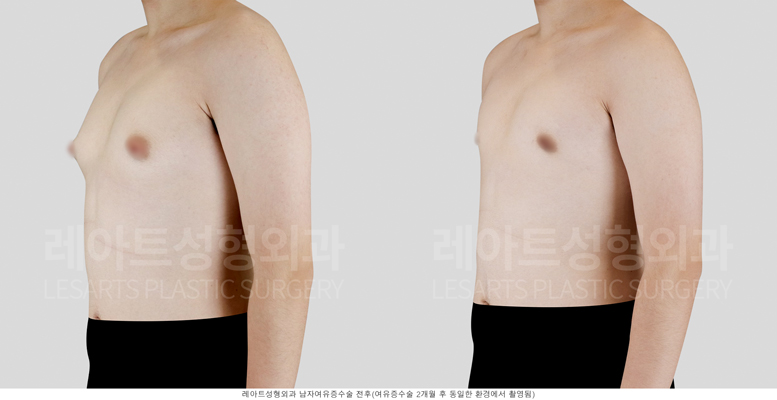
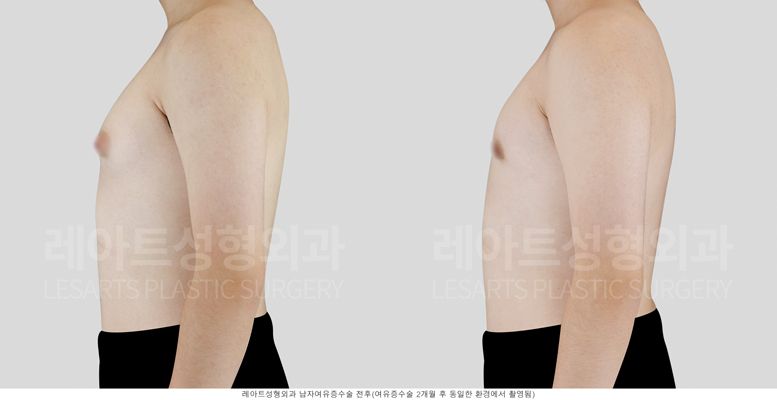
Before surgery,
the areola and nipple were prominently raised,
with rounded volume surrounding them.
The lower chest and nipples formed sharp protrusions
that were especially noticeable under thin clothing.
These issues often drew unwanted attention
to the chest area and made wearing fitted tops
a source of stress.
But 2 months after surgery,
with both gland excision and fat removal performed,
the volume in the chest area was naturally reduced,
and the puffiness of the nipple and areola disappeared,
creating a more stable and masculine contour.
The once pointy, cone-shaped chest was corrected,
resulting in a flat and defined male chest line.
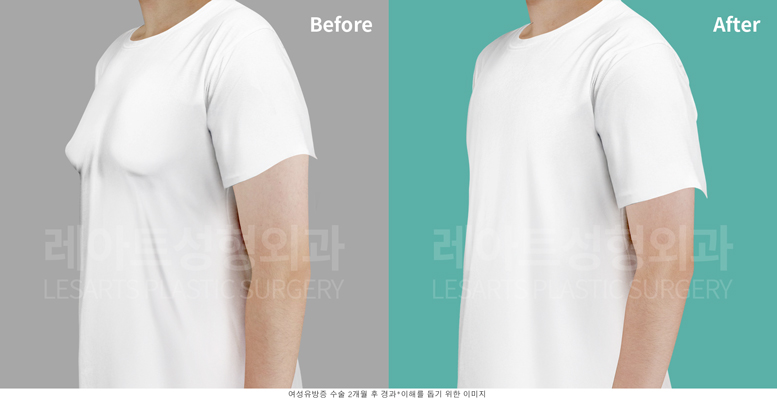

After surgery,
wearing a T-shirt gave the patient
a cleaner and more athletic silhouette.
Before surgery,
his nipple and chest contour were visible
through thin clothes,
causing self-consciousness and discomfort.
Now, with the gland and lateral fat removed,
his chest is flatter,
and the nipple projection has been resolved,
eliminating that concern.
This patient reported that
not only had the chest size improved,
but the pain and pressure around the nipples,
which he had experienced for years,
were completely gone after surgery.
He expressed high satisfaction,
knowing both cosmetic and physical discomfort
were resolved through the procedure.
For patients like him with true gynecomastia
due to glandular overgrowth,
the condition may include
not only visible breast enlargement
and nipple protrusion,
but also persistent pain and discomfort.
If you're experiencing similar symptoms,
it’s important not to delay treatment.
Consult with a qualified specialist
to receive an accurate diagnosis
and explore surgical solutions
tailored to your case.












