Anyone who has consistently tried dieting
knows that some stubborn fat areas
just won’t go away with meal control alone.
In particular, areas like the abdomen,
where fat tends to accumulate easily,
cover a large surface area—
so even if you lose some volume,
you may still not achieve a smooth or slim appearance.
For many women especially,
the goal of belly fat reduction
is not just losing size,
but shaping a slim waistline
and restoring balance to the upper body.
This shift in trend reflects a broader desire
to correct the overall bodyline flow,
not just the numbers on the scale.
Taking these abdominal body traits into account,
this case focuses on how we reshaped the midsection
by targeting specific fat deposits
to refine the waistline and torso silhouette.
[Patient Information]
Age: Late 20s
Occupation: Professional
Height: 163 cm
Weight: 54 kg
BMI: 20
Even with similar body specs,
liposuction results may vary per individual.
This patient had been managing her weight
through consistent dietary control,
but without regular exercise,
fat accumulated easily around her lower abdomen
and flanks.
Though her weight remained steady,
she struggled with persistent love handles,
which made it hard to achieve
a defined and attractive waistline.
Eventually, she determined that
a more structural solution was needed
and decided to undergo abdominal liposuction
to refine the waist and side contours
in a three-dimensional way.
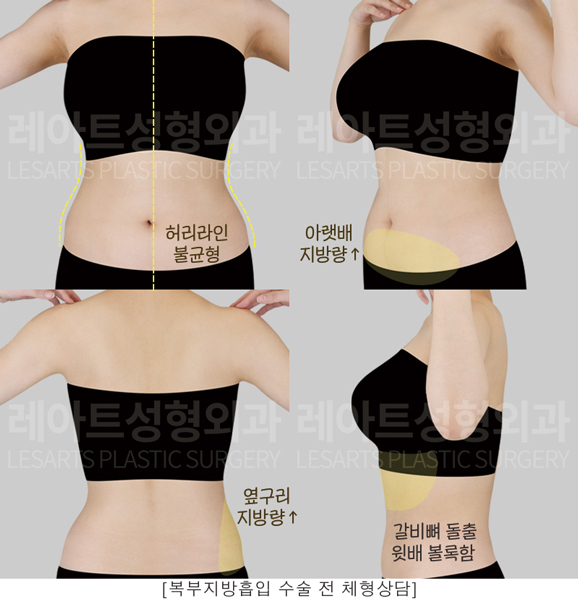
The patient had visible fat
around the lower belly and flanks,
which made her waist look wider
and the abdominal shape droop below the navel—
creating a heavy and unbalanced appearance.
Her navel was slightly shifted to the right,
which further distorted the balance
of her waistline from left to right.
Additionally, her lower ribs protruded slightly,
adding volume to the upper abdomen
and contributing to a dull upper body silhouette.
Based on this, we created a surgical plan
for full abdominal liposuction,
targeting the lower belly, love handles, and flanks.
Let’s take a look at the changes
1 month after her abdominal liposuction surgery.
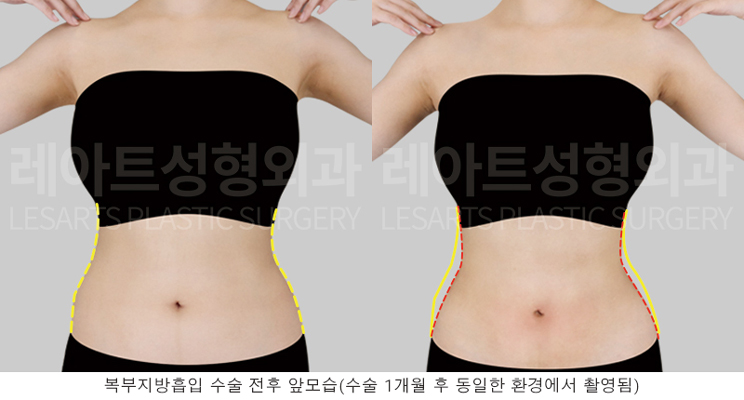
Before surgery,
her lower belly bulged forward,
and her waistline lacked definition—
giving her upper body a wide, heavy look
with most of the volume concentrated downward.
Just 1 month post-op,
the side waist curve had been reshaped inward,
creating a more feminine, balanced figure.
The love handles and back flanks
had also been refined,
allowing the lines beside the belly button
to flow naturally into the pelvis—
lightening the entire upper body silhouette.
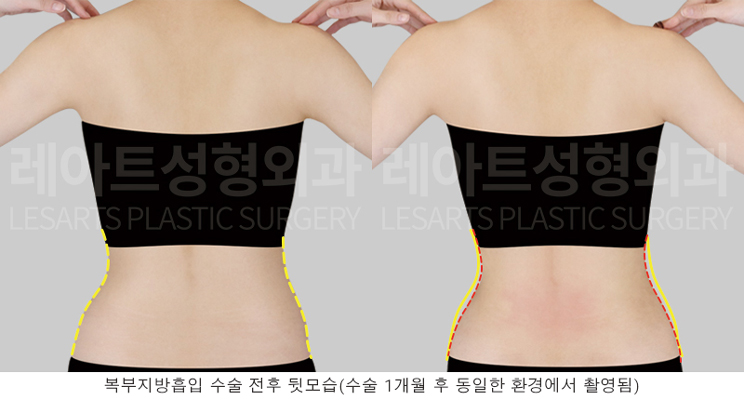
From the back view,
the difference in the waist and flank area
was even more pronounced.
Before surgery,
excess fat extending from the flanks
to the back created an uneven waist
with visible left–right asymmetry.
Fat above the pelvis also blurred
where the legs started,
making her legs look shorter in proportion.
After liposuction,
the side waistline was refined symmetrically,
and volume in the back flanks was reduced—
creating a smoother curve
from waist to hips.
Her overall backside silhouette looked lighter,
and the newly defined waist
gave her a more feminine line.
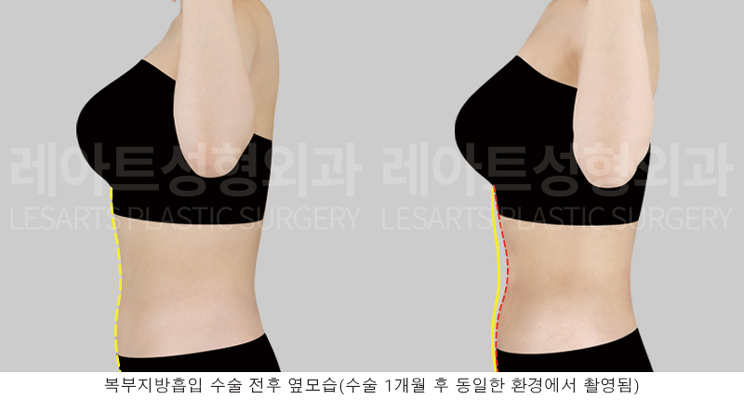
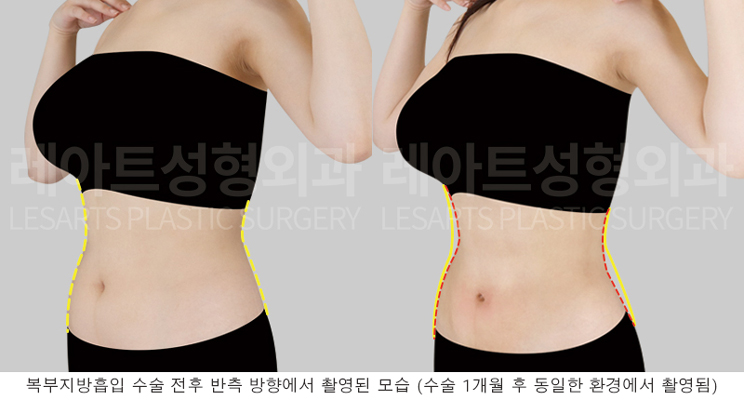
From the side,
fat in the lower belly made the waistline disappear
and gave the central body a heavy appearance.
After abdominal liposuction,
the bulging lower belly volume was reduced,
and the curve above the pelvis was restored—
creating a sleek, hourglass-like shape
from every angle.
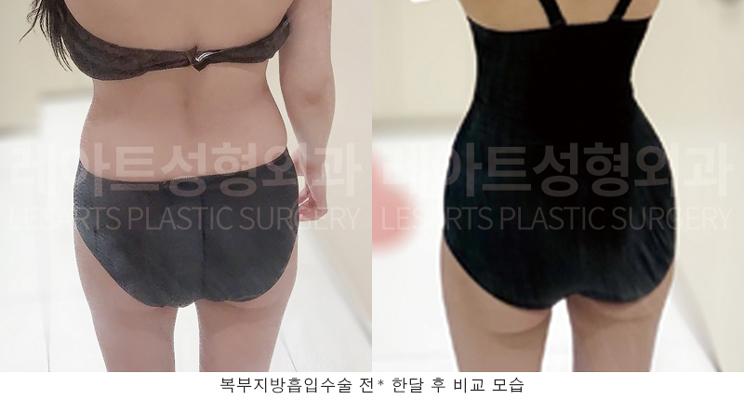
Comparing her selfies
before and after the surgery
highlighted the difference even more clearly.
Previously, her waistline lacked definition,
and her upper body appeared bulky—
affecting how clothes fit
and how she felt about her figure.
But after liposuction,
her upper body proportions were refined,
and even just one month later,
her silhouette had become noticeably sharper.
This 1-month mark is the stage
where tissue begins to stabilize
with the help of radiofrequency therapy.
As recovery continues,
her waistline and flanks
are expected to become even more contoured,
delivering not just reduced circumference,
but also a dramatic improvement
in bodyline and overall balance.












