Many men who first recognize the symptoms
of gynecomastia, a condition where the male chest
enlarges like a woman’s,
often assume it’s due to
weight gain and body shape changes.
But even those with an average build,
or those who are slim but experience only chest enlargement
with protruding nipples and areolae,
can be understandably alarmed.
In such cases, an accurate diagnosis and treatment
are essential,
as firm tissue under the nipple
or continuously growing chest volume
may be caused by overgrowth
of the mammary glands.
This case of gynecomastia surgery
involves just that—
a patient with an average build
who visited us for diagnosis and treatment
due to these symptoms.
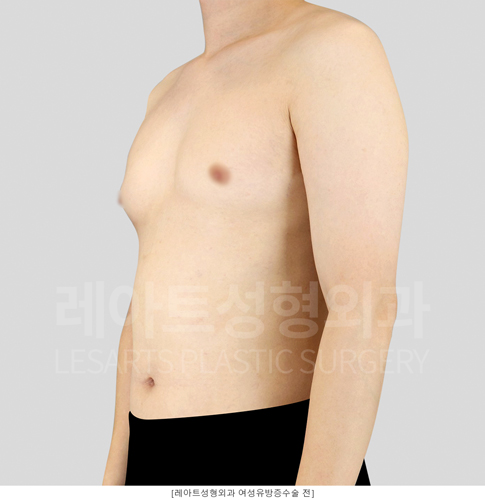
This patient, now in his 40s,
began to notice chest enlargement
and nipple protrusion in his 30s,
which led to persistent discomfort
and ultimately brought him to our clinic.
Though he had a fit, average build
and exercised regularly,
he still experienced prominent changes
in the nipple area,
which made him feel self-conscious
when wearing white T-shirts
or thin clothing.
Notably, he had been taking
hair loss medication for about 10 years,
but he could not clearly recall
whether the gynecomastia symptoms
started before or after beginning the medication.

During examination,
his chest enlargement and nipple protrusion
were clearly visible.
The entire area around the nipple
appeared swollen,
and upon palpation,
firm mammary gland tissue
was felt under the nipple.
Ultrasound results confirmed
that mammary gland tissue
was widely distributed
in both breasts.
Although there was mild asymmetry
between left and right sides,
both breasts were classified
as Simon Grade 2A—
diagnosed as true gynecomastia.
Based on this,
we recommended a surgical plan
that included glandular excision
and liposuction.
1. Glandular Excision
Through an incision around the areola,
the overgrown mammary gland tissue
would be removed to reduce chest size
and improve the protrusion,
creating a flatter chest contour.
2. Liposuction
In this case,
a high proportion of fat was present
in the lower and lateral chest areas.
Therefore, chest liposuction was planned
to smooth out the entire chest contour
and create a more natural shape.
3. Prevention of Skin Adhesion and Depression
To prevent tissue adhesion around the nipple
or sunken areas where gland tissue was removed,
we planned a tissue repositioning technique
to help the chest heal with
a stable and natural shape.
4. History of Medication and Recurrence Risk
The patient had been on
hormone-affecting medication
for hair loss treatment.
Since he couldn’t clearly recall
whether symptoms worsened before or after,
we based our decision
on current clinical findings
and diagnostic results.
We also explained the possibility
of recurrence due to continued medication
and emphasized the need
for regular post-op monitoring.
Now, let’s take a look
at how his chest contour has changed
approximately 4 months after the gynecomastia surgery,
comparing the before and after.
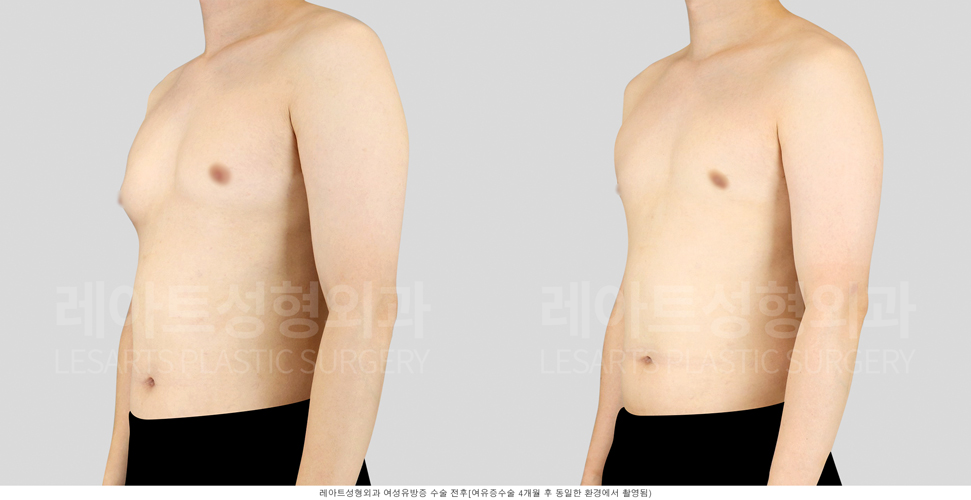
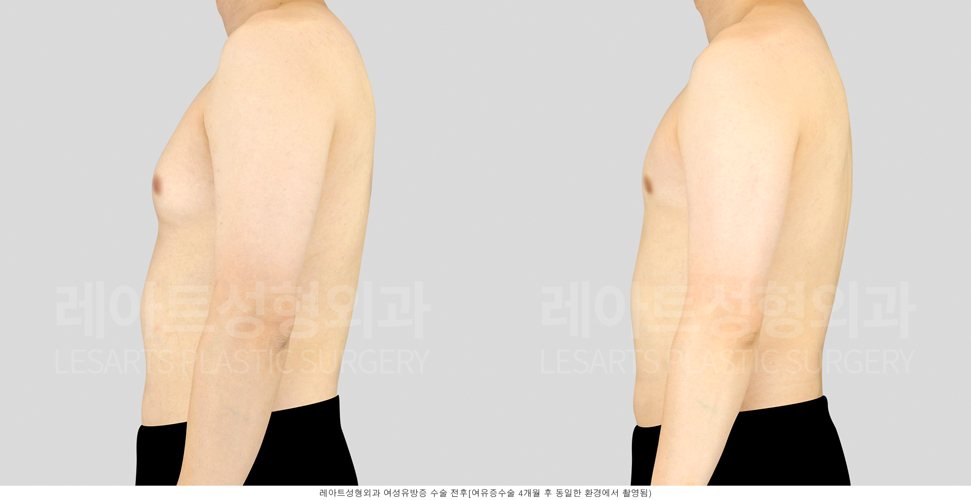
Before the surgery,
his chest had a rounded shape,
with the nipple as the center point.
The areola and surrounding area
were also visibly swollen,
and due to fatty buildup,
the lower chest curve was accentuated,
making the chest contour more noticeable.
After the surgery,
both the mammary glands
and the fat in the lower
and lateral chest were removed,
leading to a smoother, more masculine shape.
The nipple protrusion was also reduced,
and the entire chest was flattened,
showing a clear contrast
in the before-and-after results.
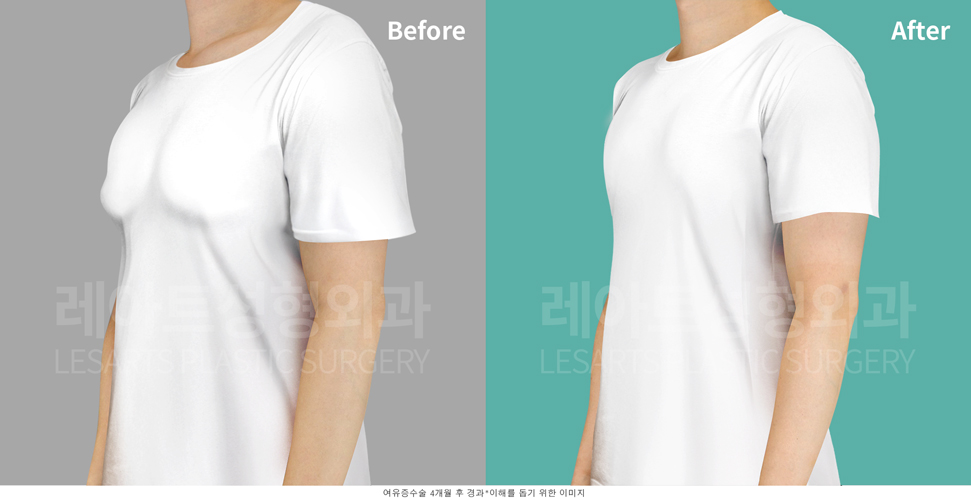

The change in appearance
while wearing a T-shirt
was also significant.
Before surgery,
the chest protrusion
was clearly visible through clothing.
After the surgery,
the chest appeared flat,
with no visible bulge through the shirt—
a clear indicator of the natural improvement
achieved through gynecomastia surgery.
For this patient,
his biggest concern was that,
despite an average build,
his chest stood out
every time he wore thin clothing.
Now that this concern has been resolved,
he expressed high satisfaction
with the outcome.
After 4 months post-op,
the patient maintained a stable and improved condition,
with even the slight asymmetry
between left and right sides corrected well.
We advised the patient to continue
avoiding strain on the surgical area
and maintain consistent body care habits,
so that the natural, clean results
could be preserved long-term.












