




Online Consultation
Please accurately enter the information below.
Quick Cost Consultation
Quick Consultation & Reservation
Cases finding
similar to my profile






Cases finding
similar to my profile
Customer Diagnostics
Male enlarged chest that doesn’t shrink with exercise may require gynecomastia surgery
2025-04-24
Some men develop enlarged breasts similar to women,
a condition known as gynecomastia.
The causes of this condition are more varied than expected,
ranging from hormonal imbalances to medication side effects.
In some cases, it’s simply due to fat accumulation,
but true gynecomastia involves glandular tissue growth.
This often occurs during puberty or middle age,
and may result from underlying diseases or medications.
If chest enlargement is fat-related, exercise may help.
However, when caused by hormones, improvement is limited,
even with consistent efforts in diet and training.
Patients often feel stressed as their chest shape
stands out under tight shirts or gym wear,
leading to discomfort, poor fit, and self-consciousness.
Many avoid situations like gyms, saunas, or pools
due to fear of exposing their upper body.
In early stages, many assume it’s just fat gain,
but if true gynecomastia is suspected,
ultrasound examination can assess glandular growth.
Surgery to remove this tissue may be required
to reduce chest size effectively and permanently.
In this post, we’ll explore the full case of a patient
who visited Lesarts for gynecomastia surgery
after failed attempts at improvement through exercise and diet.
We’ll examine his pre-surgery diagnosis,
surgical approach, and visible results.
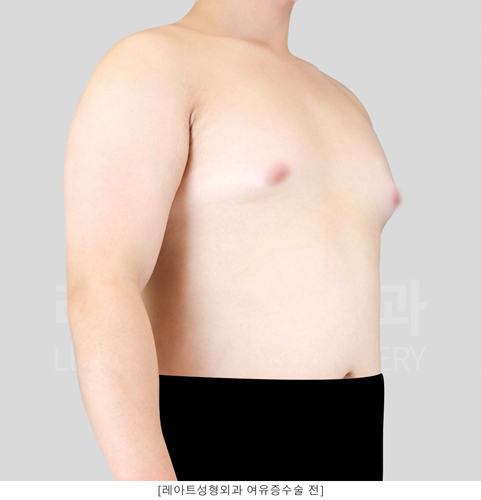
This patient had developed enlarged breasts
since adolescence, with persistent nipple protrusion.
Even in his late 20s, the condition remained unchanged,
leading him to seek treatment at Lesarts.
He had consistently managed his physique
through chest workouts and a controlled diet,
successfully losing weight overall.
However, the chest size, areola bulge,
and nipple swelling remained the same.
These symptoms caused discomfort in daily life,
especially when wearing fitted clothes or
in situations requiring shirtless exposure
— such as at the beach or sauna.
Before visiting our clinic,
he had already received a gynecomastia diagnosis
from another provider,
but no treatment or surgery was pursued at the time.
As his discomfort persisted,
he decided to undergo an ultrasound evaluation
and receive a tailored surgical consultation
at Lesarts Plastic Surgery.

Before surgery, both sides of the patient’s chest
were visibly enlarged, with a pronounced bulge in the nipples
and swelling of the areolar area.
Upon physical examination, firm glandular tissue
was palpated beneath the nipples.
The nipples appeared raised and oversized,
with the areolas also significantly expanded.
This likely caused considerable distress
regarding the patient’s chest appearance.
Ultrasound imaging confirmed the presence
of excessively developed glandular tissue,
which explained the protruding breast shape.
The case was classified as Simon Grade 2A,
indicating true gynecomastia
requiring surgical intervention.
Based on this diagnosis, we planned a procedure
involving areolar incision and glandular excision,
addressing both the root cause of breast enlargement
and the nipple size and projection.
Below, we’ll review the before-and-after comparison
photos taken one month post-surgery
to visualize the extent of transformation.
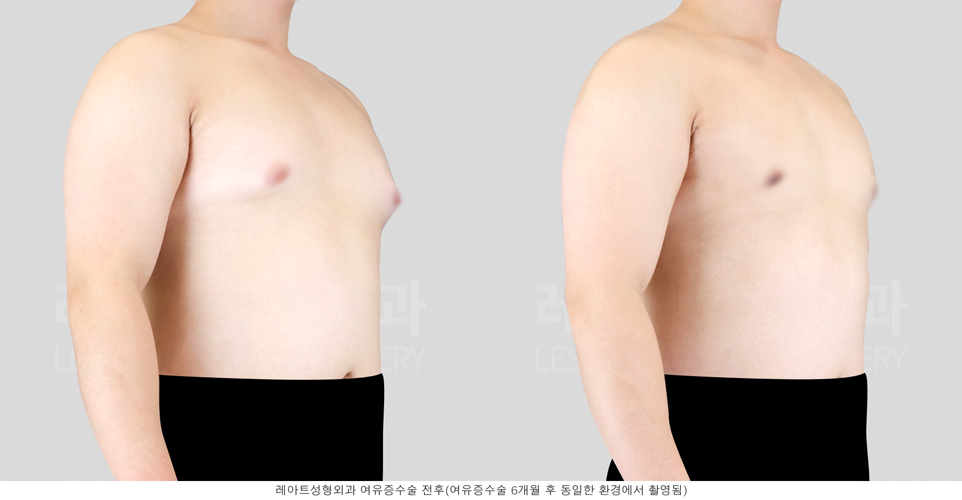
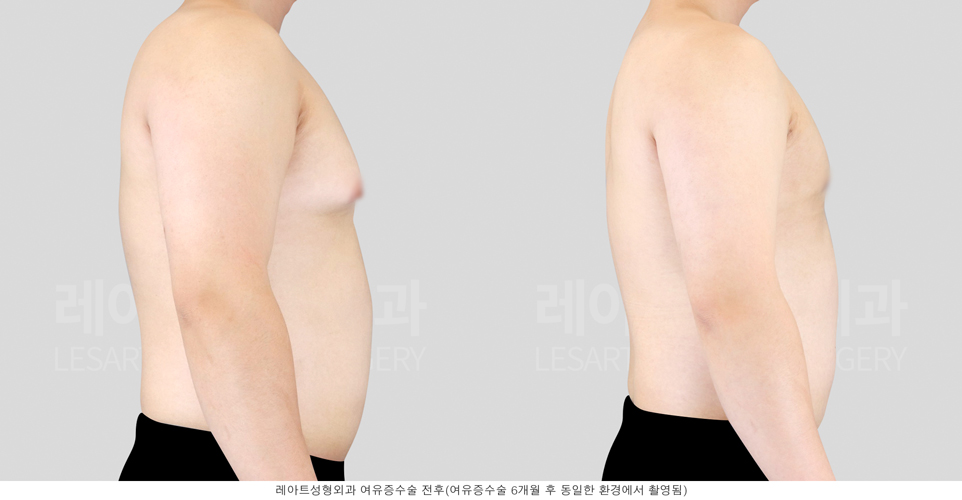
Comparison photos taken at a 45-degree oblique angle
and full 90-degree side view clearly show the change
in chest shape after gynecomastia surgery.
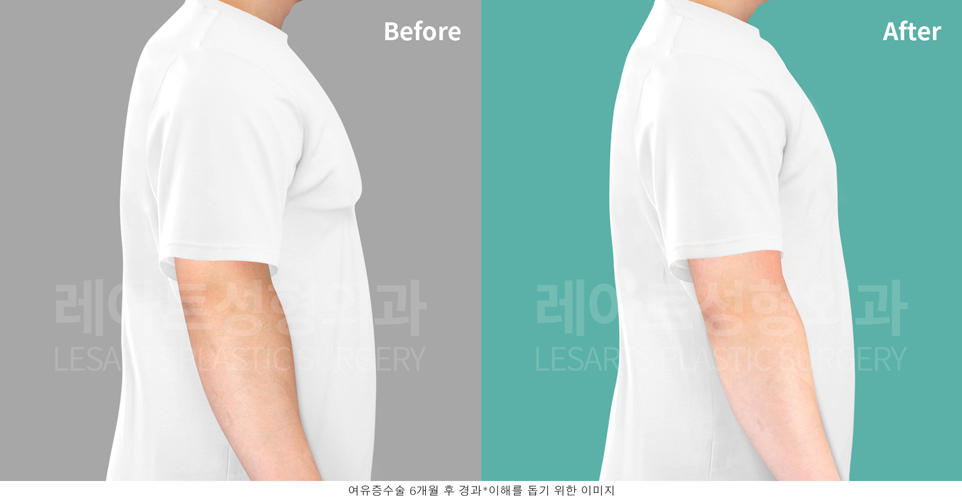
Previously enlarged and protruding on both sides,
the chest has been corrected into a flatter, smoother contour.
From the side angle before surgery,
the nipples appeared swollen and elevated,
giving the chest a pointed, unnatural shape
that disrupted the natural ribcage silhouette.
At 6 months post-op, the chest now shows
a well-defined and masculine line,
as the glandular tissue has been fully removed,
and the once-protruding nipples and areolas
have returned to a more natural appearance.
Most notably, the sharp, forward-projecting chest
has been reshaped into a smooth transition
from the chest to the upper abdomen,
restoring a balanced male profile.
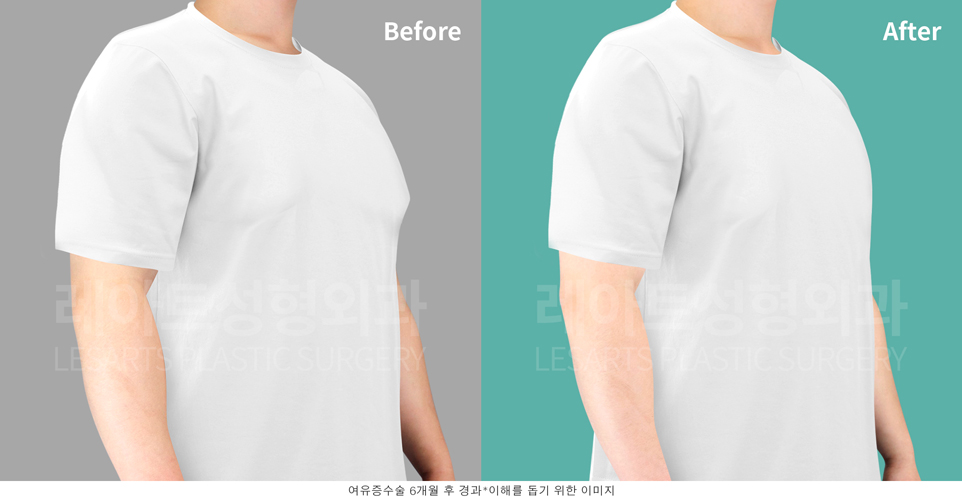
#Male body contouring
#Gynecomastia
#Grade2-A #true gynecomastia


Cases finding
similar to my profile
Customer Diagnostics


Select the surgery and
area you are interestedto see real
before andafter changes.


we
make you,
the art
Clinic hours
MON - FRI
10 am – 7pm
SAT
10 am – 4pm
Holiday
SUN, HOLIDAY
Location
Lesarts Moon Clinic Tower 4-5F, 40, Nonhyeon-ro 168-gil,
Gangnam-gu, Seoul, Republic of Korea

Medical institution name Lesarts Plastic Surgery
Address Lesarts Moon Clinic Tower 4-5F, 40, Nonhyeon-ro 168-gil, Gangnam-gu, Seoul, Republic of Korea
Representative Moon sung jun
