




Online Consultation
Please accurately enter the information below.
Quick Cost Consultation
Quick Consultation & Reservation
Cases finding
similar to my profile






Cases finding
similar to my profile
Customer Diagnostics
Male Gynecomastia Causes – What If the Problem Is Glandular Tissue, Not Fat?
2025-04-16
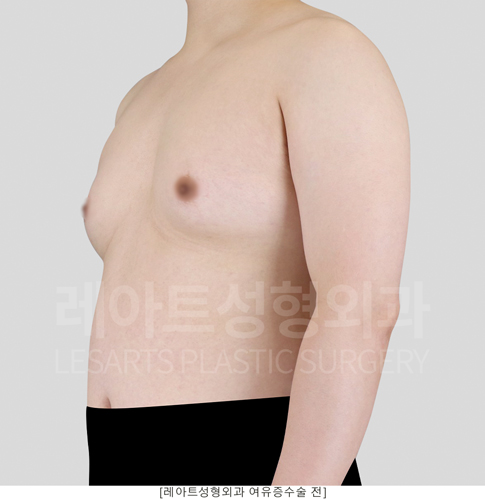
Today’s gynecomastia surgery case
features a patient in his late 30s
whose chest enlargement and protrusion
worsened after entering his 20s.
He recalled that during his teenage years,
there were slight changes in chest size,
but they were not significant enough
to cause concern at the time.
In recent years, while taking hair loss medication,
he began to notice increased discomfort
in his chest area, making the symptoms
much more noticeable and bothersome.
Additionally, recent weight gain
and body fat accumulation
led to further chest size increase.
This resulted in a more prominent protrusion
around the areola area, and he could also
feel palpable lumps under the skin,
which ultimately led him to consider surgery.
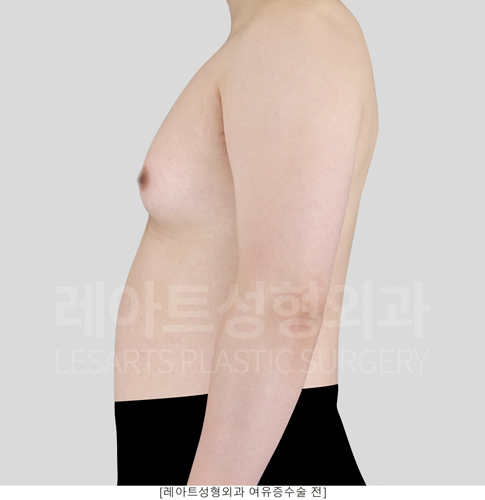
During the medical consultation,
the patient’s enlarged chest and the protrusion of the areola and nipple
were clearly visible to the naked eye.
An ultrasound examination confirmed
glandular tissue overgrowth in both breasts,
leading to a diagnosis of true gynecomastia,
classified as Simon Grade 2A.
Based on this, our clinic recommended
the following surgical treatment plan:
1. Glandular Excision –
Carefully remove the overgrown glandular tissue
to address the root cause of enlarged chest
and nipple-areola protrusion.
2. Liposuction –
Eliminate fat from the lower chest and sides
to create a flatter, smoother chest contour.
3. Adhesion & Depression Prevention –
Fill the excision space evenly and
reposition tissue to prevent uneven contours
or depressions caused by postoperative tissue adhesion.
Next, we will review 2-month postoperative photos
to see how the chest shape has changed.

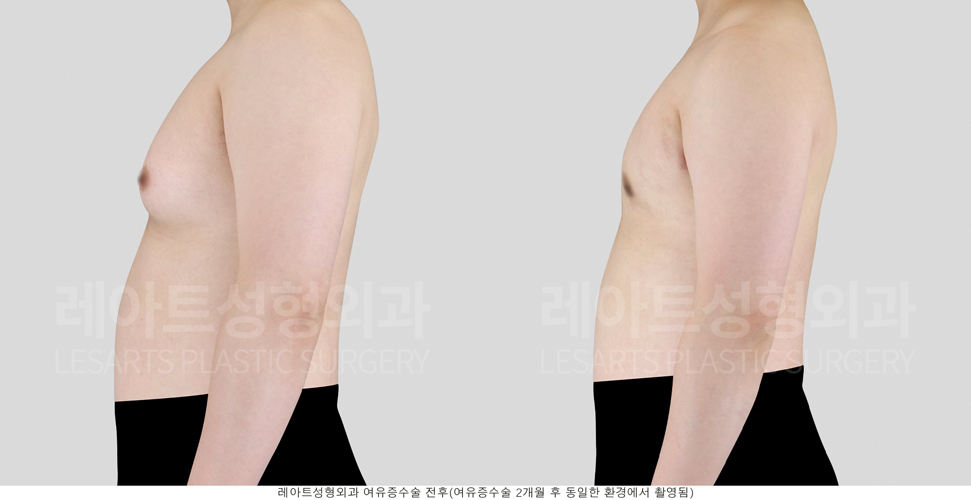
Before gynecomastia surgery,
both areola areas were visibly protruding,
and the firm glandular tissue underneath
caused the chest contour to be noticeable
through clothing, which was a major concern.
After glandular tissue removal
combined with liposuction
of the lower chest and lateral chest,
the chest size was reduced
and the areola protrusion was improved.
If only chest size reduction
had been performed without contour correction,
the chest shape might have looked unnatural.
However, with tissue repositioning
and sculpting liposuction
to create a three-dimensional, masculine contour,
the result is a natural, firm chest appearance.

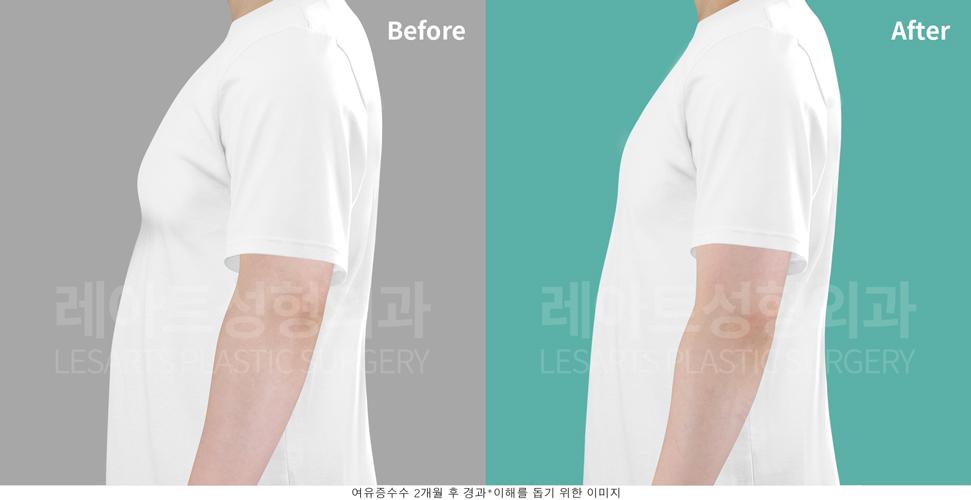
In the before-and-after photos wearing
a plain white T-shirt,
the areas the patient was concerned about
were completely resolved.
Before gynecomastia surgery,
wearing thin clothing made the chest volume
stand out, drawing attention to the chest area
and causing discomfort.
After surgery, even with just a
thin white cotton T-shirt,
there was no chest protrusion—
only a smooth, athletic-looking
male chest contour.
With such satisfying results,
the patient gained more freedom in clothing choices
and saw a significant reduction
in daily, habitual stress.
In complex cases like this,
where multiple factors such as
puberty changes, weight fluctuations,
and hair loss medication are involved,
precise diagnosis, surgical planning,
and post-operative management are crucial.
For patients requiring continuous
hair loss medication,
the possibility of recurrence
cannot be fully excluded.
Therefore, regular follow-up visits
to monitor progress after surgery
are strongly recommended.
#Male body contouring
#Gynecomastia
#Grade2-A


Cases finding
similar to my profile
Customer Diagnostics


Select the surgery and
area you are interestedto see real
before andafter changes.


we
make you,
the art
Clinic hours
MON - FRI
10 am – 7pm
SAT
10 am – 4pm
Holiday
SUN, HOLIDAY
Location
Lesarts Moon Clinic Tower 4-5F, 40, Nonhyeon-ro 168-gil,
Gangnam-gu, Seoul, Republic of Korea

Medical institution name Lesarts Plastic Surgery
Address Lesarts Moon Clinic Tower 4-5F, 40, Nonhyeon-ro 168-gil, Gangnam-gu, Seoul, Republic of Korea
Representative Moon sung jun
