




Online Consultation
Please accurately enter the information below.
Quick Cost Consultation
Quick Consultation & Reservation
Cases finding
similar to my profile






Cases finding
similar to my profile
Customer Diagnostics
Is It Okay to Drink or Smoke After Gynecomastia Surgery?
2025-04-10
As the weather warms up
and layers get lighter,
many men feel self-conscious
about their chest line—
especially when wearing a T-shirt.
In consultations,
we often see male patients
struggling with body image concerns,
mainly due to gynecomastia.
Gynecomastia is more common than expected
and can occur even without weight gain—
something many of our blog readers
may already be aware of.
Even with exercise
and a strict diet,
if the large chest
and protruding areola remain,
there’s a high chance
that true gynecomastia is present.
This is more than just a cosmetic issue—
it can cause daily discomfort
and lead to psychological distress.
In today’s case,
we’ll walk through the gynecomastia surgery process,
post-op improvements,
and key aftercare tips
for long-lasting results.
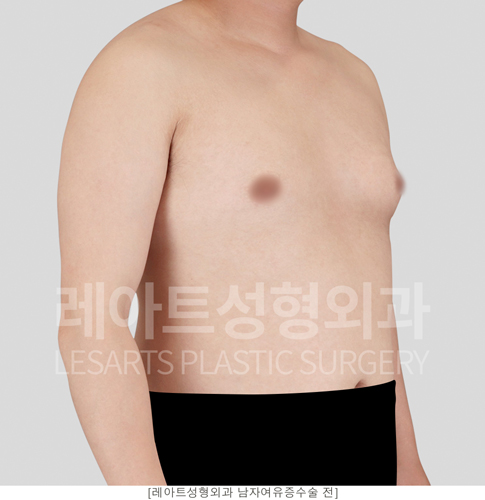
This case features a male patient
in his late 30s, who began experiencing
a gradual increase in chest size and firmness
several years before visiting our clinic.
He reported significant stress
due to the protrusion of the chest and areola area,
especially when wearing T-shirts.
To improve his condition,
he consistently did chest workouts
and even reduced his body weight,
but saw no improvement in the shape
or prominence of the chest.
This led him to seek medical consultation.
He shared that during workouts at the gym,
he became increasingly self-conscious—
not only about the visible chest protrusion
but also about the jiggling sensation
during movement.
At first, he believed the issue
was related to weight gain,
but as the discomfort persisted,
he suspected gynecomastia
and visited Lesarts Plastic Surgery
for a proper evaluation.
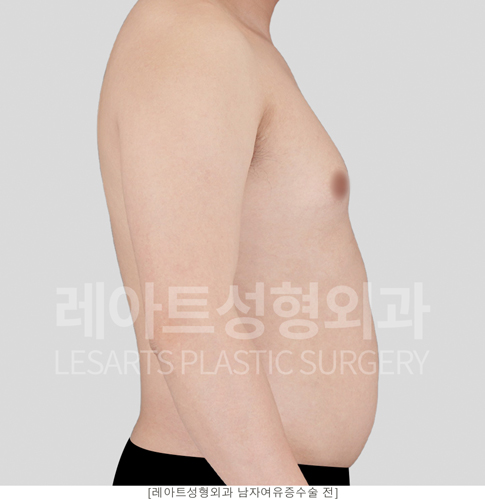
Before the consultation,
a visual assessment of the patient showed
that both sides of the chest were protruding,
with a firm texture overall.
The nipple and areola areas
appeared enlarged and swollen.
This case was classified as Simon Grade 2A,
and ultrasound examination
confirmed glandular hypertrophy
on both sides.
As a result, the patient was diagnosed
with true gynecomastia,
which requires surgical treatment.
Based on the diagnosis,
the surgical plan included the following steps:
1. Glandular Tissue Excision
Through an areolar incision,
the enlarged glandular tissue would be removed,
directly addressing the cause
of chest size and nipple protrusion.
2. Liposuction
Via the same incision,
fat accumulation in the chest
would also be removed through liposuction,
creating a flatter and smoother chest contour.
3. Tissue Reshaping to Prevent Dimpling
To avoid irregular contours
caused by empty space or tissue clumping
after excision and liposuction,
tissue rearrangement would be performed
to maintain natural and even shaping.
Below, we’ll take a look at
before and after photos
taken one month after gynecomastia surgery,
to review the patient’s visible improvements.

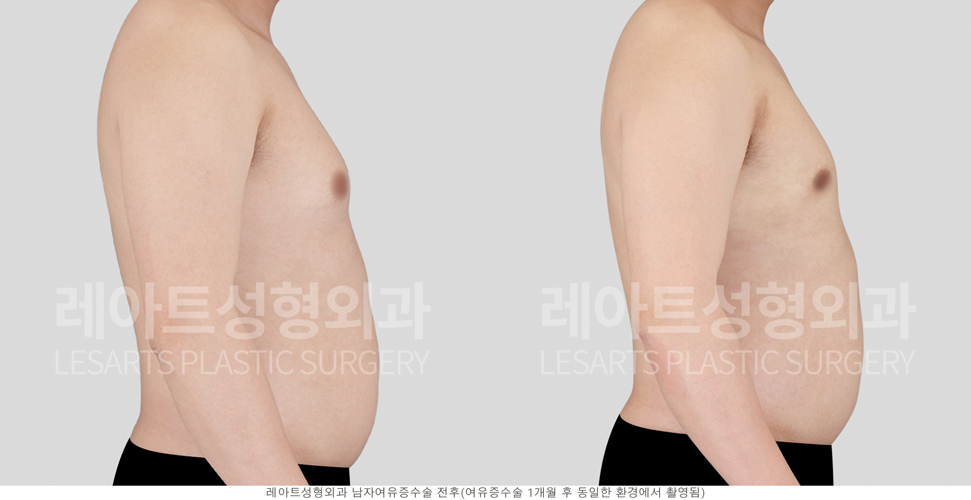
In the pre-surgery photo,
both sides of the chest show noticeable protrusion
caused by glandular hypertrophy.
The nipple and areola areas
appear enlarged and swollen,
making the chest the most prominent feature
of the upper body.
This is even more apparent
when viewed from the side.
The chest begins to protrude sharply
just above the areola,
resulting in a pointed and unnatural shape
that likely caused discomfort
in daily life and physical activities.
In addition,
the lower chest line was uneven,
giving the overall chest contour
an unbalanced and unrefined appearance.
After gynecomastia surgery,
the enlarged glandular tissue—
the main cause of both volume
and nipple protrusion—was removed,
resulting in a flatter, smoother chest line.
The swollen appearance
of the nipple and areola
was also fully corrected,
giving the upper body
a more masculine and stable silhouette.
From the side view,
the shape of the rib cage
also appears more natural and firm,
with the chest blending smoothly
into the rest of the torso.
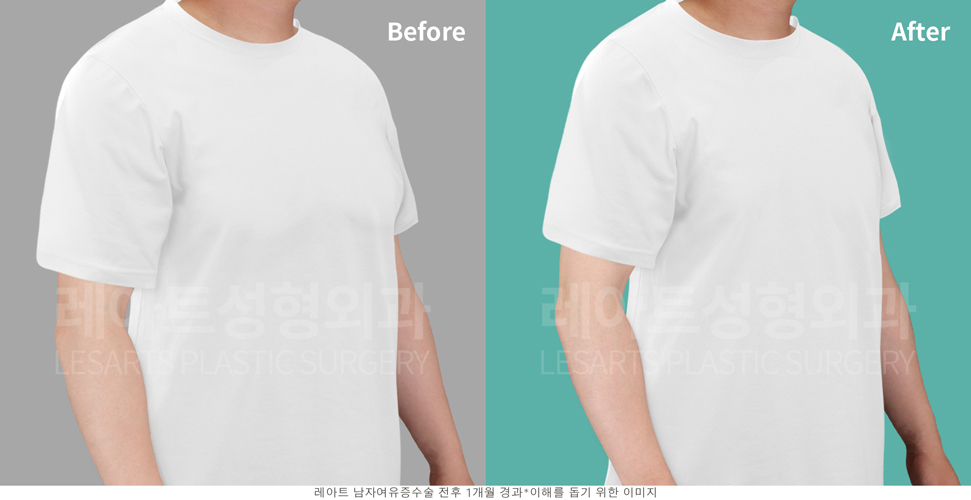
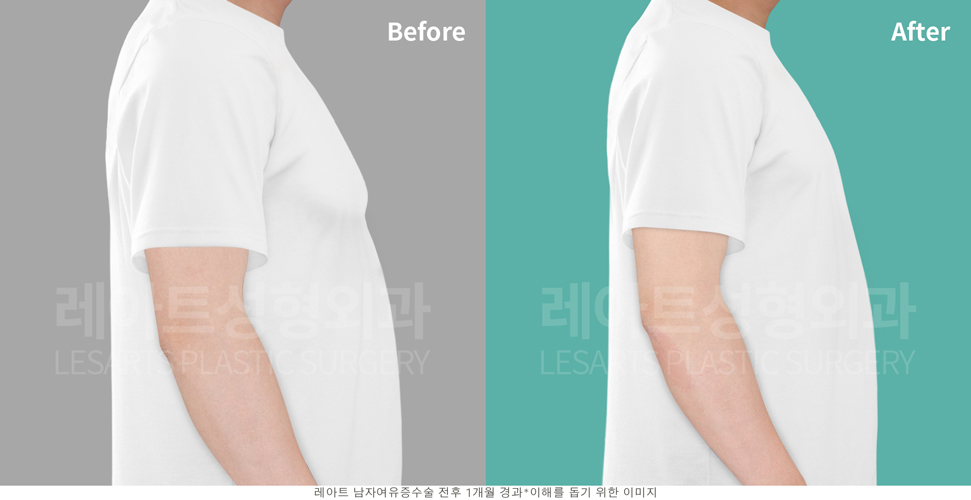
The difference before and after
gynecomastia surgery
became even more noticeable
when the patient wore a white T-shirt.
Before surgery, the protrusion of both breasts,
along with the swelling of the nipple and areola,
was clearly visible through the shirt.
This distorted the overall fit,
creating a sense of discomfort and self-consciousness.
For a patient who had consistently engaged
in fitness and strength training,
this issue likely caused even more emotional stress.
In the photo taken one month post-op,
the glandular tissue and excess fat
had been successfully removed,
resulting in a noticeable reduction in chest size.
The T-shirt fit became smoother and more stable,
reflecting a more masculine upper body contour.
However, this patient had a long-standing habit
of smoking more than one pack per day.
We emphasized the importance of
quitting smoking and alcohol
for at least two weeks post-op,
as smoking increases the risk of infection
and negatively affects healing.
Even with visible improvement,
stable recovery is essential
to achieve high satisfaction with the final result.
By following post-op guidelines,
maintaining regular exercise
and a healthy lifestyle,
this patient is expected to preserve
his new, improved appearance
for the long term.
#Male body contouring
#Gynecomastia
#Grade2-A #true gynecomastia


Cases finding
similar to my profile
Customer Diagnostics


Select the surgery and
area you are interestedto see real
before andafter changes.


we
make you,
the art
Clinic hours
MON - FRI
10 am – 7pm
SAT
10 am – 4pm
Holiday
SUN, HOLIDAY
Location
Lesarts Moon Clinic Tower 4-5F, 40, Nonhyeon-ro 168-gil,
Gangnam-gu, Seoul, Republic of Korea

Medical institution name Lesarts Plastic Surgery
Address Lesarts Moon Clinic Tower 4-5F, 40, Nonhyeon-ro 168-gil, Gangnam-gu, Seoul, Republic of Korea
Representative Moon sung jun
