




Online Consultation
Please accurately enter the information below.
Quick Cost Consultation
Quick Consultation & Reservation
Cases finding
similar to my profile






Cases finding
similar to my profile
Customer Diagnostics
Male Gynecomastia Surgery – 2-Month Post-Op Results Before-and-After Photos from Lesarts Plastic Surgery, Gangnam Seoul Korea
2025-10-05
Many men who experience gynecomastia symptoms
start by trying to reduce chest size through exercise and weight loss.
Since enlarged chests are often mistaken for simple fat gain,
people usually assume the cause is excess body fat rather than glandular tissue.
However, if the chest size does not improve even after significant weight reduction,
the underlying cause is often true gynecomastia, not just obesity-related fat accumulation.
This case will show how surgical correction can effectively treat gynecomastia
and restore a natural, masculine chest contour
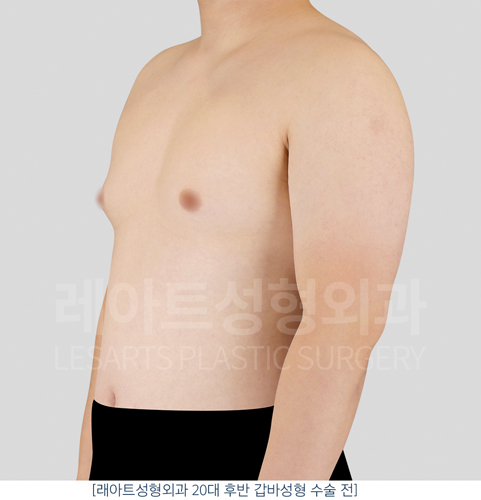
Pre-Operative Evaluation
On physical examination, both sides of the patient’s chest
showed noticeable enlargement and outward projection.
The nipples and areola were swollen,
creating a puffed appearance.
When palpated, a firm glandular lump was detected,
suggesting excessive gland development.
Ultrasound imaging confirmed the presence of overgrown glandular tissue,
and the patient was diagnosed with Simon Grade 2A true gynecomastia.
While the main cause of the chest enlargement was the overgrowth of mammary glands,
the lower and lateral chest areas also contained significant fat deposits.
Therefore, a combined procedure of gland excision
and chest liposuction was planned
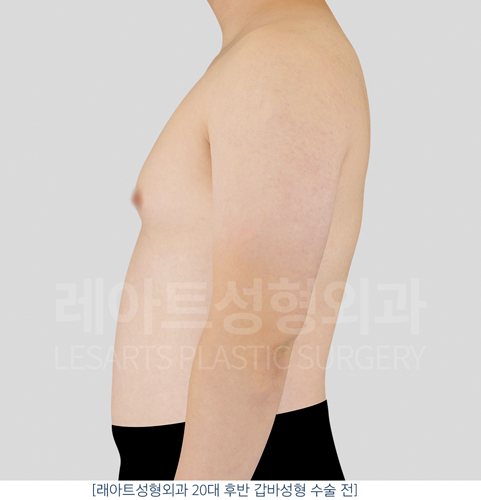
Surgical Plan
1.Gland Excision
The incision was made along the areola
to minimize visible scarring after recovery.
The enlarged gland tissue
that caused the protrusion of the nipple
and areola was removed to correct the overall chest shape.
2.Chest Liposuction
Fat was suctioned from the lower and
lateral chest to eliminate additional volume and
to create a smoother transition toward the flank and upper abdomen.
3.Chest Sculpting (Chest Contouring)
After gland and fat removal,
tissue redraping was performed
to prevent depression or flatness,
enhancing the upper chest definition
to achieve a naturally firm and athletic look.

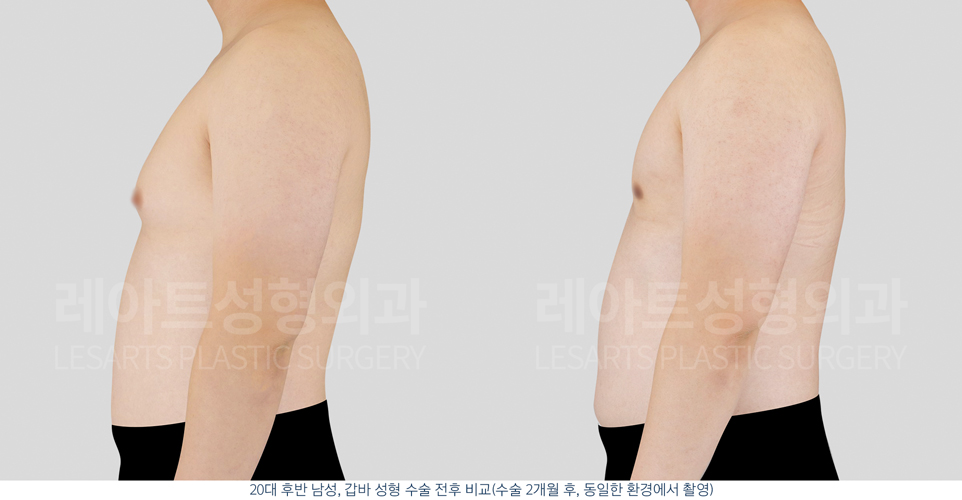
Two-Month Post-Op Comparison
Before surgery, both sides of the chest were enlarged and projected forward,
with puffiness around the nipple and areola—causing visible discomfort and
self-consciousness, especially for a patient with a large build.
Two months after surgery, the chest volume had reduced significantly,
and the previously swollen nipple and areola became flat and well-defined.
The overall chest line appeared tidy, masculine, and natural
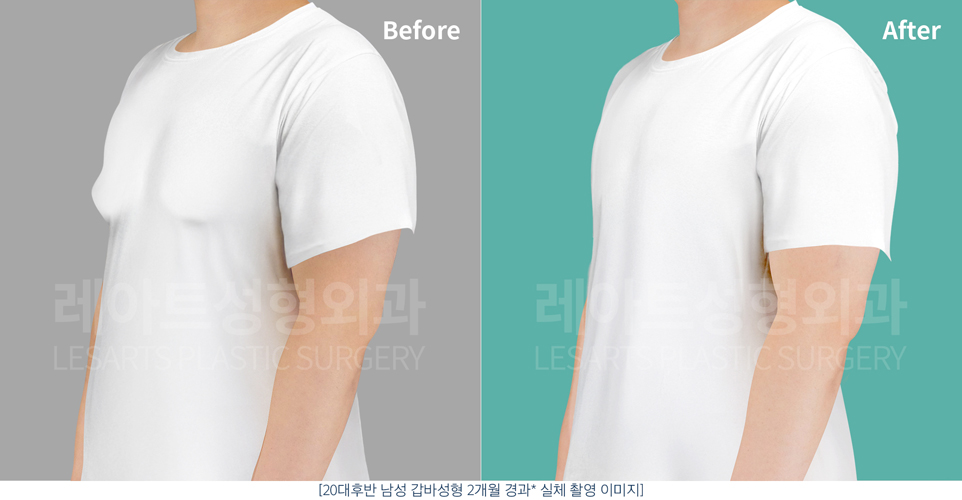
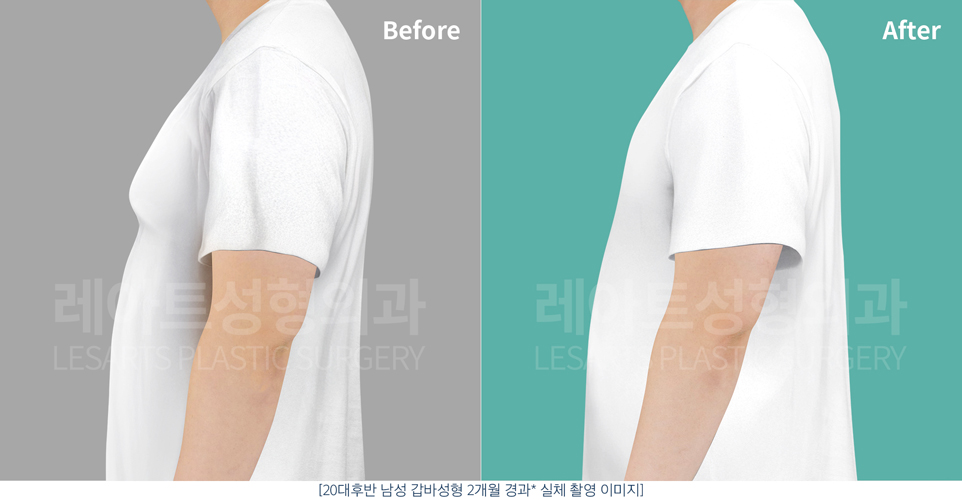
T-Shirt Fit Comparison
The difference was especially clear in the T-shirt fit.
Before surgery, the chest protrusion was easily visible through clothing,
causing discomfort and a lack of confidence.
After the procedure, the reduced volume and firm contour created a cleaner,
more sculpted upper body line even under fitted shirts.
At this stage (2 months post-op), some mild swelling remained,
but the upper chest line was already firm and toned, resembling a naturally trained physique.
Unnecessary bulges were corrected, and the upper-body proportion became more balanced.
This patient, who initially suffered from true gynecomastia
(Simon Grade 2A) and a heavier build, reported improved comfort and
confidence in daily life after surgery.
The stable reduction in chest volume and
refined contour gave him a more masculine,
confident appearance.
With consistent self-care,
continued improvement in firmness and
skin quality is expected, allowing for even more
refined long-term results.
Clinic Info for Google & Map Search Visibility
▶ Lesarts Plastic Surgery Clinic & Hospital
4-5F, 40 Nonhyeon-ro 168-gil, Gangnam-gu, Seoul, Korea
☎ +82-549-2080
☏ KakaoTalk ID: 레아트성형외과
#Male body contouring
#Gynecomastia
#Grade2-A #true gynecomastia #Side chest liposuction


Cases finding
similar to my profile
Customer Diagnostics


Select the surgery and
area you are interestedto see real
before andafter changes.


we
make you,
the art
Clinic hours
MON - FRI
10 am – 7pm
SAT
10 am – 4pm
Holiday
SUN, HOLIDAY
Location
Lesarts Moon Clinic Tower 4-5F, 40, Nonhyeon-ro 168-gil,
Gangnam-gu, Seoul, Republic of Korea

Medical institution name Lesarts Plastic Surgery
Address Lesarts Moon Clinic Tower 4-5F, 40, Nonhyeon-ro 168-gil, Gangnam-gu, Seoul, Republic of Korea
Representative Moon sung jun
