




Online Consultation
Please accurately enter the information below.
Quick Cost Consultation
Quick Consultation & Reservation
Cases finding
similar to my profile






Cases finding
similar to my profile
Customer Diagnostics
Gynecomastia After Finasteride Use – 2-Month Postoperative Result Male Chest Reduction & Gland Removal Surgery in Gangnam, Seoul, Korea
2025-10-15
Many men take hair loss medications,
such as finasteride, to manage male pattern baldness.
While these drugs are generally effective,
some users experience side effects,
including gynecomastia —
the enlargement of male breast tissue
due to hormonal imbalance.
It’s important to note that not all patients
who take finasteride develop gynecomastia,
but since a few cases have been reported,
monitoring and early consultation with
medical professionals are strongly recommended

patient Background
This patient, a man in his 40s,
first noticed chest enlargement and
protrusion in his twenties.
Initially, he assumed the change was related to weight gain,
but even after losing weight, his chest size and
nipple bulging did not improve.
Feeling uncomfortable about how his chest looked
under fitted clothing, he sought professional treatment.
Patient Information
-Age: Mid-40s
-Diagnosis: Simon Grade 2A True Gynecomastia
-Medication history: Finasteride use for 4–5 years
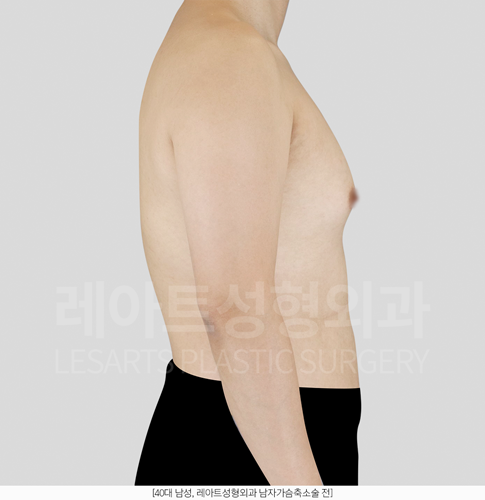
Preoperative Examination
1.Physical Findings
The chest was noticeably protruding in the center,
and the nipples appeared swollen.
The shape was visible even through a T-shirt,
creating an awkward, bulky upper body impression.
2.Palpation
A firm, fibrous glandular mass was felt beneath the nipple —
a typical sign of true gynecomastia caused by glandular tissue overgrowth.
3.Ultrasound Imaging
The scan confirmed enlarged glandular tissue beneath the nipple,
clearly distinguishable from the surrounding fat layer.
Based on these findings, the patient was diagnosed with true gynecomastia
(Simon Grade 2A) caused by glandular hyperplasia,
and a combination of gland removal and chest liposuction was planned
Surgical Plan
1.Gland Removal (Subcutaneous Mastectomy)
-Removed the overdeveloped glandular tissue
responsible for chest protrusion.
-Since the patient had been on finasteride for several years,
recurrence risk was considered, and long-term
follow-up care was explained in detail.
2.Liposuction (Lower and Lateral Chest)
-Fat along the lower and outer chest was
suctioned to smooth the contour and reduce visual bulkiness.
3.Chest Contouring (Pectoral Sculpting)
After gland removal, tissue was redistributed and
reshaped to prevent flattening or indentation.
The goal was to create a firm,
masculine chest line resembling a naturally toned physique.

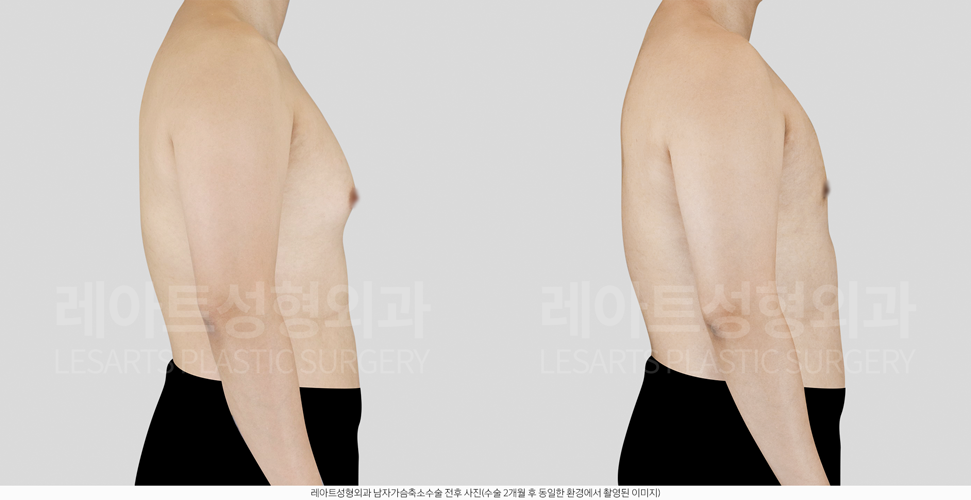
2-Month Postoperative Results
Front View
Before surgery, the patient’s chest was enlarged,
and the nipples protruded forward, creating a heavy, rounded look.
After surgery, both the gland and fat were reduced,
resulting in a flat and well-defined chest.
The area beneath the nipple became smooth,
and the transition from the chest to the abdomen
appeared natural and continuous.
Side View
Previously, even thin shirts made the chest protrusion clearly visible,
causing the patient to avoid fitted clothing.
After surgery, the chest appeared flat and muscular,
giving the impression of a naturally athletic build.
The improvement was especially noticeable in light T-shirts,
where the chest contour looked clean and stable.
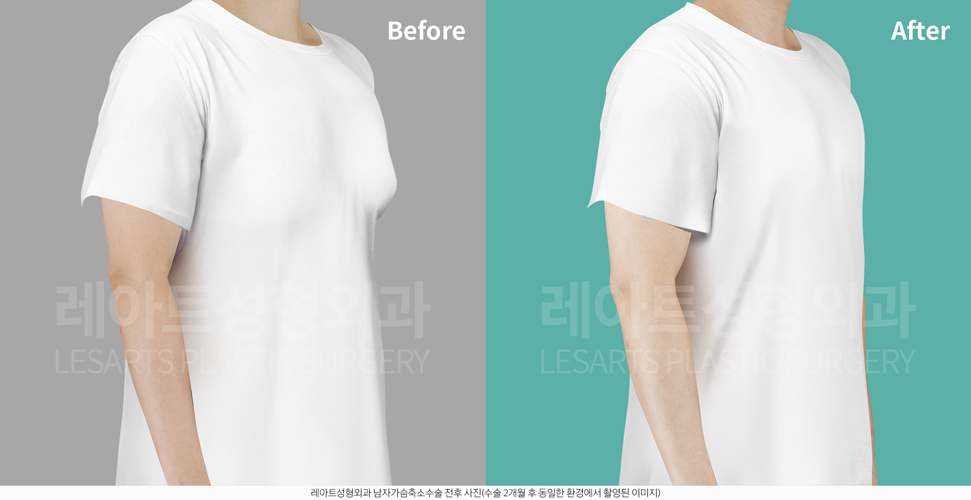

Real Image (2-Month Follow-Up)
The before-and-after comparison clearly shows
the disappearance of puffiness and the formation of a firm, even chest line.
The patient described feeling lighter and
more confident with his new body shape
Postoperative Progress
Two months after surgery, the patient continued
taking finasteride for hair loss under medical guidance.
No recurrence or new discomfort
was observed during follow-up.
His nipple shape remained stable,
and the chest contour stayed flat and symmetrical.
Key Takeaways
Gynecomastia can be caused by multiple factors —
hormonal changes, medications, weight fluctuations,
or underlying health conditions.
In patients taking finasteride or
similar drugs, it’s essential to:
-Monitor for early signs of chest swelling or tenderness
-Consult a qualified surgeon for accurate diagnosis and ultrasound evaluation
-Continue post-surgery observation to prevent recurrence
Summary
This case demonstrates how gland removal combined
with chest liposuction and contouring can effectively correct gynecomastia,
even in patients with a history of finasteride use.
By removing glandular tissue and refining the surrounding fat,
the chest regained a flat, firm, and masculine appearance.
At Lesarts Plastic Surgery in Gangnam, Seoul,
Korea, we specialize in male chest reduction and gynecomastia correction,
offering precise diagnosis, tailored surgical plans,
and careful postoperative follow-up to ensure lasting results.
#Male body contouring
#Gynecomastia
#Grade2-A #true gynecomastia #Side chest liposuction


Cases finding
similar to my profile
Customer Diagnostics


Select the surgery and
area you are interestedto see real
before andafter changes.


we
make you,
the art
Clinic hours
MON - FRI
10 am – 7pm
SAT
10 am – 4pm
Holiday
SUN, HOLIDAY
Location
Lesarts Moon Clinic Tower 4-5F, 40, Nonhyeon-ro 168-gil,
Gangnam-gu, Seoul, Republic of Korea

Medical institution name Lesarts Plastic Surgery
Address Lesarts Moon Clinic Tower 4-5F, 40, Nonhyeon-ro 168-gil, Gangnam-gu, Seoul, Republic of Korea
Representative Moon sung jun
