




Online Consultation
Please accurately enter the information below.
Quick Cost Consultation
Quick Consultation & Reservation
Cases finding
similar to my profile






Cases finding
similar to my profile
Customer Diagnostics
Abdominoplasty for Sagging and Uneven Belly After C-Section (With Photos)
2025-11-05
Many women who have given birth via C-section
often visit us for tummy tuck consultations,
not only because of loose skin
or separated abdominal muscles,
but also due to adhesions that make
the skin’s surface appear uneven and bumpy.
Such complex concerns can usually be effectively corrected
through abdominoplasty, but the final outcome depends
heavily on precise diagnosis, a personalized surgical plan,
and careful post-operative management.
It’s worth emphasizing that every body is different.
Sometimes, patients decide on the type of incision
or procedure after simply comparing
before-and-after photos online.
However, the right surgical approach
should always be determined through an
in-person consultation with a qualified specialist.
Today’s case involves a woman
who underwent abdominoplasty
not only to address sagging belly skin
but also to correct surface irregularities
and tight adhesions following a C-section.
If you’re facing similar issues,
this story may help you understand
what results are possible.

Patient Information
Age: Late 40s
Height: 165 cm
Weight: 57 kg
BMI: 21
Results may vary depending on
individual body conditions.
After giving birth to two children via C-section,
the patient experienced progressive skin laxity
and irregular abdominal contours.
The skin around her navel was thin,
wrinkled, and partially adhered,
causing the surface to appear bumpy.
The right lower abdomen was particularly tight and
uneven compared to the left.
While pregnancy and previous surgeries
contributed to these changes,
a past liposuction procedure had likely caused
tissue adhesions and uneven fat distribution,
worsening the contour irregularities.
A small umbilical hernia was also
detected near the right side of the navel,
where the belly button appeared
slightly pulled downward and off-center.
Because her abdominal skin was thin and not very elastic,
a full abdominoplasty would have been excessive.
Instead, an S–M type tummy tuck—
a moderate-range lift—was planned to provide
a smoother result without unnecessary tension.
The dark, uneven C-section scar would be removed and
replaced with a cleaner, lower scar line as part of the surgery.

Patient Background
Patient Information
Age: Mid-30s
Diagnosis: Simon Grade 2A
True Gynecomastia
Type: Glandular gynecomastia
with thick subcutaneous fat layer
Results may vary depending on each
individual’s body type and condition.
The patient had previously tried dieting and
upper-body workouts to reduce chest size,
but the protruding chest line and nipple area
showed little improvement.
After an ultrasound examination,
both sides of the chest were found to have
overdeveloped glandular tissue,
confirming a diagnosis of true gynecomastia
that required surgical treatment.
Surgical Plan
1.Abdominoplasty (S–M Type) with Adhesion Release
Removed the darkened C-section scar
and lifted the lower abdomen.
Released hardened, uneven adhesions
that pulled the skin. Performed an umbilical floating
technique to reposition the belly button to a balanced,
central location.
2.Rectus Muscle Plication (Abdominal Wall Tightening)
Repaired the stretched and weakened abdominal wall
caused by pregnancy, restoring core firmness.
3.Hernia Repair
Corrected the small umbilical hernia near the navel.
4.Abdominal Liposuction
Removed residual fat to smooth the transition
between the abdomen and waist, enhancing the overall contour.
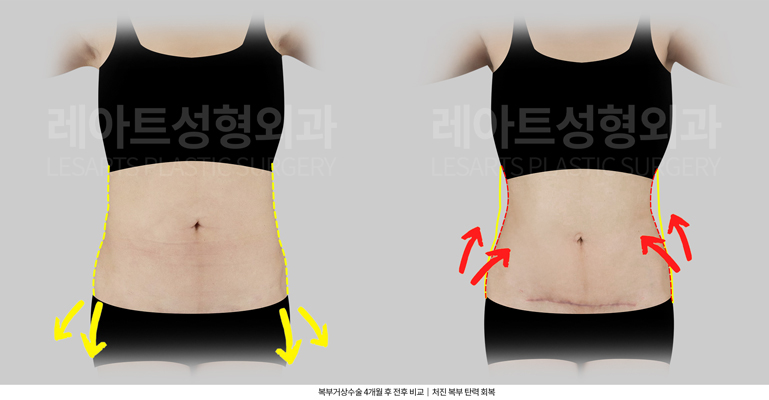
4 Months After Surgery – Noticeable Improvement
in Skin Texture and Firmness
Four months after surgery,
the once uneven, sagging abdomen
had become smooth and firm.
Before surgery, multiple skin folds and
a heavy lower-belly appearance
emphasized imbalance, especially below the navel.
After the procedure, the tummy tuck combined
with liposuction effectively addressed
the adhesions, sagging, and remaining fat, resulting
in a tight and balanced abdominal line.
The belly button, which was previously high and pulled to one side,
was corrected through the umbilical floating technique
and now aligns naturally with the body’s center.
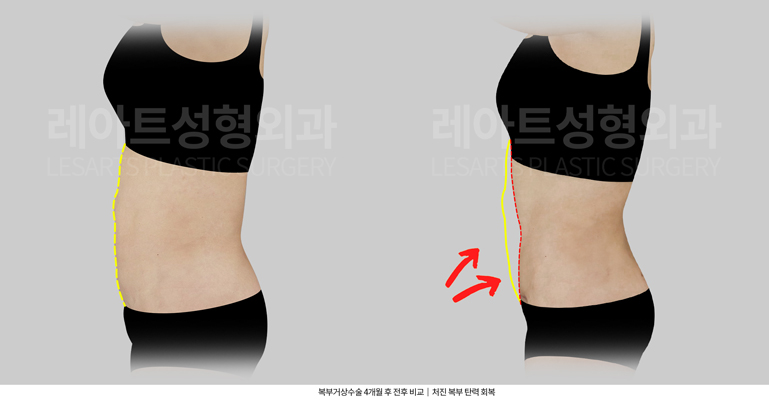
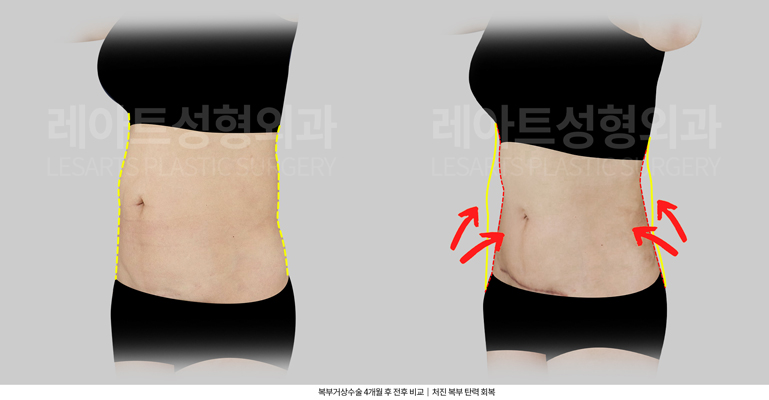
Side View Comparison
From the side, the protrusion caused by weak abdominal muscles
and uneven adhesions has been completely corrected.
Although the recovery was still ongoing at four months,
the skin tension and natural curves of the abdomen
were already well stabilized.
Despite not undergoing a full tummy tuck,
the core area regained firmness, and the navel’s shape and
position were symmetrically aligned, giving the overall figure
a more balanced appearance.
The old C-section scar was removed and
replaced by a new, clean incision line
that continues to improve with laser toning aftercare.
The patient expressed high satisfaction,
particularly with the smoother skin and
elimination of wrinkles and dimpling around the navel area.
Because abdominoplasty involves a longer recovery,
consistent post-operative care and follow-up visits remain
crucial for maintaining the best results.
Clinic Info for Google & Map Search Visibility
▶ Lesarts Plastic Surgery Clinic & Hospital
4-5F, 40 Nonhyeon-ro 168-gil, Gangnam-gu, Seoul, Korea
☎ +82-549-2080
☏ KakaoTalk ID: 레아트성형외과
#Abdominoplasty
#S-type #M-type
#Abdominal liposuction(S) #Abdominal liposuction(M)


Cases finding
similar to my profile
Customer Diagnostics


Select the surgery and
area you are interestedto see real
before andafter changes.


we
make you,
the art
Clinic hours
MON - FRI
10 am – 7pm
SAT
10 am – 4pm
Holiday
SUN, HOLIDAY
Location
Lesarts Moon Clinic Tower 4-5F, 40, Nonhyeon-ro 168-gil,
Gangnam-gu, Seoul, Republic of Korea

Medical institution name Lesarts Plastic Surgery
Address Lesarts Moon Clinic Tower 4-5F, 40, Nonhyeon-ro 168-gil, Gangnam-gu, Seoul, Republic of Korea
Representative Moon sung jun
