




Online Consultation
Please accurately enter the information below.
Quick Cost Consultation
Quick Consultation & Reservation
Cases finding
similar to my profile






Cases finding
similar to my profile
Customer Diagnostics
Tummy Tuck Revision Surgery in Korea – Correcting Abdominal Sagging and Muscle Laxity Best Abdominoplasty Clinic in Gangnam, Seoul | Lesarts Plastic Surgery Hospital Korea
2025-11-14
Many people think abdominoplasty
(tummy tuck) is simply a procedure to remove loose skin
and improve the body’s outer appearance.
However, in most real cases,
abdominal sagging and protrusion are caused not only by stretched skin,
but also by loosened abdominal muscles (rectus diastasis) and thick fat layers.
In addition, some patients have tissue adhesions
from previous liposuction or C-section scars,
which can distort the abdominal contour and
make the surface uneven.
If such multi-layered structural issues are not properly diagnosed and
corrected during the first operation,
there’s a high chance that secondary deformities or
bulging may occur over time —
often leading to the need for tummy tuck revision surgery.
Because these internal structural imbalances
cannot be fixed through exercise or self-management alone,
a thorough evaluation and precise surgical approach are
essential from the start.
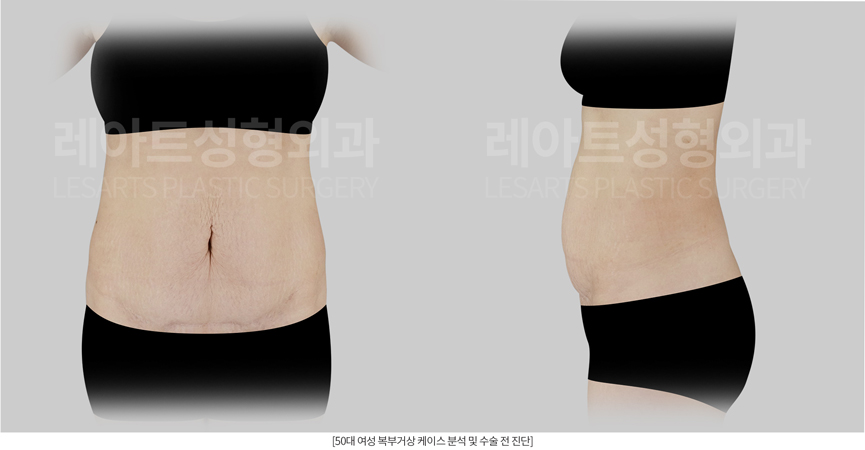
Patient Information
Age: Early 50s
Height: 158 cm
Weight: 55 kg
BMI: 22
Results may vary depending on
individual body condition.
This patient, in her early 50s,
had previously delivered two children via C-section.
After childbirth, her lower abdomen showed loose skin,
fine wrinkles, and sagging, and over time,
she also developed upper abdominal bulging
that distorted the overall shape of her abdomen.
A few years earlier, she had undergone a mini tummy tuck
at another clinic to correct these issues.
However, since rectus muscle plication
was not performed during that surgery,
her abdominal wall gradually lost support,
causing the central bulge to persist long-term.
As time went on, the skin sagging worsened,
and wrinkles around the umbilicus became more visible.
A revision tummy tuck was planned to comprehensively correct the skin,
fat, and muscle layers, and to restore core
abdominal structure and contour balance.
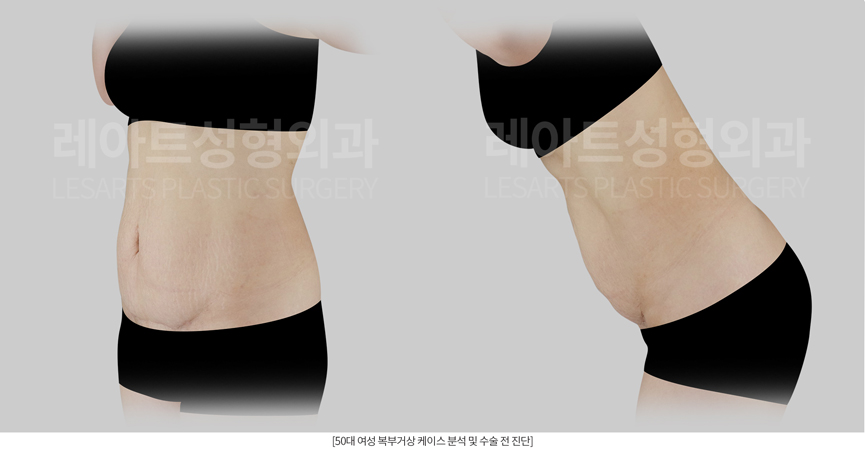
Surgical Plan and Procedure
1.S-type Tummy Tuck with Adhesion Release
-Dissection of irregular adhesion areas caused
by previous surgery or scarring.
-Removal of sagging lower abdominal skin and fine wrinkles.
Excision of C-section scar.
-Postoperative scar management program
initiated for long-term care.
2. Rectus Muscle Plication (Abdominal Wall Repair)
-Reinforcement of the abdominal wall that
was not addressed in the first surgery.
-Tightening from above the umbilicus
downward to restore core support.
3.Umbilical Floating and Repositioning
-The previous navel position was too high;
it was adjusted to a natural position matching the lifted abdominal line.
4.Abdominal Liposuction
-Performed simultaneously with the tummy tuck for waistline contouring
and smoother transition between the upper and lower abdomen.
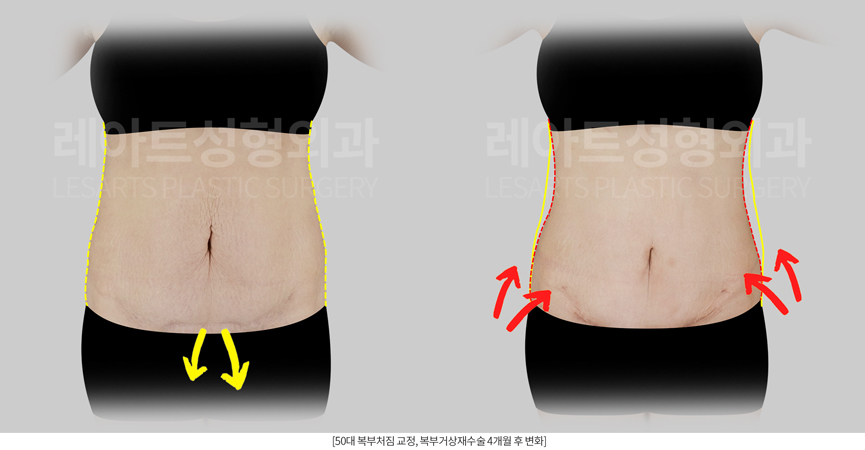
4 Months After Revision Surgery – Front View
Before surgery, there was obvious sagging and
wrinkling in the lower abdomen,
along with C-section scars and right-side
adhesion that caused asymmetry.
After surgery, the abdominal wrinkles and sagging were corrected,
and the umbilicus was repositioned naturally to align with the lifted contour.
The skin appears smoother and tighter,
showing improved elasticity and firmness.
Previously, the skin would fold downward when standing,
but after revision, it is now lifted and supported,
restoring a firm and youthful abdominal appearance.
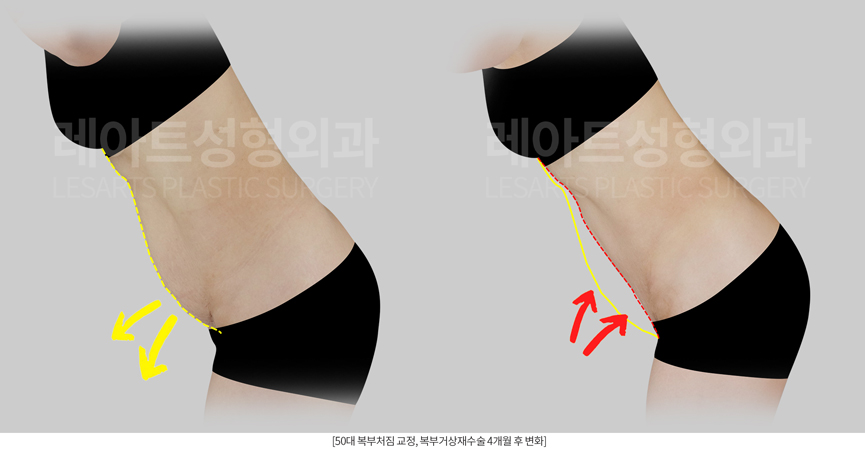
4 Months After Revision Surgery – Bent Position
When bending forward, both abdominal wall bulging
and skin sagging were visible before surgery.
This was due to the lack of proper muscle
repair in the first procedure.
After revision surgery,
with full rectus plication performed from
above the navel downward, these issues were corrected.
The abdominal wall now firmly supports the internal organs,
maintaining tension even when leaning forward —
without the previous “folding” effect.
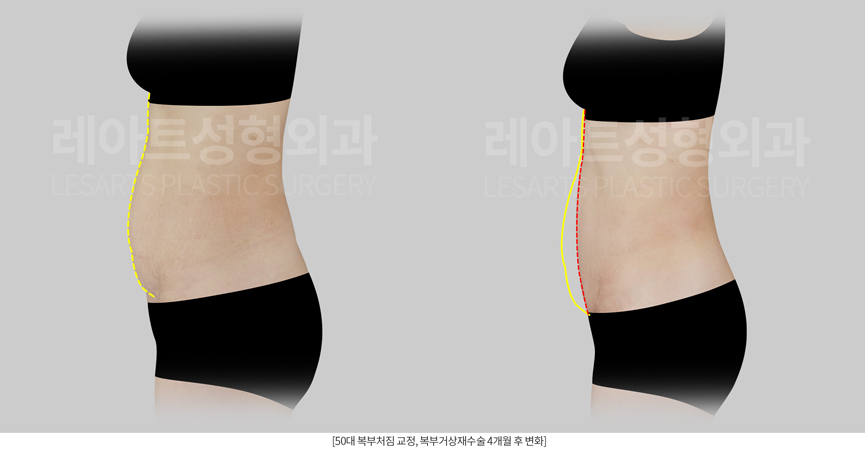

4 Months After Revision Surgery – Side View
From the side, the abdomen previously showed protrusion and heaviness,
caused by a combination of muscle separation,
fat accumulation, and loose skin.
Four months after the revision surgery,
the abdominal profile is flatter and firmer,
with the centerline restored to its proper position.
The transition between the upper and lower abdomen
is smoother, and the waistline appears naturally contoured.
Liposuction helped reduce the abdominal thickness,
improving both silhouette and waist circumference,
resulting in a balanced, refined body shape.
At this stage, the patient still reported a slight firmness from bio-bond
(used for internal adhesion control) and
required continued laser toning and scar care.
She was advised to maintain gentle massage and hydration,
along with regular follow-up visits to ensure
optimal long-term healing and stabilization.
#Abdominoplasty
#S-type
#Hip Fat Transfer(S)


Cases finding
similar to my profile
Customer Diagnostics


Select the surgery and
area you are interestedto see real
before andafter changes.


we
make you,
the art
Clinic hours
MON - FRI
10 am – 7pm
SAT
10 am – 4pm
Holiday
SUN, HOLIDAY
Location
Lesarts Moon Clinic Tower 4-5F, 40, Nonhyeon-ro 168-gil,
Gangnam-gu, Seoul, Republic of Korea

Medical institution name Lesarts Plastic Surgery
Address Lesarts Moon Clinic Tower 4-5F, 40, Nonhyeon-ro 168-gil, Gangnam-gu, Seoul, Republic of Korea
Representative Moon sung jun
