




Online Consultation
Please accurately enter the information below.
Quick Cost Consultation
Quick Consultation & Reservation
Cases finding
similar to my profile






Cases finding
similar to my profile
Customer Diagnostics
Teenage Gynecomastia — Will It Go Away With Time? Gynecomastia Surgery Case | Lesarts Plastic Surgery, Gangnam, Seoul
2025-12-03
Gynecomastia that appears during adolescence
is often hormone-related and may improve naturally
as hormone levels stabilize.
However, in many cases,
the breast enlargement persists into adulthood,
ultimately requiring surgical treatment for correction.
During puberty, temporary hormonal imbalance
between estrogen and testosterone can cause
glandular tissue growth beneath the nipple.
In mild cases, this enlargement may subside
over a period of six months to a year without intervention.
But if the condition continues for years,
or symptoms such as nipple protrusion,
firm lumps, or tenderness remain,
it is advisable to seek medical evaluation and
discuss potential treatment options.
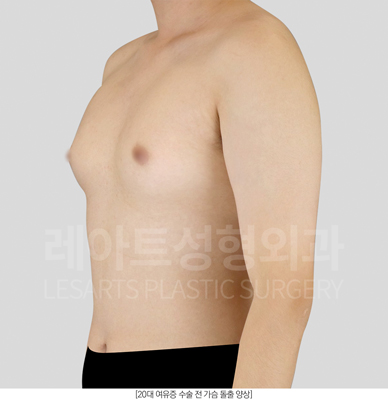
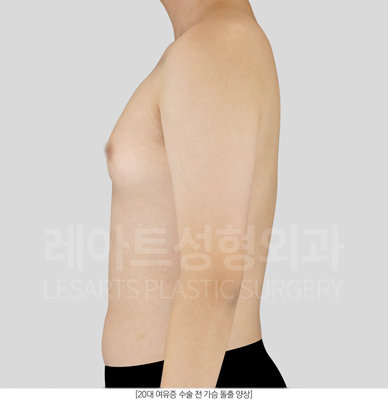
[Patient Information]
Age: 20s
History: Gynecomastia since teenage years
Results may vary depending on
individual anatomy and condition.
This patient first noticed breast enlargement
and nipple protrusion in adolescence.
Despite physical maturity and lifestyle adjustments
—including exercise and diet—
the breast size did not decrease
after reaching adulthood.
Ultrasound examination revealed
enlarged glandular tissue,
and he was diagnosed with
true gynecomastia (Simon Grade 2A).
Surgical Plan
To achieve a natural, flat chest contour,
the procedure included both
glandular tissue removal and
liposuction around the chest area.
1. Glandular Tissue Excision
Since the main cause of breast enlargement
was glandular hypertrophy,
surgical removal of this tissue was essential.
2. Chest Liposuction
In addition to the glandular tissue,
excess fat around the chest was suctioned
to refine the shape and balance
the overall upper body contour.
Removing only the glandular tissue
without addressing fat can sometimes result in
asymmetric or sunken chest shapes,
so both were performed together.
3. Tissue Repositioning & Adhesion Prevention
After gland removal, repositioning techniques
were used to smooth out the area
and prevent surface irregularities or indentations.
Anti-adhesion treatment was
also applied to minimize uneven healing.
The goal was not simply to reduce the chest volume,
but to create a flat, masculine chest shape
with natural lines extending from
the upper chest to the outer chest wall.
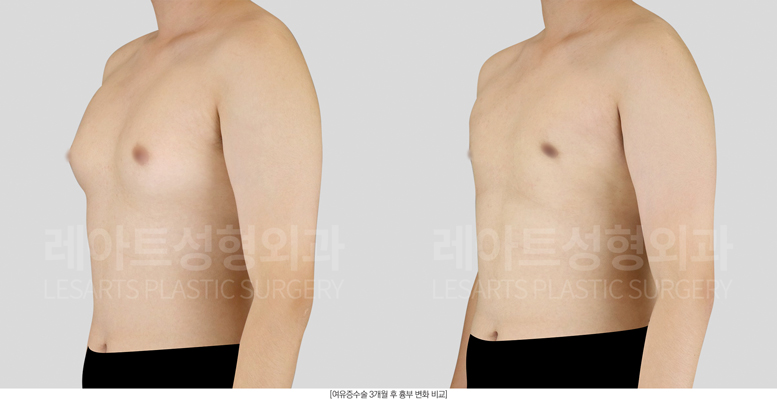
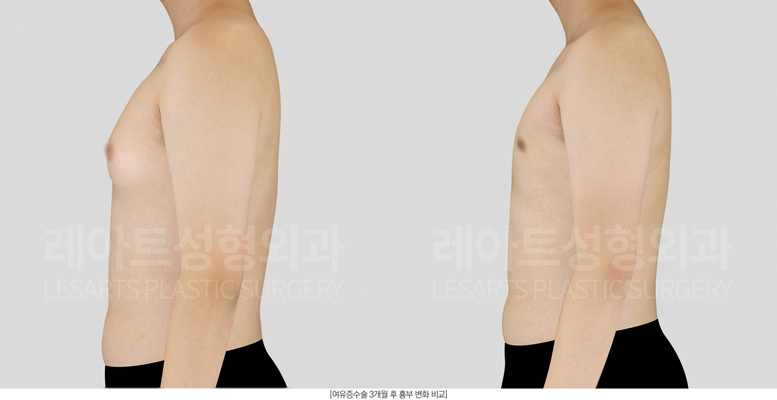
3-Month Postoperative Results
At three months after surgery,
the protruding breast contour had noticeably flattened.
The previously enlarged and
puffy areola and nipple had also been corrected,
resulting in a balanced and athletic chest appearance.
Because liposuction and tissue
repositioning were performed simultaneously,
the improvement was not limited to the central chest area—
the outer chest line also appeared smoother and more defined,
creating a result similar to a pectoral contour enhancement.
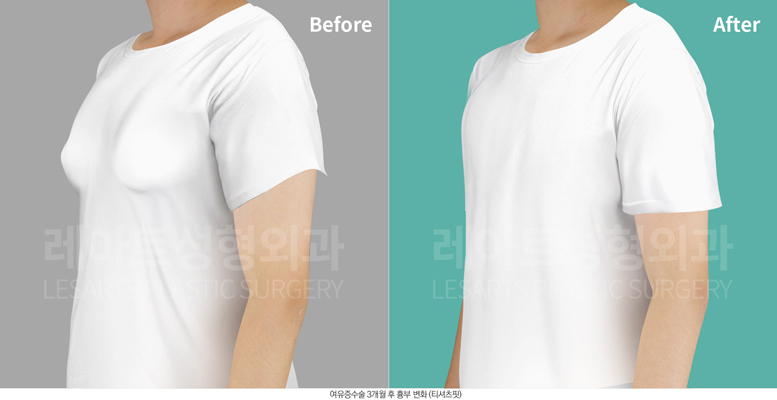
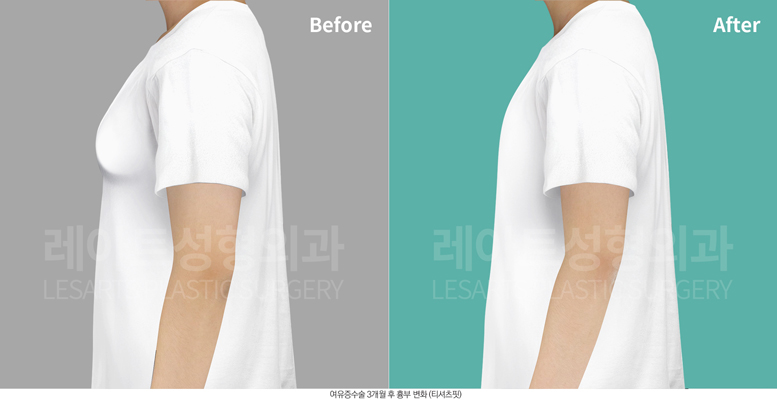
T-Shirt Fit Comparison
Before surgery, the patient struggled with
clothing fit due to nipple projection and chest bulging,
which were especially noticeable in light T-shirts.
After the gynecomastia surgery,
the protrusion under the nipples was significantly reduced,
allowing clothes to fall naturally
against the chest without any visible bulge.
The result is a firm, masculine chest line that
maintains its shape even during movement.
Final Thoughts
This case demonstrates how long-standing
teenage gynecomastia can be effectively corrected
through a combination of glandular removal,
liposuction, and precise contouring techniques.
The patient, who had lived with this concern for years,
achieved both physical comfort and renewed confidence after surgery.
With continued exercise and healthy lifestyle management,
further improvements and long-term
stability of the chest contour are expected.
#Male body contouring
#Gynecomastia
#Grade2-A #true gynecomastia #Side chest liposuction


Cases finding
similar to my profile
Customer Diagnostics


Select the surgery and
area you are interestedto see real
before andafter changes.


we
make you,
the art
Clinic hours
MON - FRI
10 am – 7pm
SAT
10 am – 4pm
Holiday
SUN, HOLIDAY
Location
Lesarts Moon Clinic Tower 4-5F, 40, Nonhyeon-ro 168-gil,
Gangnam-gu, Seoul, Republic of Korea

Medical institution name Lesarts Plastic Surgery
Address Lesarts Moon Clinic Tower 4-5F, 40, Nonhyeon-ro 168-gil, Gangnam-gu, Seoul, Republic of Korea
Representative Moon sung jun
