




Online Consultation
Please accurately enter the information below.
Quick Cost Consultation
Quick Consultation & Reservation
Cases finding
similar to my profile






Cases finding
similar to my profile
Customer Diagnostics
Can Gynecomastia That Starts in Teen Years Continue Into Adulthood? (Gynecomastia Surgery | Male Breast Reduction | Best Plastic Surgery Clinics in Gangnam, Seoul, Korea)
2025-12-23
Gynecomastia is a condition many men
experience during puberty.
For some, it improves naturally
as hormones stabilize.
But for others, the enlarged chest persists into adulthood
—often becoming a long-term source of discomfort.
During colder months, bulky clothes may temporarily hide the shape,
but many men still feel the outline of their chest pushing
forward under sweaters or padded jackets.
Some avoid taking off their coat indoors or
feel self-conscious even in loose clothing.
The patient in today’s case also developed breast enlargement during
his teenage years and saw no improvement into adulthood,
eventually deciding to pursue gynecomastia surgery.
Despite weight loss efforts and chest workouts,
he did not see noticeable external improvement.
He also began to feel hardened lumps beneath both nipples and
noticed that the areola appeared swollen,
which made him realize the issue was not simply due to body fat.
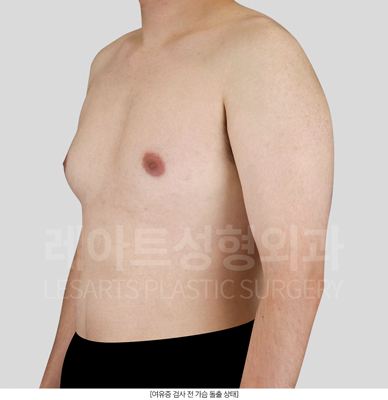
Clinical Examination & Ultrasound Findings
Ultrasound and physical examination confirmed:
-Overgrowth of glandular tissue (true gynecomastia)
-Palpable glandular nodules under both areolas
-Enlarged areolas due to gland-induced stretching
-No tenderness or pain
-Skin elasticity within normal range
-No significant sagging
Based on these findings, the condition was diagnosed
as Simon Grade II-A true gynecomastia.
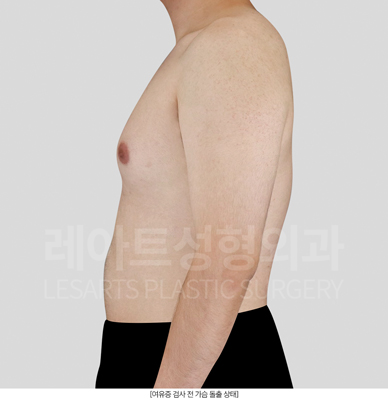
Surgical Plan: Gland Removal + Chest Contouring Liposuction
To correct the long-standing protrusion:
1. Subcutaneous gland removal
-The enlarged gland was the primary cause of forward projection.
2. Liposuction of the surrounding chest area
-To smooth the contour and prevent residual roundness.
3.Tissue repositioning
-To avoid dents or unevenness after gland removal
and ensure a natural, masculine chest line.
The patient did not have excessive fat overall,
but the wide gland distribution beneath
the areola pushed the chest forward.
Thus, reshaping was essential
to avoid an unnatural postoperative result.
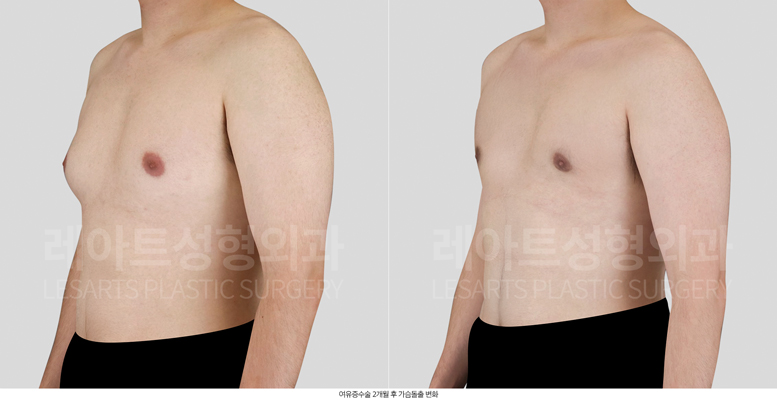
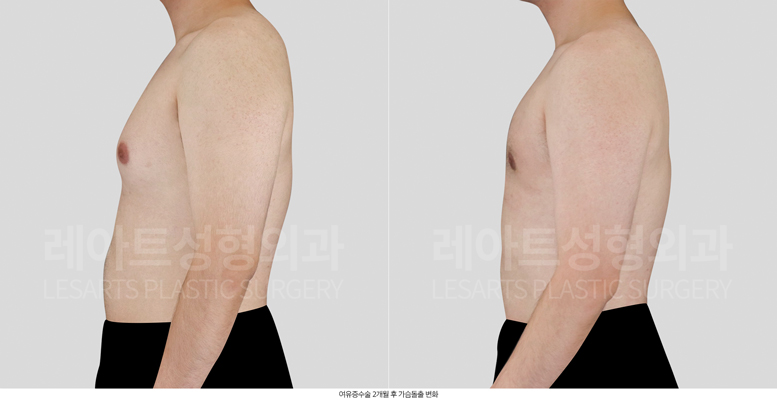
2-Month Post-Op Results: Chest Protrusion Improvement
At 2 months after surgery:
-The swollen, projected lower-areola region flattened
-The chest contour became firm and athletic
-The upper chest, inner chest, and outer chest formed smooth, natural lines
-The silhouette resembled a fit chest from working out
Because both gland removal and contouring were performed,
the results look balanced from every angle.
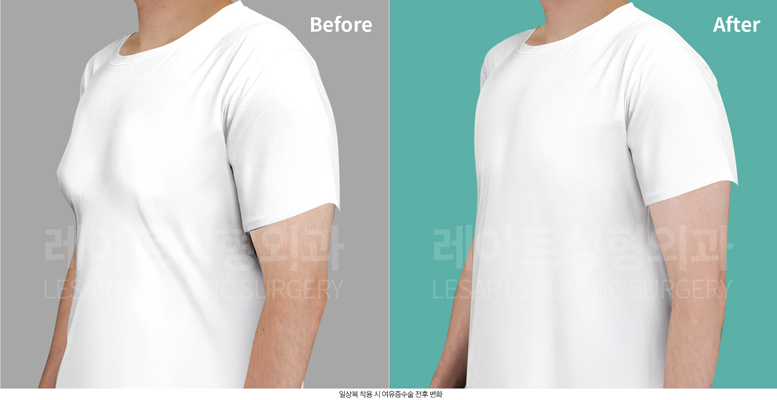
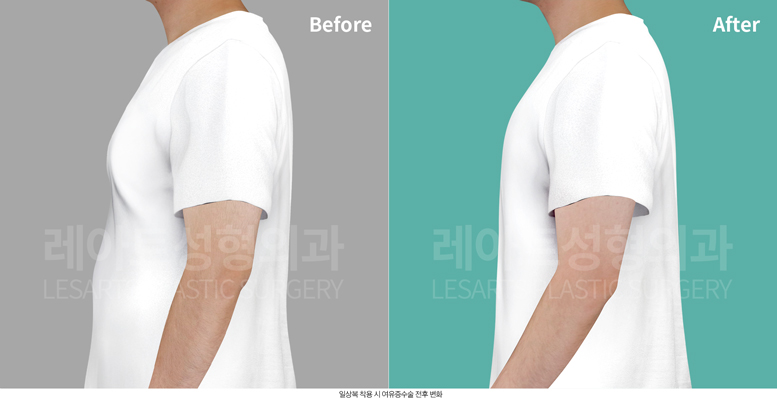
Everyday Clothing Comparison — Before & After
Before surgery, the enlarged areola and overall chest volume
made his upper body line look rounded and prominent through clothing.
This had affected his confidence since adolescence.
After surgery:
-The chest line from collarbone to upper abdomen appears straight and clean
-Clothing no longer shows unwanted bumps
-The protrusion seen from the side has disappeared
-He reported feeling comfortable wearing fitted tops again
The patient expressed significant emotional relief
after correcting something that had bothered him for so many years.
Teenage-Onset Gynecomastia:
When Should You Consider Surgery?
Gynecomastia that starts in adolescence
can improve naturally—
but when it persists without
change into adulthood, it often leads to:
-Long-term self-consciousness
-Avoidance of certain clothes or activities
-Emotional stress
-Accumulated discomfort over years
In such cases, surgical treatment is the most effective and
reliable solution, especially when gland tissue is the cause.
If you are experiencing similar symptoms,
visiting a gynecomastia-specialized clinic in Gangnam,
Seoul, Korea for an ultrasound evaluation
can help determine the best treatment plan.
#Male body contouring
#Gynecomastia
#Grade2-A #true gynecomastia #Side chest liposuction


Cases finding
similar to my profile
Customer Diagnostics


Select the surgery and
area you are interestedto see real
before andafter changes.


we
make you,
the art
Clinic hours
MON - FRI
10 am – 7pm
SAT
10 am – 4pm
Holiday
SUN, HOLIDAY
Location
Lesarts Moon Clinic Tower 4-5F, 40, Nonhyeon-ro 168-gil,
Gangnam-gu, Seoul, Republic of Korea

Medical institution name Lesarts Plastic Surgery
Address Lesarts Moon Clinic Tower 4-5F, 40, Nonhyeon-ro 168-gil, Gangnam-gu, Seoul, Republic of Korea
Representative Moon sung jun
