




Online Consultation
Please accurately enter the information below.
Quick Cost Consultation
Quick Consultation & Reservation
Cases finding
similar to my profile






Cases finding
similar to my profile
Customer Diagnostics
4-Month Results After Tummy Tuck Revision (Tummy Tuck Revision | Full Abdominoplasty (M-Type) | Adhesion Release | Diastasis Repair | Gangnam Seoul Korea Plastic Surgery Clinic)
2025-12-31
The patient previously underwent
a lower-abdominoplasty after giving birth to twins.
However, she continued to struggle with upper abdominal wrinkles,
loose skin around the navel, and uneven abdominal contour,
which made it difficult for her abdomen to look smooth in daily life.
Even though she maintained a stable weight
after childbirth and did not have a large amount of fat overall,
the first surgery addressed only the lower abdomen,
leaving the upper abdomen and periumbilical area insufficiently corrected.
She described persistent issues such as:
-Wrinkling around the upper abdomen
-Skin drooping around the belly button
-Uneven abdominal surface
-A sense of tightness due to prior surgical adhesions
Because these concerns could not be addressed through exercise
or weight management alone, she visited the clinic to discuss tummy tuck revision.
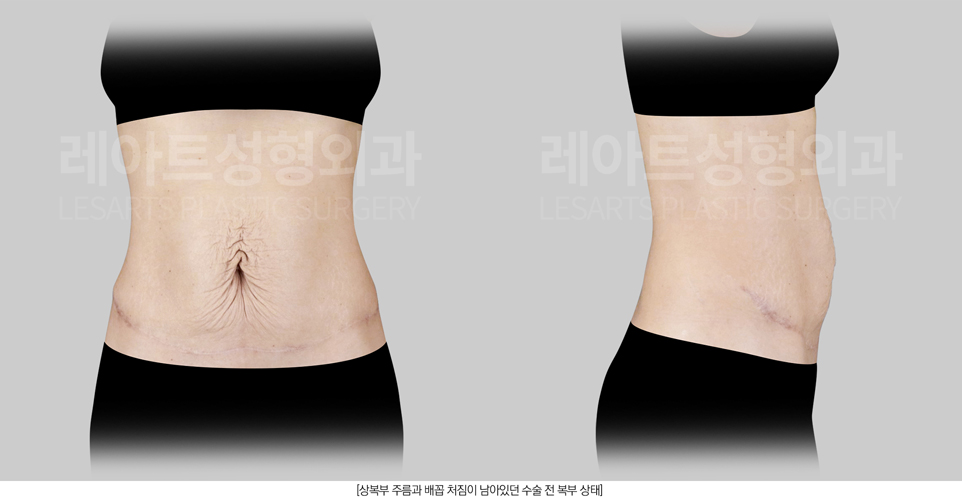
Pre-Revision Assessment
Before the revision, both the upper abdomen
and the area around the navel showed:
-Downward skin sagging
-Fine folds and wrinkling
-Visible abdominal adhesions from the previous surgery
Since the original procedure only lifted the lower abdomen,
there was limited improvement in:
-Upper abdominal tightening
-Navel positioning
-Continuity of the overall abdominal curve
The reduced upper-abdominal elasticity caused the navel to appear distorted,
making the entire abdominal silhouette look uneven.
These issues stemmed from multiple factors:
-Natural post-pregnancy changes
-Limited surgical range during the first tummy tuck
-Lack of diastasis recti correction
-Adhesion formation after the initial procedure
A structural, full-abdominal correction was needed—
not just lower-abdominal tightening.

Revision Surgery Plan
Because the first surgery was limited to the lower abdomen,
several problems remained unresolved.
To restore full contour, the revision required a multi-step approach:
1. Full Abdominoplasty (M-Type)
-Used the previous incision
-Lifted both the upper and lower abdomen
-Removed remaining loose skin
-Tightened the entire front abdominal surface to create a smoother line
2. Adhesion Release (Upper & Lower Abdomen + Flanks)
-Released strong adhesions around the umbilicus and flank area
-Allowed the skin to stretch and settle naturally
-Prevented puckering and tethering after tightening
3. Diastasis Recti Repair
-Reinforced midline abdominal support
-Improved long-term abdominal stability and shape
4. Liposuction (Abdomen, Flanks, Love Handles)
-Removed residual fat volumes
-Refined curves and improved silhouette continuity
-Enhanced waistline visibility
These steps were essential to correct the uneven abdominal
contour and achieve a balanced overall result.

4-Month Postoperative Changes
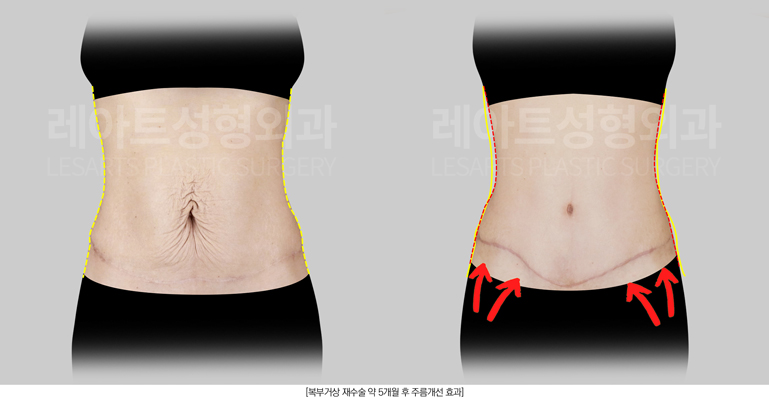
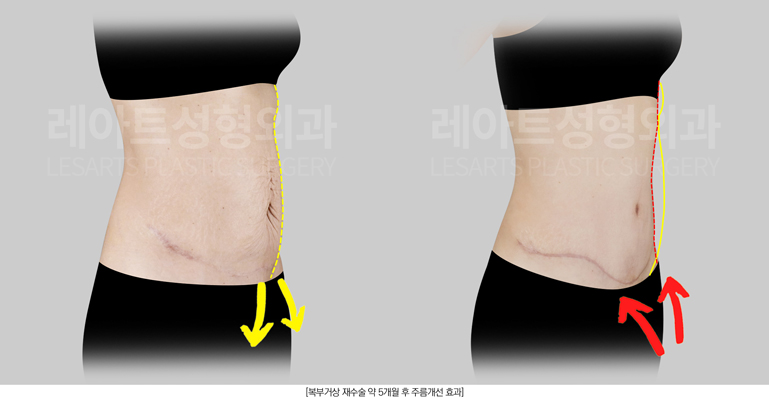
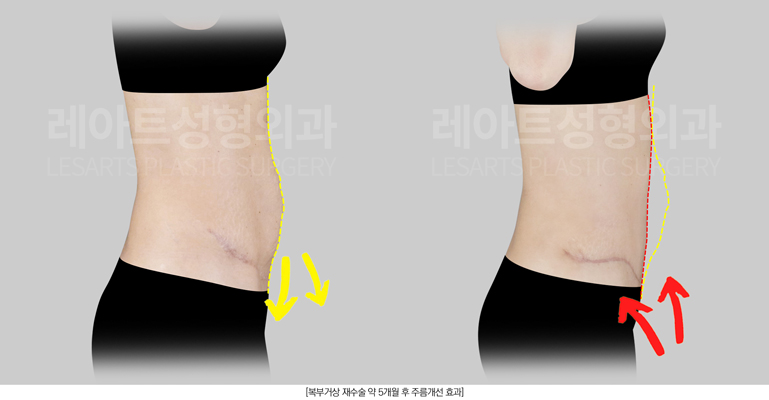
At 4 months and 20 days after revision:
-The upper and lower abdomen are evenly tightened
-The abdominal surface appears flatter and more uniform
-Skin folds under and around the belly button have disappeared
-The flow from upper → mid → lower abdomen is smooth and continuous
-The previous sagging and wrinkling in the upper abdomen have resolved
Compared to the pre-revision state—
where wrinkles gathered around the navel and
the upper abdomen sagged downward—the abdomen
now shows significant structural improvement.
While the incision line and the navel area are still in the healing phase,
the overall silhouette is stable and well-maintained.

Daily-Life Comparison
In the preoperative daily photos:
-Deep wrinkles gathered below the navel
-Skin appeared to pull downward toward one area
-The belly button was partially hidden within folds
-The abdominal center looked blurred and uneven
-Skin laxity made the torso appear short and heavy
At around 3 months after surgery:
-The gathered wrinkles were greatly reduced
-The abdominal surface looked smoother and more even
-The navel appeared more central and properly positioned
-The overall abdominal shape became longer and more proportionate
Although mild pigmentation remains along the incision
as part of normal healing, the scar line itself is stable and settling well.
Tummy tuck revisions continue to evolve over time.
Scar maturation and contour stabilization
usually progress gradually, so ongoing monitoring is essential.
At this stage, the patient is healing smoothly,
and additional care will be provided as needed during follow-up visits.
#Abdominoplasty
#M-type
#Abdominal liposuction(M)


Cases finding
similar to my profile
Customer Diagnostics


Select the surgery and
area you are interestedto see real
before andafter changes.


we
make you,
the art
Clinic hours
MON - FRI
10 am – 7pm
SAT
10 am – 4pm
Holiday
SUN, HOLIDAY
Location
Lesarts Moon Clinic Tower 4-5F, 40, Nonhyeon-ro 168-gil,
Gangnam-gu, Seoul, Republic of Korea

Medical institution name Lesarts Plastic Surgery
Address Lesarts Moon Clinic Tower 4-5F, 40, Nonhyeon-ro 168-gil, Gangnam-gu, Seoul, Republic of Korea
Representative Moon sung jun
